- Takes a comprehensive and fresh new look at the topic of American indie film
- Features newly commissioned essays from top film experts and emerging scholars that represent the state-of-the-art reference to the indie film field
- Topics covered include: indie film culture; key historical moments and movements in indie film history; relationships between indie film and other indie media; and issues including class, gender, regional identity and stardom in in the indie field
- Includes studies of many types of indie films and film genres, along with various filmmakers and performers that have come to define the field
- English
- ePUB (mobile friendly)
- Available on iOS & Android
eBook - ePub
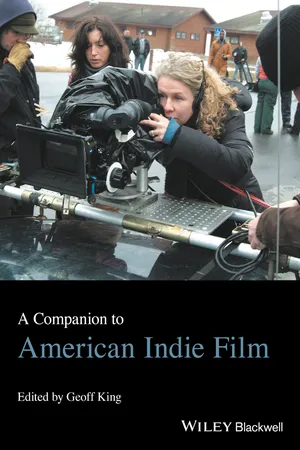
A Companion to American Indie Film
About this book
A Companion to American Indie Film features a comprehensive collection of newly commissioned essays that represent a state-of-the-art resource for understanding key aspects of the field of indie films produced in the United States.
Information
Part One
Indie Culture
1
Indie Film as Indie Culture
Michael Z. Newman
Like its counterpart, Hollywood, indie has come to mean more things than we can accommodate in a capsule summary. Like Hollywood, indie is a type of movie, a mode of production and distribution, a community of practice, a cultural ideal, and a shorthand for something people too easily celebrate or deride. Actually it is not one type, mode, community, ideal, and shorthand, but several. It is also, like Hollywood, a term with a history, naming a series of iterations of cinematic and cultural formations. The indie cinema of the 1980s and 90s is not exactly the indie cinema of the 2010s. In one sense indie cinema names a historical period, which I have called the Sundance–Miramax era, stretching from the 1980s to around 2010 (Newman 2011). But it also extends earlier and later in variations of independence and indieness (Mann 2008, King 2014). The Sundance–Miramax era, moreover, might not be as coherent as I would like it to seem.
Like Hollywood, indie cinema is also integrally part of something bigger than itself that includes many types of popular media and culture. Hollywood is an emblem of mainstream popular culture, the so‐called mass media. It has much in common with other examples such as popular music, broadcast television, large‐circulation newspapers and magazines, Broadway shows, and bestseller books that aim to reach broad audiences (Whiteside 1980). Indie film is, by contrast, one key example of a type of culture positioned in relation to mainstream, mass media: alternatives appealing more narrowly that reject the conventions of popular forms, or at least depart from or engage critically with them. Indie culture includes a wide variety of media as well as other forms of expression and experience. In addition to music, which is where its name originates as a diminutive of independent, indie references types of literature (comics, zines, small presses) and bookstores, television, video games, stand‐up comedy, fashion, crafts, and even supermarkets (Newman 2009, 2011).
The meanings produced both by mainstream media and its indie alternatives, and the cultural status of each of these types of popular culture, ultimately are premised on a conception of mass culture and mass society that has endured over many years of the twentieth and twenty‐first centuries. Without a broadly shared idea of mass culture and its production and reception, it would hardly make sense to maintain the categories of Hollywood and indie, mainstream and alternative. However symbiotic and overlapping these different kinds are in practice and as taken case by case, they remain conceptually distinct. The mass society critique of the postwar years in cultural theory and analysis, debatable and controversial as it has been from the start, continues to animate broadly shared frames of reference about media and popular culture, including cinema. This cluster of ideas about modern industrialized societies and their culture has gone through many iterations, and through its popularization has undoubtedly lost many of the nuances and historically specific claims that made it compelling and informative in the 1940s, 50s, and 60s. However, as a widely shared way of thinking about media and society, its influence remains with us. This is so even if the critique may be applied more inconsistently or tendentiously in everyday thinking than in learned essays and academic books. Adherents of indie culture might not recognize their rejection of mass media (or if this is too strong, their ambivalence) as a product of formal theorizing that emerged from debates among academics and elite cultural commentators. The mass society critique functions much more often as a lay theory of media, a broadly shared mode of reasoning about the meanings and values of popular film, television, music, games, and so on (Seiter 1999, Newman 2010).
The mass society critique may have no single foundational expression, and it was often articulated negatively, by critics pointing out its shortcomings. Given its status as a widely circulating discourse, it is less important to appreciate any particular exponent’s meanings and intentions in formulating a thesis, and more useful to capture a sense of shared cultural meanings about mainstream society, its cultural forms, and their putative functions. A simplified set of common mass society ideas would borrow opportunistically from the Marxist rhetoric of the Frankfurt school, the polemics of cultural critics and scholars such as Dwight Macdonald, Gilbert Seldes, Clement Greenberg, and Edward Shils, and the hip consumerism of the 1960s (Adorno and Horkheimer 1944/2002, Rosenberg and White 1958, Shils 1960, Frank 1997). It would judge mass media for being formulaic and standardized, imposing industrial products on its audience and thereby draining popular culture of its authentically popular nature (in the sense of popular meaning of the people). Mass media in this framing is for masses rather than elites, and produces the mass society of eager consumers it is made to serve. But even if the lay theory is fuzzy about mass media producing mass society, it assumes certain articulations between mass culture and identity formations, particularly feminine, lower class, and juvenile identities. Mass culture is easily dismissed as tripe for teenage girls or housewives, as kid’s stuff or unsophisticated pablum. It is very often feminized in comparison with modernist high culture (Huyssen 1986). Its appreciation requires no special knowledge or competence. Unlike “true art,” mass culture is made as a commercial product in factory‐like conditions, and its audience allegedly has none of the discernment required to appreciate “authentic culture.” Mass media is thus said to impose mindless conformity and docile compliance on the great audience. Its products are not the unique, inspired artifacts of genius, but interchangeable commodities. They do not admit interpretation and appreciation, but are ephemeral trash. Where they do seem to be striving for a higher status, as in the middlebrow culture derided by many mass society critics, they do so in an ersatz, contemptible attempt to marry the seriousness and prestige of high art with the accessibility of popular forms, without functioning effectively as either of these.
One kind of evidence for the wide purchase of the mass society thesis is the persistence of “high” and “low” judgments in cultural criticism. For instance, New York magazine’s weekly “approval matrix” back page feature plots cultural phenomena into four quadrants along X and Y axes. The vertical axis runs from lowbrow to highbrow, while the horizontal axis runs from despicable to brilliant. Thus it is possible for something to be lowbrow–brilliant or highbrow–despicable, and judgment applies in more ways than just high/low. The inclusion of brilliant and despicable challenges the logic of high and low, which is in tension with the newfound legitimacy of popular forms. And yet the use of high and low alongside brilliant and despicable bespeaks the persistence of traditional cultural hierarchy even in a democratized age of flexible standards and critical respect for many kinds of commercial culture. New York’s approval matrix is at once a challenge to cultural hierarchy and a force for maintaining it.
Without reducing all culture to one of two or three brow categories and reproducing the same hierarchies that animate the mass society critique, it is still possible to plot media texts on a continuum of legitimacy between high and low in terms of their reputation in popular imagination, which is what New York aims to capture. Movies and television might not be high culture in many instances, but they are judged in terms of relative cultural legitimacy. By comparison with traditional high art, indie movies and premium cable television programs may be closer to middlebrow than most high culture. This still marks them in distinction to the less prestigious mainstream film and video texts that make up the majority of moving image media, from romantic comedies to reality TV docusoaps. In this regard, indie cinema is constituted in relation to mass culture just as indie games, indie music, and any other form called indie is similarly dependent on a mainstream–alternative binary. Indie culture acquires its meaning and value in distinction to more commercial and broadly appealing forms of media; the various modes and media of indie culture have this distinction in common.
This chapter assumes that our understanding of indie film will benefit from looking at it as an example of this wider sphere of cultural practice and experience whose identity is defined in relation to mass media. The meaning and value of indie cinema are to some significant extent the meaning and value of a broader culture of media alternatives.
Autonomy and Authenticity
Indie culture in many different media acquires its core identity from a cluster of ideas about creative production and experience. Its most central appeals are autonomy, authenticity, and opposition. These are not very distinct appeals; they overlap and inform one another. All three must be understood as relational terms. Opposition, moreover, is produced through the other two terms. They are all constituted in comparison with mass media, which for cinema means Hollywood but for other forms of culture means other things. (For indie music, for example, major labels take the place of Hollywood studios, and sometimes these labels and studios are even owned by the same parent conglomerate.) The opposition can be in terms of production or distribution, but it is also typically informed by notions of audience address and reception. Mass media is not merely the products of the culture industries but also the favored diversions of the mass audience, or of segments of it of perceived lesser cultural value than indie audiences. The terms of this distinction shift and twist as culture changes, but the nature of the opposition does not change significantly. It provides a remarkably continuous frame of reference. It has probably existed for as long as mass culture, mass media, and mass society have been terms in common currency.
The autonomy of indie culture is a function of artistic expressivity unconstrained by commercial or institutional pressures and demands. The exemplar of autonomy in cinema is the director as auteur, though autonomous cultural production can extend to other creative personnel, such as producers and writers. Christine Vachon, for instance, is an indie film producer who has cultivated her own modest celebrity status and brand identity as an edgy, disruptive force in filmmaking (Vachon and Bunn, 2006). Writers such as Diablo Cody can establish distinctly indie identities, asserting a force of authorship. However, the indie auteur is most commonly a director or writer–director, and the freedom from constraint represented in discourses of indie cinema acts as a guarantee of autonomy as a central value. In the postwar politique des auteurs of the French film critics who became the New Wave and in the authorship criticism influenced by them, the Hollywood studio director’s authorship was understood to function in tension with the constraints of a commercial studio system, and the force of strong directors’ authorship was taken to be a virtue worthy of high‐art appreciation (Sarris 1968). In auteur cinemas (art cinemas, young cinemas and new waves, the New American Cinema) that followed this critical movement, the autonomy of the director, more than the force of his originality and individuality in the face of commercial constraint, became a token and criterion of quality. In this tradition, directors who are also writers or producers, or whose output reveals a strong character of coherence as an oeuvre, are most obviously representative of the autonomous indie artist. In these examples, autonomy is a creative value, and its distinction is in relation to the industrial production of culture to meet demands of mercenary studio executives and the shareholders of publicly traded companies. The imagined relations between creative and managerial personnel in Hollywood informing ideals of indie film autonomy include such things as script notes from executives, focus‐group test‐screening feedback, and approval of post‐production work by studio bosses. The realities of production in Hollywood or outside of it are not the issue here; what is more significant is how autonomy and its alternatives are imagin...
Table of contents
- Cover
- Title Page
- Table of Contents
- Contributors
- Acknowledgements
- Introduction: What Indie Isn’t… Mapping the Indie Field
- Part One: Indie Culture
- Part Two: Indie and Other Media
- Part Three: Criticism, Marketing, and Positioning Indie
- Part Four: Movements/Moments
- Part Five: Indie as Regional
- Part Six: Aesthetics and Politics
- Part Seven: Kickstarting Indie
- Part Eight: Indie Acting and Stardom
- Index
- End User License Agreement
Trusted by 375,005 students
Access to over 1.5 million titles for a fair monthly price.
Study more efficiently using our study tools.
Frequently asked questions
Yes, you can cancel anytime from the Subscription tab in your account settings on the Perlego website. Your subscription will stay active until the end of your current billing period. Learn how to cancel your subscription
No, books cannot be downloaded as external files, such as PDFs, for use outside of Perlego. However, you can download books within the Perlego app for offline reading on mobile or tablet. Learn how to download books offline
Perlego offers two plans: Essential and Complete
- Essential is ideal for learners and professionals who enjoy exploring a wide range of subjects. Access the Essential Library with 800,000+ trusted titles and best-sellers across business, personal growth, and the humanities. Includes unlimited reading time and Standard Read Aloud voice.
- Complete: Perfect for advanced learners and researchers needing full, unrestricted access. Unlock 1.5M+ books across hundreds of subjects, including academic and specialized titles. The Complete Plan also includes advanced features like Premium Read Aloud and Research Assistant.
We are an online textbook subscription service, where you can get access to an entire online library for less than the price of a single book per month. With over 1.5 million books across 990+ topics, we’ve got you covered! Learn about our mission
Look out for the read-aloud symbol on your next book to see if you can listen to it. The read-aloud tool reads text aloud for you, highlighting the text as it is being read. You can pause it, speed it up and slow it down. Learn more about Read Aloud
Yes! You can use the Perlego app on both iOS and Android devices to read anytime, anywhere — even offline. Perfect for commutes or when you’re on the go.
Please note we cannot support devices running on iOS 13 and Android 7 or earlier. Learn more about using the app
Please note we cannot support devices running on iOS 13 and Android 7 or earlier. Learn more about using the app
Yes, you can access A Companion to American Indie Film by Geoff King in PDF and/or ePUB format, as well as other popular books in Media & Performing Arts & Film & Video. We have over 1.5 million books available in our catalogue for you to explore.