- Cutting-edge special education research focusing on children and youth with disabilities from diverse cultural, ethnic, linguistic, and economic backgrounds
- An authoritative contribution to the field, this work charts a new path to effective interventions and sets an agenda for future research
- Addresses disabilities from an international perspective
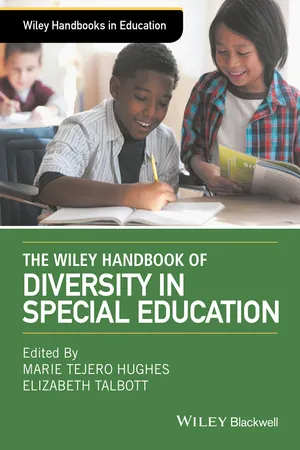
eBook - ePub
The Wiley Handbook of Diversity in Special Education
- English
- ePUB (mobile friendly)
- Available on iOS & Android
eBook - ePub
The Wiley Handbook of Diversity in Special Education
About this book
The Wiley Handbook of Diversity in Special Education is a state-of-the-art reference showcasing cutting-edge special education research with a focus on children and youth with disabilities from diverse cultural, ethnic, linguistic, and economic backgrounds.
Information
Part I
Including Students with Disabilities
1
The Convention on the Rights of Persons with Disabilities: Reconstructing Disability to Reimagine Education
Margaret Winzer and Kas Mazurek
The landmark Convention on the Rights of Persons with Disabilities (CRPD; United Nations, 2006) is the eighth human rights convention enacted by the United Nations and the first one specifically directed toward persons with disabilities. As a UN convention, it represents binding international law on ratifying State Parties (nations that have ratified a treaty and agree to comply with its obligations). The CRPD, along with its Optional Protocol, was adopted by consensus by the General Assembly of the United Nations on December 13, 2006, opened for signature on March 30, 2007, and came into force in May 2008.
The text of the CRPD encapsulates both human rights and development. The rights dimension acknowledges the dignity, autonomy, and worth of people with disabilities and enhances their visibility in the human rights system (Stein & Lord, 2008). The development pillar distills human rights into a set of plans designed to include such persons in development policies and processes. For example, the treaty enshrouds inclusive schooling as a rights‐based case, but also projects it as a development tool critical in eliminating poverty, creating opportunities, and stimulating economic development among persons with disabilities.
The social model of disability is a primary motivating hypothesis of the CRPD. Traditional medical deficit models are discarded in favor of those that address the ethical, social, and legal implications of disability. Because the overarching vision is one of people with disabilities living and participating as full members of a society, the CRPD uses the language of rights in relation to both positive objectives to be pursued and negative situations to be corrected. Accordingly, the social model of disability readily links to the concepts of inclusive schooling that imply a recognition of human diversity, stress that education should take place in environments that are broadly inclusive of all learners, and focus on identifying and removing barriers in schools and systems to create equal opportunity for those with disabilities.
As a global agenda meant to be implemented across national and cultural lines, the CRPD holds as much importance for people with disabilities in the global North as for those in the South. This chapter restricts the terrain to developing nations where the prospects for putting the treaty into operation as well as the implementation of inclusive schooling are uncharted territory. Assessing progress is both important and timely. For one thing, addressing the CRPD in the light of cultural norms and examining the cultural fit of models and their cultural universality is critical in this era of accelerated connections based on international policy frameworks. Second, movement toward inclusive schooling is just starting in developing nations, and there are few precedents or referents, few detailed studies on the processes involved, and no models that have been comprehensively tested in practice (Bines & Lei, 2011; WHO & World Bank, 2011). Third, the statistical map directs attention to nations of the global South where levels of impairment appear highest, and are significantly associated with multidimensional poverty (Mazurek & Winzer, 2015). Among the 650 million to 1 billion people within the disabled category, more than 80% live in developing nations. Of the 93–150 million children with disabilities under 14 years of age, 85% are found in the South (United Nations, 2011) but, worldwide, only 2–3% of those with disabilities go to school (Winzer & Mazurek, 2014). Germane to this chapter’s discussion, of the 107 countries that ratified the CRPD by January 2012, 80 were developing nations.
Dozens of complex theoretical, methodological, and practical matters surround the implementation of the CRPD and dissemination of the inclusive doctrine. This chapter rests on two overarching arguments. First, we contend that culture, broadly defined as ways of perceiving, evaluating, and behaving, holds powerful value in explaining much (though certainly not all) of the progress and prospects for the CRPD. The connection emerges because none of the core concepts are neutral but value‐laden and governed by whole sets of cultural and social beliefs. Disability challenges what Davis (1995, p. 48) terms “the hegemony of normalcy” and the constraints of an observer’s culture and ideological perspective define beliefs about disability and its impact. Similarly, education is a value‐based culturally contingent activity; inclusive education is also conditioned by national identity and constructed within a framework of social, cultural, and economic conditions. The complementary assumption holds that inclusive schooling for children with disabilities (reimagining education) is not possible lacking fundamental social change (reconstructing disability). As Opertti, Walker, and Zhang (2014, p. 160) argue, “Mindset transformations are at the core of open, plural, and constructive dialogue around inclusion.”
To juxtapose cultural considerations with the social model of disability and inclusive schooling, we first outline three key foundational considerations. These are an overview of the CRPD; an analysis of the paradigmatic shift from a medical to a social model of disability; and the connection of the treaty to the policy ambitions of dominant instruments of global education governance, Education for All (EFA) and the Millennium Development Goals (MDGs). With these building blocks in place, the chapter interrogates the promises and the limits of the social model both as a means of reducing social exclusion and stimulating the progress of inclusive schooling. As we examine progress and point to continuing tensions and mechanisms for resolution, examples from national agendas are used to add nuances to the discussion.
Structure and Overview of the CRPD
During the 1970s, the exclusion of large numbers of people with disabilities from socioeconomic and educational opportunities set the international community on a trek toward the forgotten shores of disability. Movement was glacial: it was not until the 1990s that disability was introduced and analyzed as a human rights issue, that ameliorative approaches became part of the UN’s overall development and human rights agenda, and that inclusive education became a fundamental principle (Winzer & Mazurek, 2014).
Historically, the UN addressed disability issues in two main ways—interpreting and applying existing human rights instruments to persons with disabilities, and creating soft laws known as declarations or standard rules. Soft laws such as the Standard Rules for the Equalization of Opportunities for Persons with Disabilities (United Nations, 1993) express the moral and political commitment of the international community but are not legally binding and lack reinforcement and accountability provisions. In contrast, the CRPD’s detailed policy pertaining to the civil, political, economic, educational, and cultural rights of persons with disabilities has the force of binding international legislation.
The dense and complex treaty incorporates the Preamble, 50 Articles, and the 18‐article Optional Protocol. Among many issues covered, the introductory articles (Preamble, Articles 1–2) define disability within a social construct and state that all people with all types of disabilities must enjoy all human rights and fundamental freedoms irrespective of their social and economic status (Article 1). The treaty then catalogues principles of universal application (Articles 3–9) that apply to persons with disabilities enjoying all rights on an equal basis with others. The substantive rights (Articles 10–30) run the gamut of life activities: included are education, vocational training, employment, and sports and recreation. Later articles establish implementation and monitoring schemes (Articles 31–40) and set forth rules governing the CRPD’s operation (Articles 41–50). The Optional Protocol, accepted at the same time as the treaty itself, provides an inquiry procedure and establishes processes regarding perceived violations.
The CRPD recognizes rights as “indivisible, interrelated and interconnected” (Preamble). The structure embeds the general principles (Articles 3–9) horizontally so that each substantive rights article (10–30) will be interpreted in light of these principles. As examples, key watchwords include participation, non‐discrimination, and equality, all of which are central if the right to education (Article 24) is to be achieved. The undergirding social model of disability is clarified in Article 1, revisited as a core idea in Article 8, and feeds into issues such as education and employment. The articles on living independently (Article 19), personal mobility (Article 20), and habilitation and rehabilitation (Article 26) are needed to make employment rights manifest. Legal capacity (Article 12) is key to every type of right, including the right to vote, to work, and to marry.
Recasting Disability as a Social Construction
Traditionally, notions about “normal” and “disabled” have been linked to dimensions that include statistical frequency (usual and unusual); normative conceptions of good and bad (appropriate and inappropriate); and independence or dependence (active, participating people or burdens on society in need of specialized and, in general, segregated support) (Nussbaum, 2004; Winzer, 2009).
Until the late 1950s, conceptions of disability as unusual, inappropriate, and burdensome were echoed in medical models that bound and deter...
Table of contents
- Cover
- Title Page
- Table of Contents
- Notes on Contributors
- Foreword
- Preface
- Acknowledgments
- Part I: Including Students with Disabilities
- Part II: Contemporary Issues in Educating Diverse Students
- Part III: Instruction
- Part IV: Supporting and Assessing Diverse Learners
- Part V: Preparation of Educators for Inclusive Environments
- Index
- End User License Agreement
Trusted by 375,005 students
Access to over 1.5 million titles for a fair monthly price.
Study more efficiently using our study tools.
Frequently asked questions
Yes, you can cancel anytime from the Subscription tab in your account settings on the Perlego website. Your subscription will stay active until the end of your current billing period. Learn how to cancel your subscription
No, books cannot be downloaded as external files, such as PDFs, for use outside of Perlego. However, you can download books within the Perlego app for offline reading on mobile or tablet. Learn how to download books offline
Perlego offers two plans: Essential and Complete
- Essential is ideal for learners and professionals who enjoy exploring a wide range of subjects. Access the Essential Library with 800,000+ trusted titles and best-sellers across business, personal growth, and the humanities. Includes unlimited reading time and Standard Read Aloud voice.
- Complete: Perfect for advanced learners and researchers needing full, unrestricted access. Unlock 1.5M+ books across hundreds of subjects, including academic and specialized titles. The Complete Plan also includes advanced features like Premium Read Aloud and Research Assistant.
We are an online textbook subscription service, where you can get access to an entire online library for less than the price of a single book per month. With over 1.5 million books across 990+ topics, we’ve got you covered! Learn about our mission
Look out for the read-aloud symbol on your next book to see if you can listen to it. The read-aloud tool reads text aloud for you, highlighting the text as it is being read. You can pause it, speed it up and slow it down. Learn more about Read Aloud
Yes! You can use the Perlego app on both iOS and Android devices to read anytime, anywhere — even offline. Perfect for commutes or when you’re on the go.
Please note we cannot support devices running on iOS 13 and Android 7 or earlier. Learn more about using the app
Please note we cannot support devices running on iOS 13 and Android 7 or earlier. Learn more about using the app
Yes, you can access The Wiley Handbook of Diversity in Special Education by Marie Tejero Hughes, Elizabeth Talbott, Marie Tejero Hughes,Elizabeth Talbott in PDF and/or ePUB format, as well as other popular books in Education & Inclusive Education. We have over 1.5 million books available in our catalogue for you to explore.