This book approaches the topic area of the Internet of Things (IoT) from the perspective of the five types of human communication. Through this perspective on the human communication types, the book aims to specifically address how IoT technologies can support humans and their endeavors. The book explores the fields of sensors, wireless, physiology, biology, wearables, and the Internet. This book is organized with five sections, each covering a central theme;
Section 1: The basics of human bond communication
Section 2: Relevance IoT, BAN and PAN
Section 3: Applications of HBC
Section 4: Security, Privacy and Regulatory Challenges
Section 5: The Big Picture (Where do we go from here?)
Trusted by 375,005 students
Access to over 1.5 million titles for a fair monthly price.
2 School of Business and Social Sciences, Aarhus University, Aarhus, Denmark
3 Basic Internet Foundation, Oslo, Norway
1.1 Introduction
Information and communications technologies (ICT) have progressed rapidly in this millennium for people to communicate and exchange information using multimedia (speech, video/image, text), and the same has extended to Internet of things (IoT) and machine‐to‐machine and machine‐to‐human communication. This trend is only going to accelerate in the years to come with powerful human–computer interaction technologies to deliver engaging and intuitive experiences. But these developments have remained confined to only the sensing and transmission of aural and optical information in the digital domain through the use of microphone, camera, speaker, and display devices. However, the ability to integrate the other three sensory features, namely, olfactory (smell), gustatory (taste), and tactile (touch) in information transfer and replication to deliver “being there in‐person” experience, are still far from reality. Human bond communication (HBC) is a novel concept that incorporates all five sensory information from sensing, to digitization, to transmission and replication at the receiver to allow more expressive, engaging, realistic, and holistic information between humans [1] and in some cases between humans and machines such as in remote sensing and robotic control. Lack of inclusion of the other three senses in the digital world of ICT limits the full exploitation of the cognitive ability of the human mind for a fuller perceptive information experience. The five senses and the environment interact in interesting ways to become complete knowledge for human species as its brain has developed and evolved naturally from the time it came into existence on this planet. The profoundness of perceiving an object depends on the incisiveness and extensity of the sense organs. Incisiveness refers to the granularity and minute details or variations an organ can detect, and extensity refers to the range of the physical property that it can detect.
In the traditional world of digital information exchange, the subject is described and presented partially via its aural and optical rendering, which gives a sense of incompleteness and dissatisfaction in fully understanding the subject. In the present era of ever increasing competition through innovation, inclusion of all five senses to deliver complete experience is the holy grail of the research community. Products have begun to appear through wearables and other embedded sensors in the body, but sensors exploiting touch, taste, and smell and embedding them into products remains a distant reality and is an area of intense research today as would become evident from the chapters included in this book.
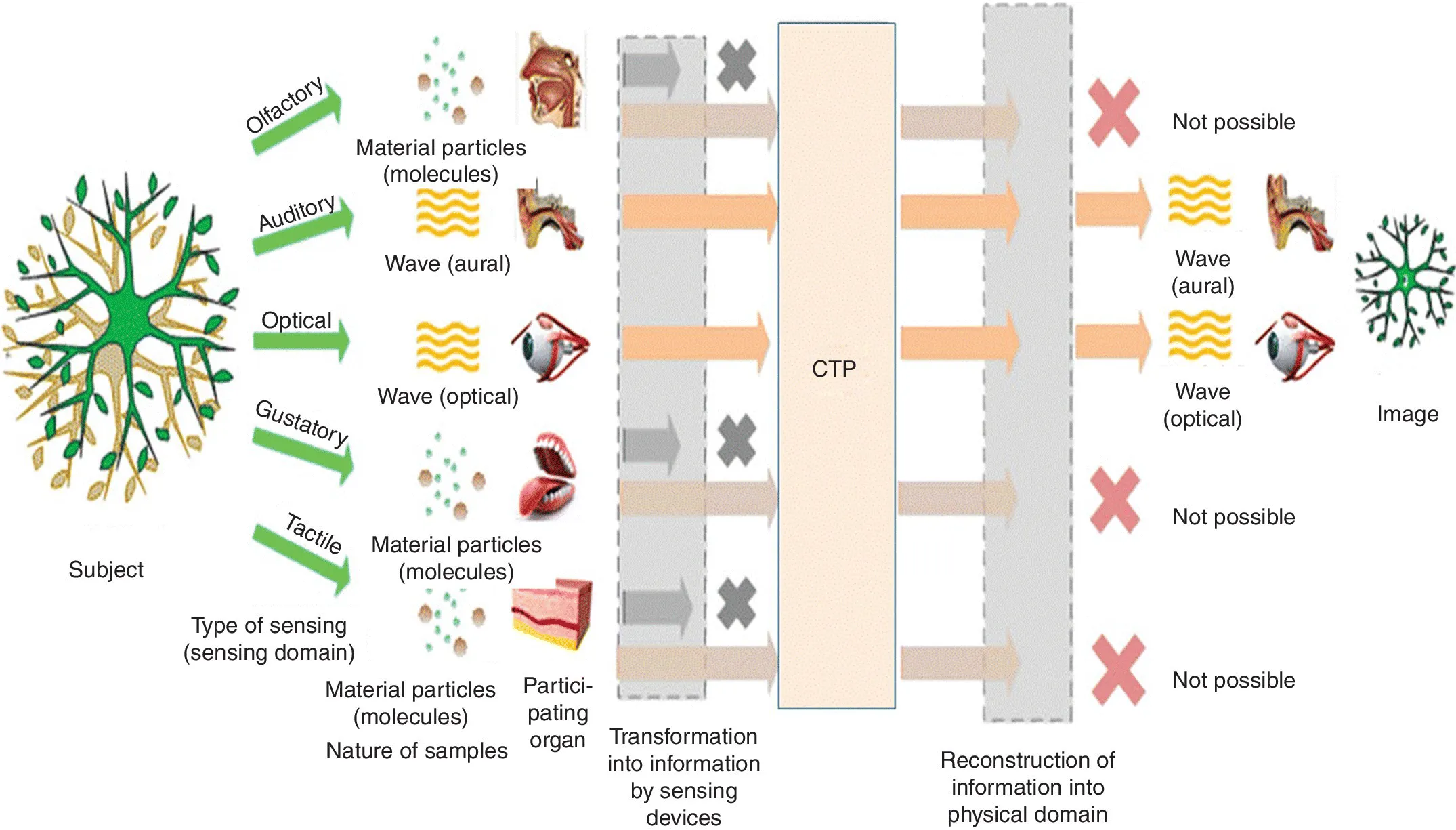
Auditory and optical sensing is wave based. In audio sound travels through waves and can be sensed and digitized. Similarly, light shining on an object is reflected in electromagnetic radiation, and a part of this spectrum (called visible light in the range of wavelength 390–700 nm) is visible to the human eye and when rendered on the retina becomes a visual formulation of the object in the nervous system. The camera does this nicely to capture an object visually and digitize it for transmission. When rendered remotely on a display device in 2‐D or 3‐D, a person can see the object as though he or she was seeing it by being physically present at a location where the camera was located. Other human senses (tactile, olfactory, gustatory) utilize particle‐based sensing and rely on smearing the object with the sensors. Building such sensors remains a technological challenge for the research community because each type of sensor must deal with large range of parameters and their wide spectrum. Digitization of these parameters is also a major challenge, and even if some finite widely prevalent values can be captured and digitized, their replication from the digital domain to the analog domain and their sensing by a person in an unobtrusive manner is a complex human‐sensor interface issue. Figure 1.1 illustrates the HBC system and depicts what is possible today and what is not.
Figure 1.1 An illustration of human bond communication (HBC) concept. CTP, communication technology platform.
Prasad [1]. Reproduced with the permission of Springer.
HBC is about understanding the human sensory functionality and works similar to human sensory system, which includes providing a perceptually holistic understanding of an object combining all five senses while incorporating the object’s environment.
1.2 Human Bond Communication (HBC) Architecture
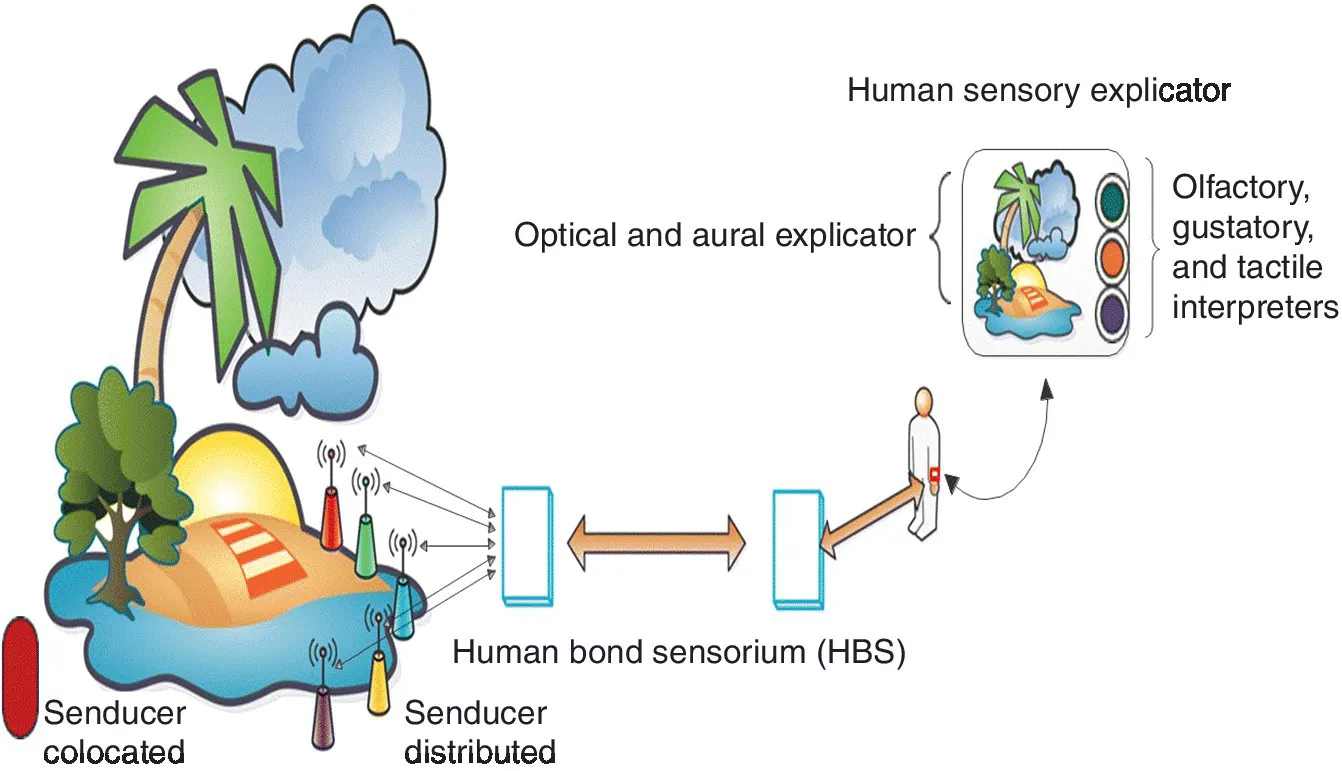
The HBS architecture extrapolates the contemporary communications architecture to include the missing three senses (or types of sensors): tactile, olfactory, and gustatory, not in use today along with the aural and optic sensors. Nevertheless, some limited deployments are happening in machine‐to‐machine and machine‐to‐human communication use cases where robots are being used, such as in industry, law enforcement, hazardous material handling, and surveillance. A proposed architecture is shown in Figure 1.2 [1]. It should be noted that the architecture goes beyond capturing just a person’s senses to also deploying all five types of sensors in any environment to capture smell (e.g., types of smoke, air pollutants), tactile information (e.g., surface roughness, temperature, wind speed), and taste (e.g., liquids, dirt, waste) and learning about an object or its surroundings.
Figure 1.2 A proposed HBC architecture.
Prasad [1]. Reproduced with the permission of Springer.
The system consists of the three key building blocks: (i) senducers that sense the characteristic parameters through stimuli and transform those analog values to electrical and digital domain for further processing and transmission, (ii) human bond sensorium (HBS) that collects the data from the senducers, processes them to make them consumable for the human perceptive system (i.e., human consumption) by removing a large amount of nonusable and redundant data and information, transmits it to the far end to the receiver gateway, and (iii) human perceivable transposer (HPT) that transforms the received digital data to human consumable format, which includes replication of the senses to a form that one would expect if the person was physically present at the site where the sensory data were collected through senducers. Until such time the replication solutions are not available, the HPT may prefer to render the non‐audio–visual sense data through digital means (such as colors, emoticons, text, other gestures like vibration, pressure, temperature, etc.).
1.3 About the Book
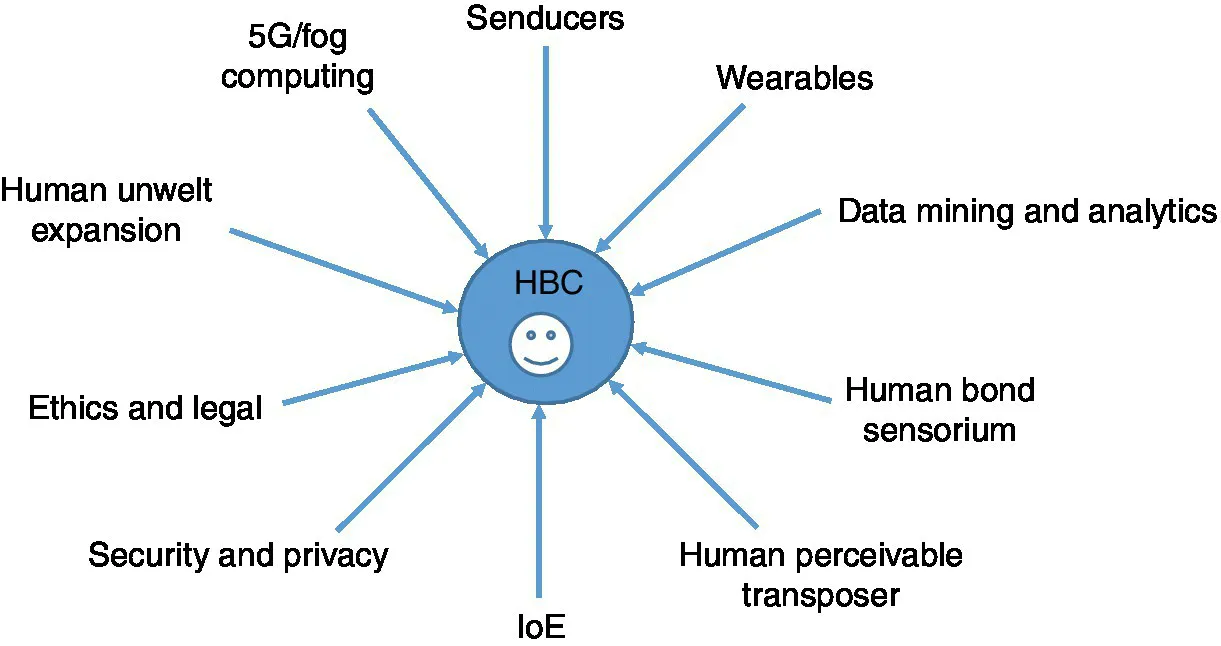
Our journey into the world of intuitive and rich communication begins with the vision of extending the contemporary form of digital communication to more natural human‐to‐human communication through the novel concept of HBC. This chapter has introduced that grand vision. HBC closely embraces the advances in the fields of sensors and wireless distributed computing, physiology, biology, wearables, chemistry, medicine, analytics, Internet, and so on that will be required to bring that vision closer to reality. Therefore, this book has included invited chapters from the experts in the various fields who look at the HBC through their perspectives and delve into the technical challenges that are before the research community. They also discuss the numerous business opportunities that are unlocked due to the intersection of the innovations emanating from interdisciplinary research and entrepreneurship. Whenever appropriate the authors have looked at the historical trends to present their ideas and invoke discourse. Figure 1.3 illustrates some of the key concepts and technologies that will have a profound impact on HBC. These are discussed in the various chapters of the book.
Figure 1.3 Key concepts and technology enablers for HBC.
Chapter 1 is an introduction of the book and lays the foundation of the grand vision for the HBC concept.
Chapter 2 presents the basic concepts behind HBC and provides an insight in the ongoing research related to the concepts of human sensory and emotional replication, physical world augmentation, and human umwelt expansion. This chapter then describes an HBC architecture and discusses its convergence with ICT. Additionally, the chapter discusses the potentials of HBC and gives a vision of possible future applications and services.
In Chapter 3, the authors postulate that the provision of enhanced augmented reality services to mobile users based on the HBC paradigm will rely on the definition of a high performance, high efficiency, and highly reconfigurable network architecture for the exchange of all the five sensory features. The objective of this chapter is to propose a novel HBC communication network architecture that is able to support the provision of such novel services incorporating all five senses. Starting from the definition of the main network, security, and quality of service requirements for HBC, a 5G network architecture based on software‐defined networking, network function virtualization, and Fog–Edge computing paradigms is presented. The main enabling technologies, including WBAN, localization techniques, and content‐oriented networking, are described together with some possible solutions to be adopted to cope with the security threats that may affect the success of HBC services.
Chapter 4 is about data mining of the human being. After describing the definition of data mining (also known as knowledge discovery in databases (KDD)) as the process of analyzing data from different perspectives and extracting hidden information and identifying patterns or relationships among the data, the author describes the var...
Table of contents
Cover
Title Page
Table of Contents
List of Contributors
About the Editors
Preface
Abbreviations
1 Introduction to Human Bond Communication
2 General Concepts Behind Human Bond Communications
3 Advanced Reconfigurable 5G Architectures for Human Bond Communication
4 Data Mining of the Human Being
5 Human-Centric IoT Networks
6 Body as a Network Node: Key is the Oral Cavity
7 Human Bond Communication Using Cognitive Radio Approach for Efficient Spectrum Utilization
8 Technology Advancement and Integration in the Context of Wildlife Conservation
9 An Investigation of Security and Privacy for Human Bond Communications
10 The Internet of Everything and Beyond
11 Human Bond Communications in Health: Ethical and Legal Issues
12 Human Bond Communication: A New and Unexplored Frontier for Intellectual Property and Information and Communication Technology Law
13 Predicting the Future of ICT: A Historical Perspective
14 Human Bond Communication Beyond 2050
Index
End User License Agreement
Frequently asked questions
Yes, you can cancel anytime from the Subscription tab in your account settings on the Perlego website. Your subscription will stay active until the end of your current billing period. Learn how to cancel your subscription
No, books cannot be downloaded as external files, such as PDFs, for use outside of Perlego. However, you can download books within the Perlego app for offline reading on mobile or tablet. Learn how to download books offline
Perlego offers two plans: Essential and Complete
Essential is ideal for learners and professionals who enjoy exploring a wide range of subjects. Access the Essential Library with 800,000+ trusted titles and best-sellers across business, personal growth, and the humanities. Includes unlimited reading time and Standard Read Aloud voice.
Complete: Perfect for advanced learners and researchers needing full, unrestricted access. Unlock 1.5M+ books across hundreds of subjects, including academic and specialized titles. The Complete Plan also includes advanced features like Premium Read Aloud and Research Assistant.
Both plans are available with monthly, semester, or annual billing cycles.
We are an online textbook subscription service, where you can get access to an entire online library for less than the price of a single book per month. With over 1.5 million books across 990+ topics, we’ve got you covered! Learn about our mission
Look out for the read-aloud symbol on your next book to see if you can listen to it. The read-aloud tool reads text aloud for you, highlighting the text as it is being read. You can pause it, speed it up and slow it down. Learn more about Read Aloud
Yes! You can use the Perlego app on both iOS and Android devices to read anytime, anywhere — even offline. Perfect for commutes or when you’re on the go. Please note we cannot support devices running on iOS 13 and Android 7 or earlier. Learn more about using the app
Yes, you can access Human Bond Communication by Sudhir Dixit,Ramjee Prasad in PDF and/or ePUB format, as well as other popular books in Technology & Engineering & Electrical Engineering & Telecommunications. We have over 1.5 million books available in our catalogue for you to explore.