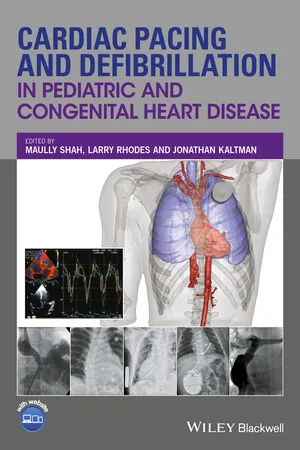
- The only book resource dedicated to pacing, cardiac resynchronization therapy and ICD therapy for the pediatric and congenital heart disease patient
- Contains practical advice for pacemaker and ICD implantation, programming, trouble-shooting, managing complications and follow up
- Up-to-date with the latest in device technology
- Contains multiple graphics, device electrogram tracings, and radiographic images for clarity
- Includes video clips and over 150 multiple choice questions with extended answers on companion website, ideal for self test
- An invaluable resource for both the specialist pediatric cardiologist and the general cardiologist responsible for children with heart disease and pacing devices
eBook - ePub
Cardiac Pacing and Defibrillation in Pediatric and Congenital Heart Disease
- English
- ePUB (mobile friendly)
- Available on iOS & Android
eBook - ePub
Cardiac Pacing and Defibrillation in Pediatric and Congenital Heart Disease
About this book
With a growing population of young patients with congenital heart disease reaching adulthood, this unique new book offers an in-depth guide to managing the challenges and issues related to device therapy in this patient group.
Information
Part 1
Introduction
Chapter 1
History of cardiac pacing and defibrillation in the young
Larry Rhodes1 and Robert Campbell2
1Chair, Department of Pediatrics, Robert C. Byrd Health Sciences Center, Professor of Pediatrics, WVU School of Medicine, Morgantown, WV, USA
2Pediatric Cardiologist, Children's Healthcare of Atlanta, Sibley Heart Center Cardiology, Professor of Pediatrics, Emory University School of Medicine, Atlanta, GA, USA
The earliest years of cardiac pacing predate the birth of many current pediatric cardiac electrophysiologists. An old saying states that “failure to understand history dooms one to repeat it.” In contrast, understanding this history of successful collaboration between pioneering physicians and engineering partners allows us to marvel at the developments that were to follow rapidly over the next 50 years, and potentially repeat this formula in years to come.
Benjamin Franklin harnessed electricity from lightning using a kite in 1752. An early “medical” use of electricity was not to augment life but to document the end of it with patients receiving an electrical shock to prove they were dead. In 1774, electrical energy was applied to resuscitate a child using a transthoracic approach.1 As early as 1899, the British Medical Journal published a report of experiments demonstrating that application of electrical impulses to the human heart would lead to ventricular contractions.2 In 1926, Dr. Mark C. Lidwell and physicist Edgar H. Booth of Sydney developed a device with pacing rates of 80–120 bpm and outputs varying from 1.5 to 120V.3 This “pacer” was described as being a portable device “plugged into a lighting point.” One pole was connected to a pad soaked in strong salt solution and applied to the skin and the other, “a needle insulated except at its point, was plunged into the appropriate cardiac chamber.” In 1928, this apparatus was used to revive a stillborn infant whose heart continued to beat after 10 minutes of stimulation.4
During the 1930s, Dr. Albert Hyman noted that the success of intracardiac delivery of medications for cardiac arrest was likely independent of the medication but was instead related to the needle stick leading to alteration in electrical potentials and myocardial contraction. Knowing that multiple needle sticks would be impractical and dangerous, he developed a generator to deliver electrical impulses via needle electrodes.5
Following World War II there was a significant interest in pacemakers generated by investigations in the use of general hypothermia for cardiac surgery. Cardiac arrest was noted during hypothermia and adequate heart rate was required to maintain adequate hemodynamics during rewarming. John A. Hopps, an engineer at the National Research Council of Canada developed a pacemaker that produced impulses at a desired rate through an electrode placed in the area of the sinus node.6
In 1952 Dr. Paul M. Zoll used an external pacemaker coupled with transcutaneous needle electrodes to rescue a patient suffering from Stokes-Adams attacks following a myocardial infarction.7,8 The patient continued to experience ventricular asystole despite being administered 34 intracardiac injections of adrenaline over a 4-hour period. Dr. Zoll applied “external electrical stimulation” and successfully paced this patient's heart over the next 25 minutes.8 The patient developed cardiac tamponade secondary to perforation of a cardiac vein during the intracardiac injections. Dr. Zoll then successfully paced a 65-year-old man with episodes of ventricular standstill for 5 days by external electrical stimulation at which time he developed an idioventricular rhythm at 44 bpm and was discharged.9
In the mid-1950s, open heart surgery was becoming a reality. Although for the first time in history, intracardiac palliation of structural heart disease was possible, the complication of surgical heart block was a significant morbidity. Dr. W. Lillehei, Dr. W. Weirich, and others at the University of Minnesota demonstrated that pacing could be performed by connecting a pulse generator to a wire electrode attached directly to the heart of a dog.10,11 In January 1957, Lillehei used this pacing system in the first human patient, a child with post-operative heart block following repair of a ventricular septal defect. The pacer was programmed to a pulse width of 2ms and a voltage ranging from 1.5 to 4.5V (Figure 1.1).12
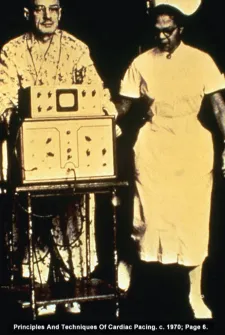
Figure 1.1 Patient pushing pacemaker cart (1958). (Source: Reproduced with permission of Medtronic, Inc.)
The generators used by both Zoll and Lillehei were devices which transformed alternating current into direct current to pace the heart. In 1957, following a power failure in Minneapolis in which patients could not be paced, Dr. Lillehei enlisted the help of Earl Bakken and Medtronic for battery backup for AC pacemakers. Silicon transistors had become commercially available in 1956 leading to the potential for development of smaller and more practical pacemakers. The original transistorized, zinc oxide battery-powered external pacemaker was developed by Mr. Bakken in 1957; the device was smaller and thus applicable for pediatric patients.13,14 This, the first wearable external pacemaker, was housed in a small plastic box, with controls to allow adjustment of pacing rate and voltage (Figure 1.2).
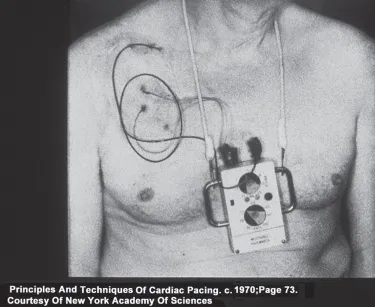
Figure 1.2 Wearable pulse generator (1958). (Source: Reproduced with permission of Medtronic, Inc.)
Although novel and potentially lifesaving, the advances described here were not a long term solution in that there was a significant risk of infection and external pacing was uncomfortable and impractical. There was a definite need for implantable pacing systems. Ake Senning, a Swedish surge...
Table of contents
- Cover
- Title Page
- Copyright
- Dedication
- Table of Contents
- Foreword
- List of Contributors
- Preface
- About the Companion Website
- Part 1: Introduction
- Part 2: Clinical Concepts
- Part 3: Implantation Techniques
- Part 4: Device Programming and Follow-Up
- Glossary
- Index
- End User License Agreement
Trusted by 375,005 students
Access to over 1.5 million titles for a fair monthly price.
Study more efficiently using our study tools.
Frequently asked questions
Yes, you can cancel anytime from the Subscription tab in your account settings on the Perlego website. Your subscription will stay active until the end of your current billing period. Learn how to cancel your subscription
No, books cannot be downloaded as external files, such as PDFs, for use outside of Perlego. However, you can download books within the Perlego app for offline reading on mobile or tablet. Learn how to download books offline
Perlego offers two plans: Essential and Complete
- Essential is ideal for learners and professionals who enjoy exploring a wide range of subjects. Access the Essential Library with 800,000+ trusted titles and best-sellers across business, personal growth, and the humanities. Includes unlimited reading time and Standard Read Aloud voice.
- Complete: Perfect for advanced learners and researchers needing full, unrestricted access. Unlock 1.5M+ books across hundreds of subjects, including academic and specialized titles. The Complete Plan also includes advanced features like Premium Read Aloud and Research Assistant.
We are an online textbook subscription service, where you can get access to an entire online library for less than the price of a single book per month. With over 1.5 million books across 990+ topics, we’ve got you covered! Learn about our mission
Look out for the read-aloud symbol on your next book to see if you can listen to it. The read-aloud tool reads text aloud for you, highlighting the text as it is being read. You can pause it, speed it up and slow it down. Learn more about Read Aloud
Yes! You can use the Perlego app on both iOS and Android devices to read anytime, anywhere — even offline. Perfect for commutes or when you’re on the go.
Please note we cannot support devices running on iOS 13 and Android 7 or earlier. Learn more about using the app
Please note we cannot support devices running on iOS 13 and Android 7 or earlier. Learn more about using the app
Yes, you can access Cardiac Pacing and Defibrillation in Pediatric and Congenital Heart Disease by Maully Shah, Larry Rhodes, Jonathan Kaltman, Maully Shah,Larry Rhodes,Jonathan Kaltman in PDF and/or ePUB format, as well as other popular books in Medicine & Physiology. We have over 1.5 million books available in our catalogue for you to explore.