Break free to make real change for yourself and others
Have you ever felt like your progress was being blocked, not just by your own circumstances, but by the presence and actions of others? Freedom to Change releases you from the trap of constantly telling yourself that you'd be more successful at teaching, leading, or contributing to an organization if only others didn't stand in your way. In his engaging, irreverent style, bestselling author Michael Fullan explores the two kinds of freedom in our daily lives: freedom from obstacles versus freedom to take initiative and act. Gaining freedom from barriers has no value in itself until it is partnered with an equally determined sense of what you truly want. What change would you like to bring about for yourself or those around you?
Given that human nature and productivity are fundamentally social, Fullan prescribes four dynamically interrelated actions we can take:
Consciously seeking a balance between our own autonomy and cooperation with others
Improving the feedback exchange—giving more valuable responses, as well as eliciting, hearing, and accepting feedback more effectively
Building accountability to others into the fabric of our working lives
Finding ways to influence others with the changes we've made and want to spread
Illustrated and enriched with examples from education, business, and nonprofit sectors, Freedom to Change offers recommendations for both individuals and organizations seeking to enhance connectedness and independence.
Most humans' lives are no longer “solitary, poor, nasty, brutish and short,” as Thomas Hobbes had it in Leviathan in 1651. But surprisingly, given centuries of escalating innovations, we are not doing all that well when it comes to personal fulfillment. Moreover, things are not improving. Studies of the workplace find time and again that only a minority of people are satisfied with their working lives. The most recent Gallup (2014) survey of 350,000 employees found that only 30 percent of them saw themselves as engaged in the workplace. In a parallel study of 200,000 employees from more than five hundred organizations, 64 percent did not feel that they had a strong work culture, and 66 percent said that the opportunity for growth on the job was limited (TINYpulse, 2014). Ron Friedman (2014) finds similar low engagement of employees in the vast majority of organizations; he also reports that “the best companies to work for” (the minority) outperform the market by a factor of two to one (p. xiii). The percentage of disengaged workers has not changed for decades. This situation to me is a “freedom from” problem. There are factors keeping things the way they are, to no one's benefit, and nobody seems to be doing anything about it.
In my own field of education, as you go up the grade levels, higher percentages of students say that they are bored; teacher satisfaction has declined dramatically from 62 percent in 2008 to 38 percent in the present; and among principals, 75 percent say that their job has become too complicated. The trend is similar for school principals; since 2008, satisfaction has dropped from 68 percent to 59 percent (Metropolitan Life Insurance, 2013).
How do we change dreary daily working lives? “Freedom from” concerns what you can do to get rid of obstacles or other constraints.
What Do We Really Want?
The key question is, What will make people more fulfilled? There is growing evidence that there are a small number of factors at the heart of what motivates people to become engaged in worthwhile endeavors. Let's start with best-selling author Daniel Pink's book Drive. The research that Pink amasses is quite clear. For routine or rudimentary tasks that are more mechanical, extrinsic rewards such as money and punishment can motivate people to put in the effort to get results, but for any task that requires making independent decisions or problem solving, extrinsic rewards actually demotivate people. According to Pink's research, what is motivating are three factors: a degree of self-directed autonomy, a sense of purpose, and mastery. In my own work, I have added a fourth factor: collaboration with peers to do something of value. These are the intrinsic motivators: a feeling that you have a degree of autonomy in what you do and how you do it; a sense of purpose, that you are helping make your part of the world a better place; a growing mastery or expertise, meaning that you are becoming increasingly capable in your line of work; and a strong identity with colleagues, which gives you the sense that you are making a difference together.
Employees note these “drivers” when they are asked about what motivates their working lives. In the TINYpulse survey cited earlier, workers were asked to select among twelve factors the most important motivators for themselves. The top five in their estimation were camaraderie/peer motivation, intrinsic desire to do a good job, feeling encouraged and recognized, having a real impact, and growing professionally. Money was number seven. As Pink argues, you do have to pay people enough money to get the topic off the table. For “freedom to” people, money is a by-product of good work. It is not that money doesn't matter but rather that it is not the main driver. When the work itself is not satisfying, that is when money looms large as a factor. Money works in strange ways. The more that money is deployed as the main motivator, the more that intrinsic factors fall off the table, the less productive people become, and the less money is made. When the intrinsic factors are in play, people aremore engaged and more productive, and more money is made.
The subject of this book is how to put intrinsic motivation factors into play for yourself and with others.
Motivational Drivers
Some degree of self-directed autonomy
Sense of purpose
Mastery
The rewards of collaborating with peers to do something of value
In a fundamental way, individual fulfillment and the evolution of humanity are intertwined. People are at their best when they are making a contribution in their own corner of the patch, leading both to personal satisfaction and to improvement in the world around them. We see from the surveys that most of us do not experience these motivators. But we could.
The starting point is to realize that the ball is in your court. The pursuit of fulfillment begins with you. It needs to be your own agenda. This book will guide you on this journey. To be successful, you will need to understand and engage in the dynamics of moving from “freedom from” to “freedom to.”
If you had a magic wand that would remove all obstacles to change that you face, would you be better off? It may surprise you, but the evidence—both surface and deep—points in the opposite direction: you would find yourself facing new and more difficult challenges! The short answer to why this is so is that human beings are uncomfortable with pure freedom, and we unknowingly adapt by gravitating to worse alternatives. So the first matter—the subject of the rest of this chapter—is to get to the bottom of the paradox of freedom.
As you will see, in this book I have deliberately set out to advise individuals and the organization as a whole. Rather than focus on “leaders” in the most formal sense (something I have written about in my five previous books for Jossey-Bass), I have expanded the notion of leaders to include anyone who can and should take initiative. If these people happen to be formal leaders in an organization, all the better, because they can affect the lives of many. But I want to look at how any of us as individuals can work toward being free to change, while creating conditions that enable us to take advantage of this greater sense of freedom.
I start from the premise that being a leader and being a member of an organization have something in common or, perhaps more accurately, that both types should recognize that they have areas of converging interest, albeit often in tension. Any organization or system will benefit from the ideas, insights, and energy of all its members. And any individual will gain from being in an organization that is designed to draw on all its members in a social change process relative to a goal for the greater good. Seeking individuality—the fulfillment of humankind—in a social context is incredibly complex. The end game is not to be free and alone, but to be free with others. What makes humankind wonderful is the prospect of continuous realization of self, and human evolution through and with others.
A Double-Barreled Freedom
I was first stimulated to tackle these matters when I came across The Freedom Report from LRN (2014), a business management consultancy that “helps people and companies navigate complex legal and regulatory environments, foster ethical winning cultures, and inspire principled performance” (p. 19). This report of a study contains a framework that distinguished between “freedom from” and “freedom to” factors. The phrases reminded me of Eric Fromm's Escape from Freedom (1969) from my graduate school days as a sociologist in the making, so I went back and reread Fromm's book closely. Doing so opened a whole new line of thinking that was implicit in my current work, but had not been drawn out. (I will be discussing Fromm's work further in this chapter.)
LRN's main premise is that “when relationships are overly regulated and constrained, employees under-contribute, customers seek alternatives, and partnerships crumble” (2014, p. 3). The LRN study was based on a small sample (834 executives and professionals from large U.S.-based companies). LRN used a “freedom from/freedom to” framework to generate a Freedom Index, whereby executives rated the degree of constraint or freedom relative to four groups in their organizations: employees, customers, supply chain partners, and community groups. These executives were asked to rate what they thought their employees found constraining (in other words, those elements having to do with the “freedom from” problem). This list included hierarchical decision making, needless approvals, micromanagement, and the like. The main “freedom to” factors the executives identified included a culture based on shared values, and whether employees had the autonomy to structure their work and were encouraged to try new ideas. The organizations that scored higher on the index (meaning both greater “freedom from” and more “freedom to”) performed much better on three key outcomes: financial performance (ten times higher than low-freedom companies), innovation, and long-term success.
But the LRN study did not go further into what exactly was going on in these successful organizations, how they had gotten to where they were, how applicable the ideas were to a r...
Table of contents
Cover
Title Page
Copyright
Dedication
About the Author
About the Ontario Principals' Council
Acknowledgments
Preface
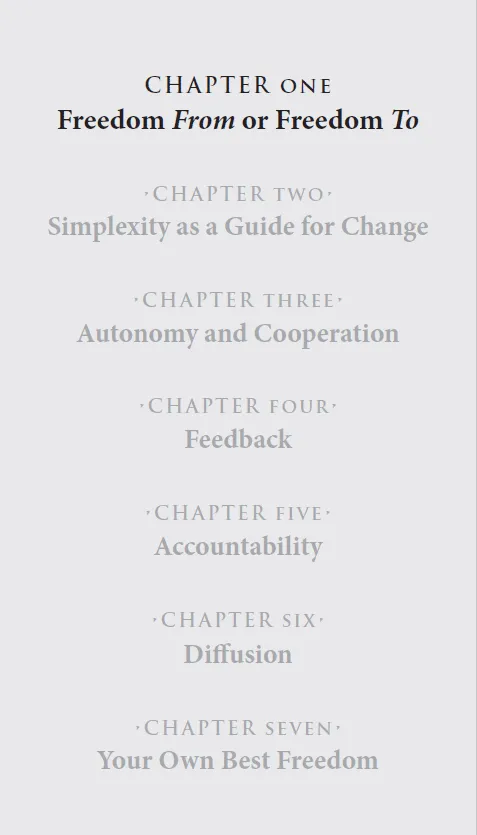
Chapter One: Freedom From or Freedom To
Chapter Two: Simplexity as a Guide for Change
Chapter Three: Autonomy and Cooperation
Chapter Four: Feedback
Chapter Five: Accountability
Chapter Six: Diffusion
Chapter Seven: Your Own Best Freedom
References
Index
End User License Agreement
Trusted by 375,005 students
Access to over 1.5 million titles for a fair monthly price.
Study more efficiently using our study tools.
Frequently asked questions
Yes, you can cancel anytime from the Subscription tab in your account settings on the Perlego website. Your subscription will stay active until the end of your current billing period. Learn how to cancel your subscription
No, books cannot be downloaded as external files, such as PDFs, for use outside of Perlego. However, you can download books within the Perlego app for offline reading on mobile or tablet. Learn how to download books offline
Perlego offers two plans: Essential and Complete
Essential is ideal for learners and professionals who enjoy exploring a wide range of subjects. Access the Essential Library with 800,000+ trusted titles and best-sellers across business, personal growth, and the humanities. Includes unlimited reading time and Standard Read Aloud voice.
Complete: Perfect for advanced learners and researchers needing full, unrestricted access. Unlock 1.5M+ books across hundreds of subjects, including academic and specialized titles. The Complete Plan also includes advanced features like Premium Read Aloud and Research Assistant.
Both plans are available with monthly, semester, or annual billing cycles.
We are an online textbook subscription service, where you can get access to an entire online library for less than the price of a single book per month. With over 1.5 million books across 990+ topics, we’ve got you covered! Learn about our mission
Look out for the read-aloud symbol on your next book to see if you can listen to it. The read-aloud tool reads text aloud for you, highlighting the text as it is being read. You can pause it, speed it up and slow it down. Learn more about Read Aloud
Yes! You can use the Perlego app on both iOS and Android devices to read anytime, anywhere — even offline. Perfect for commutes or when you’re on the go. Please note we cannot support devices running on iOS 13 and Android 7 or earlier. Learn more about using the app
Yes, you can access Freedom to Change: Four Strategies to Put Your Inner Drive into Overdrive by Michael Fullan in PDF and/or ePUB format, as well as other popular books in Education & Education Administration. We have over 1.5 million books available in our catalogue for you to explore.