A comprehensive and multidisciplinary review of the fundamental concepts and medical applications of nanomaterials development technology
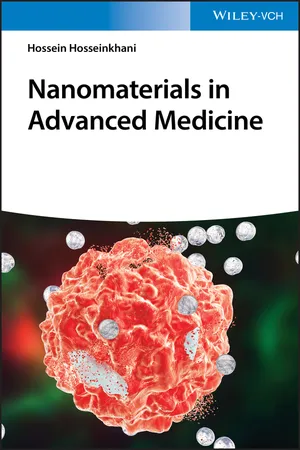
Nanomedicine offers a range of multi-interdisciplinary approaches and brings together the field of chemistry, pharmaceutical science, biology, and clinical medicines by focusing on design and preparation of biodegradable or non-biodegradable biomaterials for their biological, medical, and pharmaceutical applications. Nanomaterials in Advanced Medicine reviews the concepts and applications of the combination of the technology of biology and engineering that are emerging as an integral aspect of today?s advanced medicine. Nanomedicine provides the technology for imaging, cancer treatment, medical tools, bone treatment, drug delivery, diagnostic tests, drug development, angiogenesis and aims to exploit the improved and often novel physical, chemical, and biological properties of materials at the nanometer scale.
Designed to provide a broad survey of the field, Nanomaterials in Advanced Medicine is divided into three main sections: Nanophysics, Nanochemistry, and Nanomedicine. Each chapter describes in detail the most current and valuable methods available and contains numerous references to the primary literature. This important book:
-Offers a field guide for biologists and physicians who want to explore the fascinating world of nanotechnology
-Contains a comprehensive review of the topic from a noted expert in the field
-Includes an introduction to nanotechnology and explores the synthesis, structure and properties of various types of nanobiomaterials
-Bridges the gap between various aspects of nanomaterials? development technology and their applications
Written for pharmaceutical chemists, biotechnologists, life scientists, materials scientists, polymer chemists, and biochemists, Nanomaterials in Advanced Medicine provides a must-have guide to the fundamental concepts and current applications of nanomaterials in the medical field.
- English
- ePUB (mobile friendly)
- Available on iOS & Android
eBook - ePub
Nanomaterials in Advanced Medicine
About this book
Information
1
Introduction to Nanotechnology
1.1 Introduction
The word nano is from the Greek word “Nanos” meaning dwarf. It is a prefix used to describe “one billionth” of something, or 0.000 000 001; the prefix that means very, very small. Nanoscience is a part of science that studies small stuff and it is all sciences that work with the very small such as biology, chemistry, or physics. Nanotechnology is the art and science of making very small useful things, including advances in all industries, together with the electronic, chemical, and pharmaceutical.
Nanotechnology is the engineering of functional systems at the molecular scale. This covers both current work and concepts that are more advanced. Nanotechnology is sometimes referred to as a general‐purpose technology. That is because in its advanced form it will have significant impact on almost all industries and all areas of society. It will offer better built, longer lasting, cleaner, safer, and smarter products for the home, for communications, for medicine, for transportation, for agriculture, and for industry in general. A key understanding of nanotechnology is that it offers not just better products but a vastly improved manufacturing process. The power of nanotechnology can be encapsulated in an apparently simple device called a personal nanofactory that may sit on your countertop or desktop. Packed with miniature chemical processors, computing, and robotics, it will produce a wide range of items quickly, cleanly, and inexpensively, building products directly from blueprints. Nowadays, nanotechnology has great impact on the development of a wide range of science and technology, including information technology (IT) that provides smaller, faster, more energy‐efficient and powerful computing, and other IT‐based systems; energy that provides more efficient and cost‐effective technologies for energy production such as in solar cells, fuel cells, batteries, and biofuels; consumer goods that provide food and beverages for advanced packaging materials, sensors, and lab‐on‐chips for food quality testing, appliances and textiles for stain‐proof, water‐proof and wrinkle‐free textiles, household and cosmetics for self‐cleaning and scratch‐free products, paints, and better cosmetics; and medicines that provide technology for imaging, cancer treatment, medical tools, drug delivery, diagnostic tests, and drug development [1–7].
1.2 Importance of Size in Nanotechnology
The nanoscale size effect can be summarized as follows:
- Realization of miniaturized devices and systems while providing more functionality;
- Attainment of high surface‐area‐to‐volume ratio;
- Manifestation of novel phenomena and properties, including changes in the following:
- Physical properties (e.g. melting point),
- Chemical properties (e.g. reactivity),
- Electrical properties (e.g. conductivity),
- Mechanical properties (e.g. strength),
- Optical properties (e.g. light emission).
For instance, when carbon is a pure solid, it is found as graphite or diamond. On the nanoscale, carbon takes on very different structures and therefore provides different properties.
1.3 Approaches in Nanotechnology
Nanofabrication aims at building nanoscale structures (0.1–100 nm), which can act as components, devices, or systems with desired properties, performance, reliability, and reproducibility, in large quantities at low cost. Nanofabrication is used in several industrial applications including the following:
- Information storage,
- Optoelectronics,
- Sensors,
- Microelectromechanical (MEM) devices,
- Power semiconductors,
- Pharmaceuticals,
- Biomedical applications,
- Microelectronics (chips).
About 1020 transistors (or 10 billion for every person in the world) are manufactured every year based on VLSI (very large‐scale integration), ULSI (ultralarge‐scale integration), and GSI (giga‐scale integration). Variations of this versatile technology are used for flat‐panel displays, microelectromechanical systems (MEMS), as well as for chips for DNA screening. More conventional applications of nanofabrication can be seen in the information storage of computers, cell phones, and digital sound and images. Nanostructures and devices can be accomplished by two approaches: top‐down and bottom‐up methods.
1.3.1 Top‐Down Approach
In this method, large objects are modified to give smaller features. Examples are film deposition and growth, nanoimprint/lithography, etching technology, mechanical polishing. The top‐down approach uses the traditional methods to pattern a bulk wafer following two processes:
- Adding a layer of material over the entire wafer and patterning that layer through photolithography;
- Patterning bulk silicon by etching away certain areas.
Problems with the top‐down process are as follows:
- Cost of new machines and clean room environments grows exponentially with newer technologies.
- Physical limits of photolithography are becoming a problem.
- With smaller geometries and conventional materials, heat dissipation is a problem.
1.3.2 Bottom‐Up Approach
In this method, small building blocks are produced and assembled into larger structures. Examples are chemical synthesis, laser trapping, self‐assembly, colloidal aggregation, etc. It is the opposite of the top‐down approach. Instead of taking material away to make structures, the bottom‐up approach selectively adds atoms to create structures. Molecular assembly is like a Lego se...
Table of contents
- Cover
- Table of Contents
- Preface
- 1 Introduction to Nanotechnology
- 2 Biomaterials in Medicine
- 3 Classification of Nanomaterials
- 4 Nanomaterials in Gene Therapy Technology
- 5 Nanomaterials in Gene‐Silencing Technology
- 6 Imaging Technology
- 7 Nanotechnology in Natural Hydrogel
- 8 Nanotechnology in Tissue Engineering
- 9 Safety Issue of Nanomaterials
- Index
- End User License Agreement
Trusted by 375,005 students
Access to over 1.5 million titles for a fair monthly price.
Study more efficiently using our study tools.
Frequently asked questions
Yes, you can cancel anytime from the Subscription tab in your account settings on the Perlego website. Your subscription will stay active until the end of your current billing period. Learn how to cancel your subscription
No, books cannot be downloaded as external files, such as PDFs, for use outside of Perlego. However, you can download books within the Perlego app for offline reading on mobile or tablet. Learn how to download books offline
Perlego offers two plans: Essential and Complete
- Essential is ideal for learners and professionals who enjoy exploring a wide range of subjects. Access the Essential Library with 800,000+ trusted titles and best-sellers across business, personal growth, and the humanities. Includes unlimited reading time and Standard Read Aloud voice.
- Complete: Perfect for advanced learners and researchers needing full, unrestricted access. Unlock 1.5M+ books across hundreds of subjects, including academic and specialized titles. The Complete Plan also includes advanced features like Premium Read Aloud and Research Assistant.
We are an online textbook subscription service, where you can get access to an entire online library for less than the price of a single book per month. With over 1.5 million books across 990+ topics, we’ve got you covered! Learn about our mission
Look out for the read-aloud symbol on your next book to see if you can listen to it. The read-aloud tool reads text aloud for you, highlighting the text as it is being read. You can pause it, speed it up and slow it down. Learn more about Read Aloud
Yes! You can use the Perlego app on both iOS and Android devices to read anytime, anywhere — even offline. Perfect for commutes or when you’re on the go.
Please note we cannot support devices running on iOS 13 and Android 7 or earlier. Learn more about using the app
Please note we cannot support devices running on iOS 13 and Android 7 or earlier. Learn more about using the app
Yes, you can access Nanomaterials in Advanced Medicine by Hossein Hosseinkhani in PDF and/or ePUB format, as well as other popular books in Technology & Engineering & Materials Science. We have over 1.5 million books available in our catalogue for you to explore.