Value in the next phase of the digital era will go to those companies that don't just try digital but also scale it. Digital@Scale examines what it takes for companies to break through the gravitational pull of their legacy organizations and capture the full value of digital. Digging into more than fifty detailed case studies and years of McKinsey experience and data, the authors, along with a group of expert contributors, show how companies can move beyond incremental change to transform the business where the greatest value is generated—at its core. The authors provide practical insights into the three pillars of digital transformations that successfully scale: reinventing the business model, building out a business architecture from the customer back into the organization, and establishing an 'amoeba' IT and organizational foundation that learns and evolves. This is the ideal guide for all leaders who recognize the power and promise of a digital transformation.
eBook - ePub
Digital @ Scale
The Playbook You Need to Transform Your Company
- English
- ePUB (mobile friendly)
- Available on iOS & Android
eBook - ePub
1
DIGITAL IS CHANGING OUR WORLD, QUICKLY AND IRREVERSIBLY
FROM CUSTOMER RELATIONSHIPS and production control to communication with suppliers: In the digital age, companies need to rethink their entire business models. Those who don’t risk failure and extinction.
The successful battle of the traditional booksellers and their Tolino e-reader with the Internet giant Amazon and its Kindle device not only inspires courage, but is also rich in lessons. Even the most cursory of analyses is enough to dispel a widely held belief that, contrary to popular opinion, digitization is not primarily an information technology (IT) issue. Effective IT is just the foundation on which the digitization of the entire company is built. It’s about far more than simply implementing digital technologies—the ultimate goal is to develop completely new business models. This takes us to the heart of the issue: digitization starts with the CEO.
1.1 WHAT IS A DIGITAL TRANSFORMATION?
A digital transformation leverages the opportunities presented by technology—from IT to advanced analytics, sensors, robotics, and 3D printing—to drive business forward. The entire ecosystem of the company is affected, including employees, customers, suppliers, and partners. Companies that want to digitize successfully can either improve their current business model and processes, add new sources of revenue to their business model, or replace their old business model with a new superior model. In doing so, companies realize new customer experiences, generate new value propositions, and raise the organization to new levels of effectiveness and efficiency. Digitization thus changes structures, processes, and IT, as well as the people who live and work in this new reality.
Digital Players Conquer and Disrupt All Industries
However, this wonderful new world has a dark side: those who refuse to change, lose. Digitization triggers creative destruction, a term popularized by economist Joseph Schumpeter. The new combination of production factors ousts and destroys old structures and traditional business models.
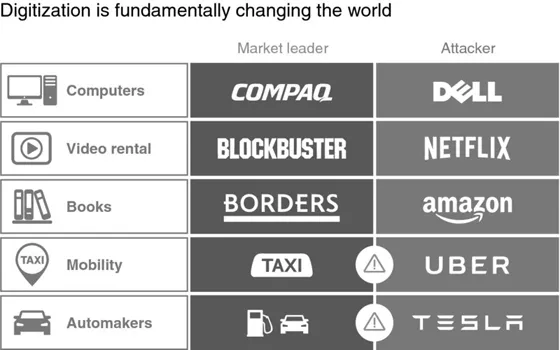
Digitization claimed its first prominent victim when the Internet was still in its infancy, when smartphones belonged to the realm of science fiction and apps were still unheard-of: Compaq was the undisputed global leader in personal computer (PC) and server sales in 1996, with a market share of more than 50 percent in the business customer segment. Compaq built its computers in the old-fashioned way, and delivered them to distribution partners for sale in their stores. That same year, the then 31-year-old Michael Dell launched direct sales of his Dell PCs via the Internet without the need for brick-and-mortar stores. And it wasn’t just the order process that was revolutionary: Dell’s customers were able to assemble their own customized PCs using a kit on the website. Thus, computers were no longer built according to the Compaq principle of “build to stock,” but rather “build to order,” and were tailored to the needs of the individual customer.
Although not immediately apparent to its competitors, Dell’s business model was superior to the business model of Compaq and the rest of the industry. Online sales and lean mass production according to the build-to-order principle made the difference between earning and losing money in this hard-fought market with tight margins. Compaq didn’t dare to change its business model because it feared a channel conflict, and ultimately stayed true to its existing model. In 1997, Compaq was acquired by Hewlett-Packard, and Dell rose to become the world market leader.
Since Dell’s digital revolution of the PC industry, many industries have had their foundations shaken. Video libraries, CD stores, travel agents, and local banks are just some of the endangered species in a world where we now stream our movies and music via Netflix and Spotify, book our flights and accommodations via portals like Expedia and Airbnb, manage our bank accounts online, and can even secure classic banking services like loans via crowdfunding sites like Prosper.
Digitization Is Relevant for All Industries—Only Scale and Speed Will Vary
Anyone who hopes one’s own industry will not be affected by digitization and chooses to continue along as before in blissful oblivion is making a risky assumption. Essentially, all sectors are affected; the only difference is the severity and length of time until the old business model is rendered obsolete.
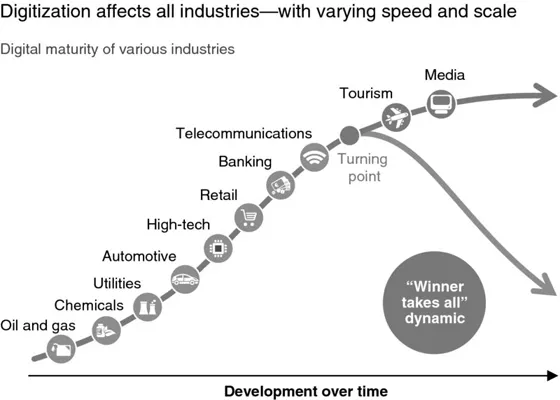
Companies face dramatic challenges in many industries. Who is to say that tomorrow’s driverless cars will still be built by Ford, BMW, Toyota, and the like, and not by Tesla, Google, or Apple? And in a few years, who will equip our smart homes with Internet-connected robot vacuum cleaners and ovens? Who will deliver the groceries that our smart refrigerators automatically order online? Kroger or Amazon?
Naturally, the topic of digitization is on the agenda of most companies. Many companies have started digital initiatives, for example in customer communications, in production, or in supplier interaction. However, most CEOs currently admit they do not have an overarching digital strategy. Their ideal transformation toward becoming a digital company often lacks definition, and all too often they have too narrow an understanding of the term digitization. It is not just IT and technology. These are only the foundation. Rather, it is about transforming the entire company—redefining customer value propositions, value-added processes, and people’s working methods.
It has radically changed consumer behavior and expectations, destroyed traditional business models, and redefined industries. It revolutionizes production—think Industry 4.0—and rocks entire business sectors. Retail faces challenges from digital competitors like Amazon and Alibaba, the banking industry is threatened by lucrative fintech segments, travel portals like Expedia and Priceline are shaking up the tourism industry, and the traditional business models of the advertising industry are being rocked by a variety of digital channels. Digitization is even creating new markets, for example the so-called sharing economy where urban hipsters dispense with owning a car in favor of Uber or Zipcar.
Companies operating in the analog world must not let it get too late before they join the digital mix. Start-ups that tap into a customer need sometimes experience explosive growth. In China, for example, Tencent, whose WhatsApp-equivalent QQ is used by 900 million Chinese customers, saw its revenues increase a hundredfold in 10 years to around €14 billion in 2015. Tencent states that one in two employees works in research and development. And Chinese Uber rival Didi Chuxing, which dominates the taxi and limousine market in the country, more than tripled its company value in 18 months from around $6 billion in 2015 to some $20 billion.
New Business Models Follow a Classic Pattern
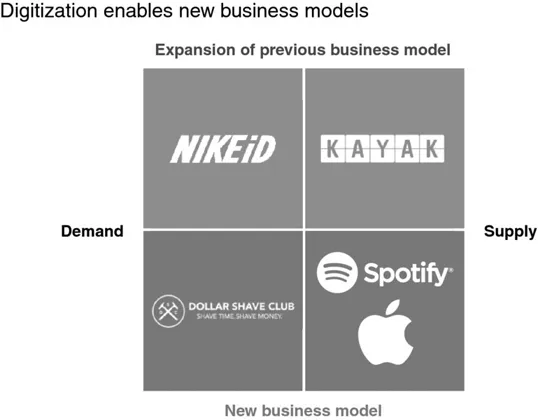
The business ideas triggered by digitization can be grouped across two dimensions depending on whether they are driven by the supply side or the demand side and whether they lead to extended or improved or even completely new business models. An example of a new offering leading to an extended business model is Kayak. The company has digitized the classic travel agency business, allowing users to search for flights, hotels, and rental cars online. The business model itself is still based on a classic system where providers pay a commission to Kayak.
Other digital companies’ offerings tap into a demand that it was previously not possible to service. One example of this is Spotify, whose streaming service provides customers with access to its entire library of music. Rather than paying to listen to individual songs, users pay a subscription. This completely new business model revolutionized the music market and fundamentally turned the industry on its head. By comparison, Apple’s iTunes music store appears conventional.
An example of a demand-driven revolution is the Dollar Shave Club. The company, which was recently bought by Unilever for $1 billion, offers razors and shaving accessories for men in return for a membership fee. By subscribing, members receive a monthly package containing the necessary blades and shaving foam, which saves a trip to the drugstore.
Nike iD is a demand-driven extension of a business model. Customers can individually design their sports shoes online, customizing the shape, material, and color, and even add a monogram.
Consumer Behavior Has Dramatically Changed in Recent Years
The McKinsey long-term study “TMT Digital Insights” tracks changes in consumer behavior in the most important global markets and segments, and has revealed dramatic changes in US consumer behavior. Here are two examples:
Consumers want everything, anywhere, anytime: In 2016, 83 percent of consumers possessed a smartphone—the same number as those who own a home PC. Even tablets, which first became a mass phenomenon in 2010 with Apple’s iPad, are now owned by two-thirds of consumers. This has key consequences for user behavior: US consumers now spend more time on their smartphones and tablets than they do on the PC. Mobile consumers expect answers immediately when researching products and prices on the move or when they want to order something. Smartphones and tablets have become personal command centers. Companies that do not adjust their online presence to service the mobile “anytime, anywhere” mentality may lose ground to their competitors.
Increasing relevance of visual media: The medium of video has become significantly more important. Consumers now spend more time watching videos than before—often at the same time as other (often also digital) activities. So-called over-the-top (OTT) video content published directly online is threatening traditional linear TV and pay-per-view models. To remain attractive to customers...
Table of contents
- Cover
- Title Page
- Copyright
- Preamble: Thinking Digital
- 1 Digital Is Changing Our World, Quickly and Irreversibly
- 2 Digitization Requires Fundamental Renewal: Digital@Scale
- 3 Why? The Clock Is Ticking
- 4 What? Doing the Right Things Intelligently
- 5 What? Developing Business Architecture
- 6 What? Strengthening the Foundation
- 7 How? Decisive, Holistic, and Rapid Implementation
- 8 How? Ramping Up the Digital Company
- 9 How? Scaling Forcefully
- 10 Are We in Good Shape for the Transformation?
- About the Authors
- Special Thanks
- Index
- EULA
Trusted by 375,005 students
Access to over 1.5 million titles for a fair monthly price.
Study more efficiently using our study tools.
Frequently asked questions
Yes, you can cancel anytime from the Subscription tab in your account settings on the Perlego website. Your subscription will stay active until the end of your current billing period. Learn how to cancel your subscription
No, books cannot be downloaded as external files, such as PDFs, for use outside of Perlego. However, you can download books within the Perlego app for offline reading on mobile or tablet. Learn how to download books offline
Perlego offers two plans: Essential and Complete
- Essential is ideal for learners and professionals who enjoy exploring a wide range of subjects. Access the Essential Library with 800,000+ trusted titles and best-sellers across business, personal growth, and the humanities. Includes unlimited reading time and Standard Read Aloud voice.
- Complete: Perfect for advanced learners and researchers needing full, unrestricted access. Unlock 1.5M+ books across hundreds of subjects, including academic and specialized titles. The Complete Plan also includes advanced features like Premium Read Aloud and Research Assistant.
We are an online textbook subscription service, where you can get access to an entire online library for less than the price of a single book per month. With over 1.5 million books across 990+ topics, we’ve got you covered! Learn about our mission
Look out for the read-aloud symbol on your next book to see if you can listen to it. The read-aloud tool reads text aloud for you, highlighting the text as it is being read. You can pause it, speed it up and slow it down. Learn more about Read Aloud
Yes! You can use the Perlego app on both iOS and Android devices to read anytime, anywhere — even offline. Perfect for commutes or when you’re on the go.
Please note we cannot support devices running on iOS 13 and Android 7 or earlier. Learn more about using the app
Please note we cannot support devices running on iOS 13 and Android 7 or earlier. Learn more about using the app
Yes, you can access Digital @ Scale by Anand Swaminathan,Jürgen Meffert in PDF and/or ePUB format, as well as other popular books in Business & Finance. We have over 1.5 million books available in our catalogue for you to explore.