This is the most comprehensive and in-depth study of the theory and practical applications of a new and groundbreaking method for the energy industry to "go green" with renewable and alternative energy sources.
The global warming phenomenon as a significant sustainability issue is gaining worldwide support for development of renewable energy technologies. The term "polygeneration" is referred to as "an energy supply system, which delivers more than one form of energy to the final user." For example, electricity, cooling and desalination can be delivered from a polygeneration process. The polygeneration process in a hybrid solar thermal power plant can deliver electricity with less impact on the environment compared to a conventional fossil fuel-based power generating system. It is also THE next generation energy production technique with the potential to overcome the undesirable intermittence of renewable energy systems.
In this study, the polygeneration process simultaneous production of power, vapor absorption refrigeration (VAR) cooling and multi-effect humidification and dehumidification (MEHD) desalination system from different heat sources in hybrid solar-biomass (HSB) system with higher energy efficiencies (energy and exergy), primary energy savings (PES) and payback period are investigated, focusing on several aspects associated with hybrid solar-biomass power generation installations, such as wide availability of biomass resources and solar direct normal irradiance (DNI), and other technologies. Thermodynamic evaluation (energy and exergy) of HSB power has also been investigated, along with the VAR cooling system, the modelling, simulation, optimization and cost analysis of the polygeneration hybrid solar biomass system, all accompanied by multiple case studies and examples for practical applications.
This volume provides the researcher, student and engineer with the intellectual tool needed for understanding new ideas in this rapidly emerging field. The book is also intended to serve as a general source and reference book for the professional (consultant, designer, contractor etc.) who is working in the field of solar thermal, biomass, power plant, polygeneration, cooling and process heat. It is a must-have for anyone working in this field.
The energy scene in the world is a complex picture of a variety of energy sources being used to meet growing energy needs. However, there is a gap in the demand and supply position. It is recognized that decentralizing generation based on the various renewable energy technologies can help in meeting growing energy needs. Renewable energy landscapes in India during the last few years have witnessed tremendous changes in policy framework with accelerated and ambitious plans to increase the contribution of renewable energy such as solar, wind, bio-power, etc. Concentrated solar thermal and biomass powers have good potential for power generation and/or process heat in the industrial sector from renewable energy.
The launching of the Jawaharlal Nehru National Solar Mission (JNNSM) symbolizes both and indeed encapsulates the vision and ambition for the future of solar energy in India. The cost of power produced from Concentrated Solar Power (CSP) is becoming competitive with conventional energy sources with the development of technologies [1].
As capacity of CSP with heat energy storage is growing rapidly, hybridization with CSP is receiving more attention due to low levels of insolation in this country. The demand for biomass is increasing for use as solid fuels, such as wood pellets. It is the power generation potential of biomass, however, which has recently attracted greater attention. On the other hand, biomass power plants should have a secured supply of the required quality and quantity of biomass resources at a competitive price for sustainable operation of the plant. The cost of biomass resources has been slowly increasing due to non-availability of feed stock at the right price in recent years, so biomass and solar resources are important and supplement and complement each other for hybridization for continuous power generation.
Solar-biomass hybrid systems could be a viable reliable option for meeting energy demand in the industrial sector. In hybrid systems, solar energy can be optimally utilized in regions of high direct normal solar irradiance and where the biomass is available in abundance for supplementing and complementing each other in a cost effective manner. Solar thermal technology drives the thermal power system in peak sunshine hours and biomass heat drives in short transient periods during the day and at night time to generate constant power.
The energy demand for cooling, process heat, and desalination applications is increasing continuously in industry, office complexes, institutions, hospitals, residential areas, shopping complexes, etc. This is, at present, being met by conventional electricity, thus increasing the load on the grid and causing environmental pollution. Globally, in industrial sector, about two-thirds of the total consumption of energy is used for process heat applications.
The world’s huge and growing population is putting a severe strain on all the natural sources of the countries. Most of the water resources are contaminated by sewage and agricultural runoff. India has made progress in supplying drinking water to people, but gross disparity in coverage exists across the country. In India, access to drinking water to different communities and states has increased in the recent past, but as per estimation of World Bank, about 21% of communicable diseases are related to unsafe water supply. Ground water is the major source of drinking water in our country with 85% of the population dependent on it [2–3]. It is true that providing drinking water to such a large population is an enormous challenge.
Presently, most of the industries either buy power from the state electricity boards or generate their own power largely for end use applications like industrial production of materials and goods, office works, communication, cooling, and desalination. In India, the increase in huge electricity demand for industry, institutions, office complexes, commercial establishments, etc. has resulted in a higher consumption of conventional energy, as well as increasing greenhouse gas (GHG) emissions and is responsible for the negative impact on climate change. The process heat requirement is more than 67% of total energy consumption at a global level and about 50% of this heat requirement is for temperatures lower than 400 °C. At present levels, about 40% of primary energy consumption of the industry is contributed by natural gas and contribution from petroleum is about 41% [4]. Some of industries, through cogeneration, produce power as well as process heat for their end use applications to reduce their net power consumption. Cogeneration systems can reduce the grid electricity demand of the residential sector for lighting, space heating, and cooling and hot water, thus reducing greenhouse gas emissions.
Cogeneration is considered advanced technology for the generation of both electricity and process heat, but it is not possible to provide energy for more than two such outputs like space cooling, water desalination, and/or process heat for their requirements. However, polygeneration processes can meet full energy demands such as power, space cooling and heating, and process heating, including desalination. Polygeneration processes in hybrid solar thermal power plants can improve overall efficiencies (energy and exergy) and reliability.
1.1 Global Scenario on Renewable Energy
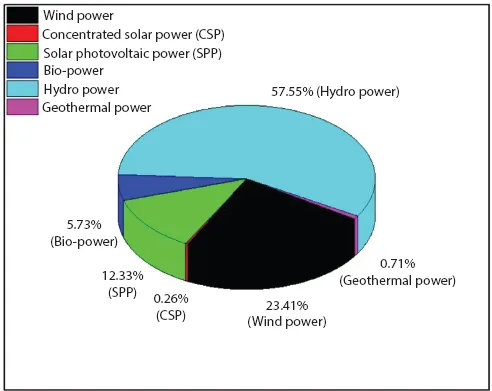
Renewable energy is one of the options to transform the energy system to make it less carbon intensive, sustainable, meet climate change goals, and bring energy security benefits. Renewable energy encompasses a broad range of energy resources and technologies that have differing attributes and applications. Renewable energy resources include solar energy, bioenergy, geothermal, wind, and hydropower. These sources are abundant and widely distributed, but they are not equally easy to harness. Solar, biomass, and geothermal resources are for generation of electricity, water pumping, and process heat applications. Hydropower and wind resources are only for the generation of electricity and water lifting and bioenergy resources are utilized for electricity generation and in transport sectors. Renewable energies are the world’s second largest source of electricity generation after coal based power generation plants. These sources have huge potential in meeting energy requirements for process heat in industry and transport sectors. For the first time, the renewables industry has achieved a major milestone in 2015 with capacity additions exceeding as compared to fossil fuels and nuclear energy [5]. The total renewable power capacity reached 1,849,000 MW (including hydro power) at the end 2015 [6]. Of this renewable power capacity, wind energy increased contribution to 23.41% of installed capacity (433,000 MW), solar photovoltaic power (SPV) to 12.33% (228,000 MW), bio-power capacity to 5.73% (106,000 MW), geothermal power capacity to 0.713% (13,200 MW), concentrated solar thermal power capacity to 0.259% (4,800 MW), and hydro power capacity to 57.54% amounting to 1064,000 MW, as shown in Figure 1.1.
Wind Power Globally, total wind power generation capacity is 433,000 MW at the end of 2015. China has the world’s highest generation capacity of 29.87% (129,340 MW), followed distantly by the United States 16.76% (72,578 MW), Germany 10.39% (45,000 MW), India 5.79% (25,088 MW), Spain 5.31% (23,008 MW), United Kingdom 3.27% (14,191 MW), Canada 2.58% (11,205 MW), France 2.39% (10,358 MW), Italy 2.1% (9,126 MW), Brazil 2.01% (8,715 MW), and the rest of world 19.48% (84,391 MW).
SPV Power Globally, the present installed capacity of SPV power is 228,000 MW. China, Germany, Japan, the USA, and Italy are the top five countries on SPV power generation. Out of 228,000 MW, China achieved 18.93% (43,180 MW) of SPV power installed capacity followed by Germany 17.38% (39,634 MW), Japan 14.60 % (33,300 MW), the United States 9.7% (22,178 MW), Italy 8.29% (18,910 MW), the United Kingdom 3.91% (8,915 MW), India 3.8% (8,727 MW), France 2.87% (6,549 MW), Australia 2.20% (5,031 MW), Spain 2.12% (4,832 MW), and other countries 16.11 % (36,744 MW).
Bio-Power Bio-power is increasing with rapid growth for power generation in the major countries, i.e. Brazil, the United States, China, Germany, India, Sweden, the United Kingdom, and Japan. The total installed capacity of bio power is 106,000 MW. Brazil is the largest producer of bio-power electricity 14.98% (15,887 MW) followed by the United States 11.76% (12,474 MW), China 9.73% (10,320 MW), Germany 8.61% (9,132 MW), India 5.28% (5,605 MW), Sweden 4.58% (4,864 MW), the United Kingdom 4.21% (4,463 MW), Japan 3.84% (4,076 MW), and other countries 36.96% (39,179 MW).
Geothermal Power The total installed capacity of geothermal power is 13,200 MW. The major countries with the largest geothermal power capacity are the United States 27.27% (3,600 MW), the Philippines 14.39% (1,900 MW), Indonesia 10.6% (1,400 MW), Mexico 8.33% (1,100 MW), New Zealand 7.57% (1000 MW), Italy 6.81% (900 MW), Iceland 5.3% (700 MW), Turkey and Kenya 4.54% (600 MW), Japan 3.78% (500 MW), and other countries 11.36 % (1500 MW).
Concentrated Solar Thermal Power Globally, the concentrated solar thermal power generation capacity increased by 420 MW to reach nearly 4800 MW at the end of 2015. Spain is the highest producer of solar thermal electricity 47.91% (2300 MW) followed by the United States 37% (1776 MW), India 4.24% (203.5 MW), South Africa 3.12% (150 MW), United Arab Emirates 2.08% (100 MW), and rest of world 5.63% (270.5 MW). Apart from thermal power generation, the total installed capacity of solar thermal heating, cooling, and other industrial process heat applications in the World is 37200 MW (collector installed capacity of solar thermal technologies is 53.1 million m2).
Hydro Power The total installed capacity of small, medium, and large and pump storage and mixed hydro power plants is 1064,000 MW. The seven major countries for hydropower capacity were China, the United States, Brazil, Canada, the Russian Federation, Japan, and India at the end of 2015. China has the highest hydro power generation of 30.16% (320,910 MW) followed by the United States 9.63% (102,543 MW), Brazil 8.65% (92,062 MW), Canada 7.42% (79,043 MW), Russian Federation 4.84% (51,523 MW), Japan 4.61% (49,145 MW), India 4.4% (46,816 MW), and the rest of the world 30.25% (321,949 MW).
Figure 1.1 World’s Renewable Energy Scenario at the End of 2015.
1.2 Indian Scenario on Renewable Energy
The total installed capacity of a renewable energy system in India is 45,743 MW (including small hydro power only), as of November 2016. This includes 61.39% (28,082 MW) from wind power, 17.79% (8,138 MW) from SPV power,...
Table of contents
Cover
Title page
Copyright page
Foreword
Preface
Chapter 1: Introduction
Chapter 2: State-of-the-Art Concentrated Solar Thermal Technologies for End Use Applications
Chapter 3: Resource Assessment of Solar and Biomass for Hybrid Thermal Power Plant
Chapter 4: Solar Thermal Power Plant
Chapter 5: Modeling and Simulation of Hybrid Solar and Biomass Thermal Power Plant
Chapter 6: Modeling, Simulation, Optimization and Cost Analysis of a Polygeneration Hybrid Solar Biomass System
Appendix 1
Appendix 2
Appendix 3
About the Author
Index
End User License Agreement
Trusted by 375,005 students
Access to over 1.5 million titles for a fair monthly price.
Study more efficiently using our study tools.
Frequently asked questions
Yes, you can cancel anytime from the Subscription tab in your account settings on the Perlego website. Your subscription will stay active until the end of your current billing period. Learn how to cancel your subscription
No, books cannot be downloaded as external files, such as PDFs, for use outside of Perlego. However, you can download books within the Perlego app for offline reading on mobile or tablet. Learn how to download books offline
Perlego offers two plans: Essential and Complete
Essential is ideal for learners and professionals who enjoy exploring a wide range of subjects. Access the Essential Library with 800,000+ trusted titles and best-sellers across business, personal growth, and the humanities. Includes unlimited reading time and Standard Read Aloud voice.
Complete: Perfect for advanced learners and researchers needing full, unrestricted access. Unlock 1.5M+ books across hundreds of subjects, including academic and specialized titles. The Complete Plan also includes advanced features like Premium Read Aloud and Research Assistant.
Both plans are available with monthly, semester, or annual billing cycles.
We are an online textbook subscription service, where you can get access to an entire online library for less than the price of a single book per month. With over 1.5 million books across 990+ topics, we’ve got you covered! Learn about our mission
Look out for the read-aloud symbol on your next book to see if you can listen to it. The read-aloud tool reads text aloud for you, highlighting the text as it is being read. You can pause it, speed it up and slow it down. Learn more about Read Aloud
Yes! You can use the Perlego app on both iOS and Android devices to read anytime, anywhere — even offline. Perfect for commutes or when you’re on the go. Please note we cannot support devices running on iOS 13 and Android 7 or earlier. Learn more about using the app
Yes, you can access A Polygeneration Process Concept for Hybrid Solar and Biomass Power Plant by Umakanta Sahoo in PDF and/or ePUB format, as well as other popular books in Technology & Engineering & Engineering General. We have over 1.5 million books available in our catalogue for you to explore.