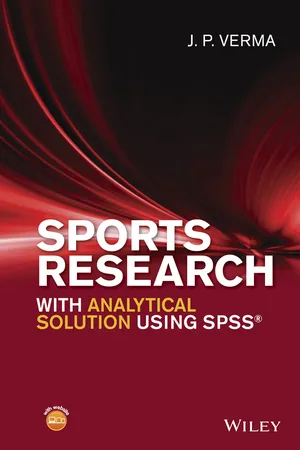
Sports Research with Analytical Solution using SPSS
eBook - ePub

Sports Research with Analytical Solution using SPSS

  1. English
  2. ePUB (mobile friendly)
  3. Available on iOS & Android
eBook - ePub

Sports Research with Analytical Solution using SPSS

About this book

A step-by-step approach to problem-solving techniques using SPSSĀ® in the fields of sports science and physical education

Featuring a clear and accessible approach to the methods, processes, and statistical techniques used in sports science and physical education, Sports Research with Analytical Solution using SPSSĀ® emphasizes how to conduct and interpret a range of statistical analysis using SPSS. The book also addresses issues faced by research scholars in these fields by providing analytical solutions to various research problems without reliance on mathematical rigor.

Logically arranged to cover both fundamental and advanced concepts, the book presents standard univariate and complex multivariate statistical techniques used in sports research such as multiple regression analysis, discriminant analysis, cluster analysis, and factor analysis. The author focuses on the treatment of various parametric and nonparametric statistical tests, which are shown through the techniques and interpretations of the SPSS outputs that are generated for each analysis. Sports Research with Analytical Solution using SPSSĀ® also features:

  • Numerous examples and case studies to provide readers with practical applications of the analytical concepts and techniques
  • Plentiful screen shots throughout to help demonstrate the implementation of SPSS outputs
  • Illustrative studies with simulated realistic data to clarify the analytical techniques covered
  • End-of-chapter short answer questions, multiple choice questions, assignments, and practice exercises to help build a better understanding of the presented concepts
  • A companion website with associated SPSS data files and PowerPointĀ® presentations for each chapter

Sports Research with Analytical Solution using SPSSĀ® is an excellent textbook for upper-undergraduate, graduate, and PhD-level courses in research methods, kinesiology, sports science, medicine, nutrition, health education, and physical education. The book is also an ideal reference for researchers and professionals in the fields of sports research, sports science, physical education, and social sciences, as well as anyone interested in learning SPSS.

Frequently asked questions

Yes, you can cancel anytime from the Subscription tab in your account settings on the Perlego website. Your subscription will stay active until the end of your current billing period. Learn how to cancel your subscription.
No, books cannot be downloaded as external files, such as PDFs, for use outside of Perlego. However, you can download books within the Perlego app for offline reading on mobile or tablet. Learn more here.
Perlego offers two plans: Essential and Complete
  • Essential is ideal for learners and professionals who enjoy exploring a wide range of subjects. Access the Essential Library with 800,000+ trusted titles and best-sellers across business, personal growth, and the humanities. Includes unlimited reading time and Standard Read Aloud voice.
  • Complete: Perfect for advanced learners and researchers needing full, unrestricted access. Unlock 1.4M+ books across hundreds of subjects, including academic and specialized titles. The Complete Plan also includes advanced features like Premium Read Aloud and Research Assistant.
Both plans are available with monthly, semester, or annual billing cycles.
We are an online textbook subscription service, where you can get access to an entire online library for less than the price of a single book per month. With over 1 million books across 1000+ topics, we’ve got you covered! Learn more here.
Look out for the read-aloud symbol on your next book to see if you can listen to it. The read-aloud tool reads text aloud for you, highlighting the text as it is being read. You can pause it, speed it up and slow it down. Learn more here.
Yes! You can use the Perlego app on both iOS or Android devices to read anytime, anywhere — even offline. Perfect for commutes or when you’re on the go.
Please note we cannot support devices running on iOS 13 and Android 7 or earlier. Learn more about using the app.
Yes, you can access Sports Research with Analytical Solution using SPSS by J. P. Verma in PDF and/or ePUB format, as well as other popular books in Medicine & Sports Medicine. We have over one million books available in our catalogue for you to explore.

Information

Publisher
Wiley
Year
2016
Print ISBN
9781119206712
eBook ISBN
9781119206736
Edition
1

1
INTRODUCTION TO DATA TYPES AND SPSS OPERATIONS

LEARNING OBJECTIVES

After completing this chapter, you should be able to do the following:
  • Understand different data types generated in research
  • Learn the nature of variables
  • Know various data cleaning methods
  • Learn to install SPSS package in computer
  • Prepare data file in SPSS

1.1 INTRODUCTION

Due to large stake involved in sports, research in this area is gaining momentum in different universities of the world. Even developing countries have started introducing sports sciences in different universities. The sole purpose is to create specific knowledge required for enhancing sports performance. Everyday, enormous data is being generated in the area of sports all over the world, which can be used to draw meaningful conclusions. Scientists have started organizing experiments by taking athletes as subjects. It is therefore required to support these scientists with analytical skill set to carry out their business. Since they deal with the data, it is essential that they are aware of its nature. Depending upon the data types, one identifies the relevant analytical technique for addressing research issues. Sports research can broadly be classified into two categories: descriptive and analytical. In descriptive research, the nature of dataset is investigated from different perspectives. Several statistics like mean, standard deviation, coefficient of variation, skewness, kurtosis, and percentiles are used to describe the characteristics of the dataset. Many interesting facts about the population can be investigated by using these descriptive statistics. Analytical research broadly follows two approach: exploratory and confirmatory. In explorative research, focus is on discovering the hidden relationships. It is done by hypothesis testing, data modeling, and using multivariate analysis. On the other hand, in confirmatory studies, some of the facts are either confirmed or denied on the basis of hypothesis testing.
Numerous statistical techniques are available to the researchers for analyzing their research data. Selection of an appropriate technique depends upon the research questions being investigated in the study. Due to complexities of different analytical solutions in sports research, one needs to use some user-friendly software package. This chapter will acquaint you with different types of data that are generated in sports research and some of the widely used statistical techniques by the research scholars to solve them for answering different research questions by using the most popular IBM SPSS Statistics package.

1.2 TYPES OF DATA

It is essential to know the types of data generated in research studies because choosing statistical test for analyzing data depends upon its type. Data can be classified into two categories: metric and nonmetric. Metric data is analyzed by using parametric tests such as t, F, Z, correlation coefficient, etc., whereas nonparametric tests such as Wilcoxon signed-ranked, Chi-square, Mann–Whitney U, and Kruskal Wallis are used to analyze nonmetric data.
Parametric tests are more reliable than the nonparametric, but to use such tests certain assumptions must be satisfied. On the other hand, nonparametric tests are more flexible, easy to use, and not many assumptions are required to use them.
Nonmetric and metric data are also known as qualitative and quantitative data, respective...

Table of contents

  1. COVER
  2. TITLE PAGE
  3. TABLE OF CONTENTS
  4. PREFACE
  5. ABOUT THE COMPANION WEBSITE
  6. ACKNOWLEDGMENTS
  7. 1 INTRODUCTION TO DATA TYPES AND SPSS OPERATIONS
  8. 2 DESCRIPTIVE PROFILE
  9. 3 CORRELATION COEFFICIENT AND PARTIAL CORRELATION
  10. 4 COMPARING MEANS
  11. 5 INDEPENDENT MEASURES ANOVA
  12. 6 REPEATED MEASURES ANOVA
  13. 7 ANALYSIS OF COVARIANCE
  14. 8 NONPARAMETRIC TESTS IN SPORTS RESEARCH
  15. 9 REGRESSION ANALYSIS AND MULTIPLE CORRELATIONS
  16. 10 APPLICATION OF DISCRIMINANT FUNCTION ANALYSIS
  17. 11 LOGISTIC REGRESSION FOR DEVELOPING LOGIT MODEL IN SPORT
  18. 12 APPLICATION OF FACTOR ANALYSIS
  19. APPENDIX
  20. BIBLIOGRAPHY
  21. INDEX
  22. END USER LICENSE AGREEMENT