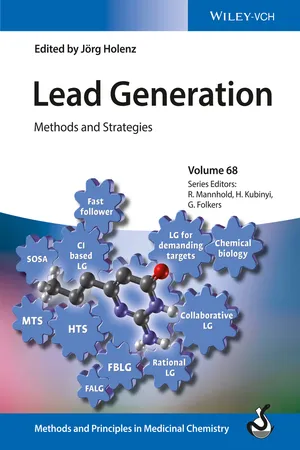
In this comprehensive two-volume resource on the topic senior lead generation medicinal chemists present a coherent view of the current methods and strategies in industrial and academic lead generation. This is the first book to combine both standard and innovative approaches in comparable breadth and depth, including several recent successful lead generation case studies published here for the first time.
Beginning with a general discussion of the underlying principles and strategies, individual lead generation approaches are described in detail, highlighting their strengths and weaknesses, along with all relevant bordering disciplines like e.g. target identification and validation, predictive methods, molecular recognition or lead quality matrices. Novel lead generation approaches for challenging targets like DNA-encoded library screening or chemical biology approaches are treated here side by side with established methods as high throughput and affinity screening, knowledge- or fragment-based lead generation, and collaborative approaches. Within the entire book, a very strong focus is given to highlight the application of the presented methods, so that the reader will be able to learn from real life examples. The final part of the book presents several lead generation case studies taken from different therapeutic fields, including diabetes, cardiovascular and respiratory diseases, neuroscience, infection and tropical diseases.
The result is a prime knowledge resource for medicinal chemists and for every scientist involved in lead generation.
eBook - ePub
Lead Generation
Methods and Strategies
- English
- ePUB (mobile friendly)
- Available on iOS & Android
eBook - ePub
About this book
Information
Part I
Introduction to Lead Generation
1
Introduction: Learnings from the Past – Characteristics of Successful Leads
Mike Hann
Contemporary nodding sages in drug discovery will often be heard to say “Tut, tut, if I wanted to get there, I wouldn't start from here.” Such comments are based on their experience (aka insights from hindsight!) where failure of compounds in late lead optimization, preclinical, or clinical work can all too often be associated with poor chemical and physicochemical properties of the chemical series being pursued. It is, of course, one of the basic truisms of science that where we start an optimization process will likely have profound influences on where it ends up!
If this is true then why does so much of medicinal chemistry, and hence drug discovery, still suffer from a lack of awareness of these facts? After all they can save enormous amounts of time and money that are spent on taking forward compounds that fall outside of “drug-like space” until they predictably failed.
Is it (1) because people still do not believe in a drug-like space and thus ignore the fact that compounds invariably get bigger and more lipophilic as lead optimization progresses in the search for potency? Or is it (2) because they believe they will be exceptional in their skills and that this will allow their project to be equally exceptional and succeed outside of received or accepted wisdom? Or is it (3) that they just cannot find a good starting point that will deliver or, possibly, they have not tried hard enough to find such a starting point? Or is it (4) that such a poor choice of target that finding a small molecule to effectively interact with it is nigh impossible? All or any of these can be crucial in determining what course a project takes, but one of the biggest confounding issues is that although it can be argued (see below) that a drug-like space exists, there are many good drugs that fall outside of this drug-like space. Thus that paradoxical saying “the exception that proves the rule” is all too often used to justify continuing. The effect of this is to allow reason (2) to be actively beckoning teams away from sticking to the drug-like space mantra. Only if you have exhaustively tried and failed to find success in the drug-like space should you feel you have permission to go beyond it and then you will most definitely need not only all your skills but probably also a large slice of luck! Note that if we all choose to back the low odds scenario, that is, (2), all of the time, then we are indeed guaranteeing a poor return on investment.
So what is drug-like space? This has somehow erroneously become associated with Chris Lipinski's rule of five (Ro5) that actually refers to the probability that a compound will be orally bioavailable in humans [1]. The Ro5 states that if a compound has more than one violation of the following criteria – greater than 5 hydrogen bond donors (defined as the total number of hydrogens directly bonded to O or N), greater than 10 hydrogen bond acceptors (defined by all N or O atoms in the molecule), a molecular weight greater than 500, an octanol–water partition coefficient LogP greater than 5 – then it will unlikely be orally bioavailable. Thus, the Ro5 only refers to one aspect (the oral adsorption) of the overall adsorption, distribution, metabolism, excretion, and toxicology (ADMET) profile of a compound. Clearly this, coupled with essential target engagement, is critical to the likelihood of it being an acceptable and efficacious drug. This conflation of Ro5 with drug space is probably due to the fact that most drug discovery projects do aspire to having oral bioavailability but while this may be desirable it is not sufficient. To truly define a drug-like space, we need guidance on parameters such as solubility, permeability, dose, toxicity, metabolism, and so on. Over the past 5–10 years, many analyses of large data sets from pharma companies have been published. A selection of the resulting “rules of thumb” about the preferred drug-like space are summarized in Table 1.1 1). The use of such cutoff-based rules has often been criticized as being too black and white and, as a consequence, other more subtle ways of doing data fusion have been introduced (e.g., the quantitative estimate of drug-likeness (QED) by Hopkins and colleagues that uses weighted desirability functions [2]).
Table 1.1 Drug-like space guidance on physchem properties.
| Drug-like property considered | Guidance | Reference |
| Lipinski/Pfizer Ro5 for Oral bioavailability | Violating 2 or more of MW < 500, LogP < 5, HBD < 5, and HBA < 10 results in poor oral bioavailability | [1] |
| AZ receptor promiscuity | Maximize LLE = pIC50 − logP to reduce promiscuity | [3] |
| Pfizer 3/75 rule for toxicity | Keep cLogP < 3 and PSA > 75 to minimize toxicity | [4] |
| GSK 4/400 rule for general ADMET | Keep cLogP < 4 and MW < 400 for generally favorable ADMET properties | [5] |
| AZ permeability model | On average larger “small molecules” need more lipophilicity to penetrate membranes | [6] |
| GSK PFI model for general drug-like properties (including solubility) | Favored space from Property Forecast Index (PFI) when PFI = mChromLogD7.4 + number of aromatic rings <6. But note that permeability max in PFI = 6–8 | [7] |
| Pfizer dosage guidance for reducing toxicity | Keep predicted human efficacious dosage of <250 nM (total drug) and <40 nM (free drug) | [8] |
| GSK Developability Classification System based on permeability, dose, and solubility | Compounds with DCS classification of I, IIa, or III are much easier to develop | [9] |
| Drug-like property reviews | General overviews | [10,11] |
The prevalence of lipophilicity in these rules indicates how important it is to pay particular attention to this property. The term “molecular obesity” was introduced as a way to anthropomorphize the impact and danger of too much lipophilicity in compounds in development by analogy to the dangers of medical obesity [12]. The causative reasons why there is a tendency to allow lipophilicity to increase were also analyzed in this paper and Table 1.2 lists a number of the more obvious ones.
Table 1.2 Reasons for lipophilicity increases in discovery projects.
| Reason for logP increase | How to mitigate | Reference |
| Potency is most easily attained by lipophilic interactions that are nondirectional | Ensure maximum potency through polar (enthalpic) interactions is achieved | [13] |
| Permeability sweet spot is often found by indiscriminate use of lipophilicity – particularly for larger molecules | Use of LLE to control lipophilicity-driven membrane effects | [14] |
| Organic synthesis favors purification of lipophilic compounds | Design synthesis, work-up, and purification schemas that can cope with more polar molecules | [15] |
At the end of the day, it is often the required human dose that defines whether a drug is successful. Dosage determinants can be broadly divided into two key components – first, how much drug gets to the site of action and second how tightly does the drug bind to its target thus eliciting the desired effect. This balance between potency and availability is elegantly expressed in the drug efficiency index (DEI) developed by scientists at GSK in Verona [16]. Drug efficiency (DE) itself is defined as the fraction of administered dose that becomes available as the biophase concentration. The derived term DEI is then defined as the affinity pKi (log of affinity constant) added to log10DE. Thus, if the drug efficiency is less than 1%, it contributes a negative number when the logarithm is taken and rapidly detracts from the intrinsic potency of a compound. Another useful way of thinking about drug efficiency is in terms of the amount of a dose that is being wasted; for instance, if a drug has a DE of 0.1%, then it means that 99.9% of a dose is never used at the target to elicit the required pharmacology!
Low dosage is not only good from the point of helping reduce the cost of goods but is also one of the only known predictors for low incidence of idiosyncratic toxicity [17]. Thus, it is generally considered very unlikely that idiosyncratic drug reactions will occur at a total dose of 10 mg per day.
Another perspective on this can be gained from a study by Pfizer scientists on the survival of CNS acti...
Table of contents
- Cover
- Methods and Principles in Medicinal Chemistry
- Title Page
- Copyright
- Dedication
- List of Contributors
- Preface
- A Personal Foreword
- Part I: Introduction to Lead Generation
- Part II: The Importance of Target Identification for Generating Successful Leads
- Part III: Hit Generation Methods
- Part IV: Converting Hits to Successful Leads
- Part V: Hypothesis-driven Lead Optimization
- Part VI: Recent Lead Generation Success Stories
- Index
- EULA
Trusted by 375,005 students
Access to over 1.5 million titles for a fair monthly price.
Study more efficiently using our study tools.
Frequently asked questions
Yes, you can cancel anytime from the Subscription tab in your account settings on the Perlego website. Your subscription will stay active until the end of your current billing period. Learn how to cancel your subscription
No, books cannot be downloaded as external files, such as PDFs, for use outside of Perlego. However, you can download books within the Perlego app for offline reading on mobile or tablet. Learn how to download books offline
Perlego offers two plans: Essential and Complete
- Essential is ideal for learners and professionals who enjoy exploring a wide range of subjects. Access the Essential Library with 800,000+ trusted titles and best-sellers across business, personal growth, and the humanities. Includes unlimited reading time and Standard Read Aloud voice.
- Complete: Perfect for advanced learners and researchers needing full, unrestricted access. Unlock 1.5M+ books across hundreds of subjects, including academic and specialized titles. The Complete Plan also includes advanced features like Premium Read Aloud and Research Assistant.
We are an online textbook subscription service, where you can get access to an entire online library for less than the price of a single book per month. With over 1.5 million books across 990+ topics, we’ve got you covered! Learn about our mission
Look out for the read-aloud symbol on your next book to see if you can listen to it. The read-aloud tool reads text aloud for you, highlighting the text as it is being read. You can pause it, speed it up and slow it down. Learn more about Read Aloud
Yes! You can use the Perlego app on both iOS and Android devices to read anytime, anywhere — even offline. Perfect for commutes or when you’re on the go.
Please note we cannot support devices running on iOS 13 and Android 7 or earlier. Learn more about using the app
Please note we cannot support devices running on iOS 13 and Android 7 or earlier. Learn more about using the app
Yes, you can access Lead Generation by Jörg Holenz, Raimund Mannhold,Hugo Kubinyi,Gerd Folkers in PDF and/or ePUB format, as well as other popular books in Medicine & Pharmacology. We have over 1.5 million books available in our catalogue for you to explore.