Conventional and Alternative Power Generation
eBook - ePub

Conventional and Alternative Power Generation

Thermodynamics, Mitigation and Sustainability

  1. English
  2. ePUB (mobile friendly)
  3. Available on iOS & Android
eBook - ePub

Conventional and Alternative Power Generation

Thermodynamics, Mitigation and Sustainability

About this book

A much-needed, up-to-date guide on conventional and alternative power generation

This book goes beyond the traditional methods of power generation. It introduces the many recent innovations on the production of electricity and the way they play a major role in combating global warming and improving the efficiency of generation. It contains a strong analytical approach to underpin the theory of power plants—for those using conventional fuels, as well as those using renewable fuels—and looks at the problems from a unique environmental engineering perspective. The book also includes numerous worked examples and case studies to demonstrate the working principles of these systems.

Conventional and Alternative Power Generation: Thermodynamics, Mitigation and Sustainability is divided into 8 chapters that comprehensively cover: thermodynamic systems; vapor power cycles, gas power cycles, combustion; control of particulates; carbon capture and storage; air pollution dispersal; and renewable energy and power plants.

  • Features an abundance of worked examples and tutorials
  • Examines the problems of generating power from an environmental engineering perspective
  • Includes all of the latest information, technology, theories, and principles on power generation

Conventional and Alternative Power Generation: Thermodynamics, Mitigation and Sustainability is an ideal text for courses on mechanical, chemical, and electrical engineering.
Frequently asked questions

Yes, you can cancel anytime from the Subscription tab in your account settings on the Perlego website. Your subscription will stay active until the end of your current billing period. Learn how to cancel your subscription.
No, books cannot be downloaded as external files, such as PDFs, for use outside of Perlego. However, you can download books within the Perlego app for offline reading on mobile or tablet. Learn more here.
Perlego offers two plans: Essential and Complete
  • Essential is ideal for learners and professionals who enjoy exploring a wide range of subjects. Access the Essential Library with 800,000+ trusted titles and best-sellers across business, personal growth, and the humanities. Includes unlimited reading time and Standard Read Aloud voice.
  • Complete: Perfect for advanced learners and researchers needing full, unrestricted access. Unlock 1.4M+ books across hundreds of subjects, including academic and specialized titles. The Complete Plan also includes advanced features like Premium Read Aloud and Research Assistant.
Both plans are available with monthly, semester, or annual billing cycles.
We are an online textbook subscription service, where you can get access to an entire online library for less than the price of a single book per month. With over 1 million books across 1000+ topics, we’ve got you covered! Learn more here.
Look out for the read-aloud symbol on your next book to see if you can listen to it. The read-aloud tool reads text aloud for you, highlighting the text as it is being read. You can pause it, speed it up and slow it down. Learn more here.
Yes! You can use the Perlego app on both iOS or Android devices to read anytime, anywhere — even offline. Perfect for commutes or when you’re on the go.
Please note we cannot support devices running on iOS 13 and Android 7 or earlier. Learn more about using the app.
Yes, you can access Conventional and Alternative Power Generation by Neil Packer,Tarik Al-Shemmeri in PDF and/or ePUB format, as well as other popular books in Technology & Engineering & Power Resources. We have over one million books available in our catalogue for you to explore.

Information

1
Thermodynamic Systems

1.1 Overview

Thermodynamics is the science relating heat and work transfers and the associated changes in the properties of the working substance within a predefined working system. A thermodynamic system is one that is concerned with the generation of heat and/or work using a working fluid. In this chapter, thermodynamic system behaviour will be described and the changes in properties will be calculated during the different processes encountered in typical engineering applications.

Learning Outcomes

  • To understand the basic units and properties of thermodynamic systems.
  • To be able to apply the laws of thermodynamics to closed and open systems.
  • To be able to apply the first law of thermodynamics and calculate the changes in properties during a process and a cycle.
  • To be able to solve problems related to compression and expansion of steam and gases.

1.2 Thermodynamic System Definitions

A thermodynamic system comprises an amount of matter enclosed within a boundary separating it from the outside surroundings.
There are two types of thermodynamic system:
  • A closed system has a fixed mass and a flexible boundary.
  • An open system has a variable mass (or mass flow) and a fixed boundary.

1.3 Thermodynamic Properties

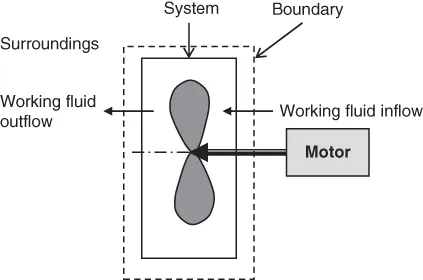
A thermodynamic property of a substance refers to any quantity whose changes are defined only by the end states and by the process. Examples are the pressure, volume and temperature of the working fluid in the system in Figure 1.1. In addition to these three properties, other thermodynamic properties include enthalpy, entropy and internal energy, which are all important in studying the behaviour of the working fluid in a power plant.
Scheme for Thermodynamic system, boundary and surroundings.
Figure 1.1 Thermodynamic system, boundary and surroundings.
A list of the most common p...

Table of contents

  1. Cover
  2. Table of Contents
  3. Preface
  4. Structure of the Book
  5. Notation
  6. Chapter 1: Thermodynamic Systems
  7. Chapter 2: Vapour Power Cycles
  8. Chapter 3: Gas Power Cycles
  9. Chapter 4: Combustion
  10. Chapter 5: Control of Particulates
  11. Chapter 6: Carbon Capture and Storage
  12. Chapter 7: Pollution Dispersal
  13. Chapter 8: Alternative Energy and Power Plants
  14. Appendix A: Properties of Water and Steam
  15. Appendix B: Thermodynamic Properties of Fuels and Combustion Products
  16. Bibliography
  17. Index
  18. End User License Agreement