Practical Physiotherapy for Small Animal Practice provides a concise and accessible introduction to physiotherapy that demonstrates its benefits to both veterinary patients and practitioners. One of the fastest growing specialties in veterinary medicine, this book will help you to successfully introduce physiotherapy into your practice improving rehabilitation and recovery of dogs and cats.
Key features:
Covers an array of different treatments and techniques, such as manual therapies, therapeutic exercise, electrotherapy, and hydrotherapy
Includes practical advice on selecting equipment, examinations, treatment protocols, and charging
Offers strategies for introducing physiotherapy into the practice schedule, including space and staffing requirements
Companion website provides over 50 printable client education handouts for download
All professions develop and evolve as new research is conducted; pioneering techniques become everyday techniques and in veterinary medicine, the use of physiotherapy to complement current treatments is becoming more widely recognised and utilised. Many owners are becoming more aware of physiotherapy through magazines, dog training clubs, social media and word of mouth that often they seek out physiotherapists and are asking whether it could be beneficial for their pets. Physiotherapy must always be carried out after a veterinary consultation and with veterinary consent. It is important to seek out appropriately qualified practitioners to carry out physiotherapy in order to ensure that no harm will come to animals during treatment. This textbook aims to introduce physiotherapy, discussing and outlining its basic principles.
Physiotherapy is defined as the therapeutic use of physical agents or means, such as massage or exercises, to treat disease or injury. It is an extremely useful adjunct to medicine, human and veterinary. The aim is to restore mobility/function and quality of life to patients. This is done by stimulating the healing process to restore injured tissues, improve the balance/strength of the injured tissues and stabilising the cardiorespiratory, neurological and musculoskeletal systems. Physiotherapy also has an important role in optimising performance and injury prevention in sporting and working animals. It can be performed on any animal, but the majority of cases seen in small animal practice are dogs.
Physiotherapy is often used to correct complications that may have occurred as a result of surgery; however, if introduced early and appropriately, these complications can be avoided. The rehabilitation must be of the highest standard to fulfill the expectations of owners and veterinarians alike. For example, following TTA surgery, physiotherapy will aid correct gait re-education-whereas without physiotherapy, the animal may adopt an adaptive gait pattern.
Physiotherapy can be beneficial for animals in a wide range of conditions. Traditionally, physiotherapy is divided into a wide variety of specialties. In veterinary medicine, we could see the following divisions:
Musculoskeletal.
Respiratory.
Orthopaedics.
Neurological.
Sports medicine.
Elderly care/geriatrics.
Developmental problems.
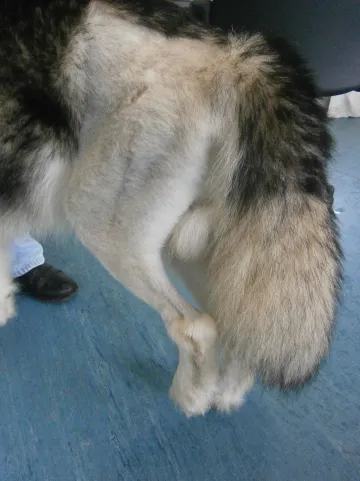
Musculoskeletal: Most people consider this as ‘traditional physiotherapy’. The conditions seen can be split into soft-tissue injuries, such as sprains/strains or ruptures of ligament, tendon or muscle; bursitis and bone or joint injuries, such as fractures (Figure 1.1) or joint disease, such as OCD. The injuries may be a result of either a traumatic event or overuse, where the owner cannot recall the specific onset of symptoms.
Figure 1.1Post fracture. This picture shows an Alaskan Malamute following a femoral fracture after being kicked by a horse. The main aims of physiotherapy for this dog are to improve its weight bearing on the leg and increase its muscle mass/strength.
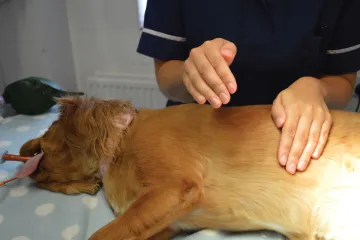
Respiratory: This is the acute care of animals in hospital; it could be post-anaesthetic recovery or ventilated animals. Physiotherapy is aimed to manage secretions, prevent pressure sores, prevent atelectasis, reduce the work of breathing and optimise the ventilation/perfusion ratio to ensure high oxygen saturation levels. These aims are achieved using positioning (for pressure relief, postural drainage or to influence ventilation/perfusion ratio within the lungs), manual techniques such as percussion (Figure 1.2) or vibrations to remove secretions, neuromuscular techniques such as rib springing to increase lung capacity and manual hyperinflation or bagging to improve ventilation and aid secretion removal.
Figure 1.2Respiratory physiotherapy. Following anaesthesia any animals requiring ventilation have the potential to develop retained secretions. Ventilated animals will also be sedated and therefore not move around, which can cause secretions to pool in the lungs and need removal.
Orthopaedics: Physiotherapy following surgery is used to maximise the success of surgery. By working with the surgeon, the recovery can be optimised. Orthopaedic surgeons may have their own protocols for rehabilitation following surgery and knowledge of these protocols is needed by the owner and therapist before embarking on a rehabilitation programme. These protocols guide the therapist on how much weight can be put through the leg and when different exercises can be introduced.
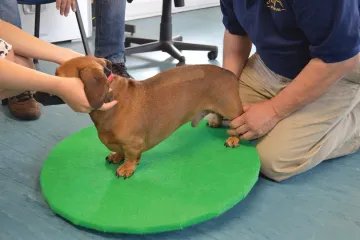
Neurological: Neurological physiotherapy is the rehabilitation of the animal following neurological injury, which can involve single limb or whole body. Neurological damage can be managed conservatively or surgically and may completely resolve or can leave lasting damage. The amount of initial damage usually has a significant impact on the amount of recovery that can be achieved. Long-term solutions to permanent damage sometimes have to be sought, such as wheels, harnesses or splints, to support the animal's everyday activities (Figure 1.3).
Figure 1.3Neurological physiotherapy. After a neurological event, physiotherapy can aid recovery by providing sensory input and re-education of normal movement.
Sports medicine: The preparation of an animal for athletic activity is extremely important requiring physical training, skill training and cardiovascular training. Physiotherapy can help guide owners on appropriate conditioning programmes for certain sports and specific to the animal being trained. Different sports will place very different demands on a dog, for example, the endurance capability of a sled dog opposed to the speed of a racing greyhound.
The rehabilitation of sports injuries is also extremely important as often these animals are not lame but subtle changes in muscle tightness can affect their performance.
Elderly care/geriatrics: As pets (and owners) are living longer now, there is a high population of arthritic animals seen in clinics; they can often have other co-morbidities such as diabetes that can complicate the rehabilitation process. The provision of a holistic approach to managing these animals, using tools such as Aim OA (http://aimoasys.com/why-aim-oa/) will mean they can stay comfortable and functional for longer. The AIM OA website is available for veterinary practices to help provide holistic care for the elderly and arthritic animals. It uses a management strategy encompassing pain relief, exercises, diet and environmental factors.
Developmental problems: A large number of young animals are seen with genetic/developmental problems, and they benefit greatly from physiotherapy to support their joints. Conditions such as hip and elbow dysplasia are often seen. Physiotherapy can improve their quality of life and prevent further problems or surgeries such as total hip replacements.
The benefits of physiotherapy
Physiotherapy can be of benefit to all animals; however, the choice of treatment can be limited by any concurrent disease or illness. The behaviour of an animal, the level of understanding of the owner and their emotions can all influence the success of physiotherapy. For example, a nervous owner will unsettle the animal causing it to become tense which can adversely affect the examination and subsequent treatment session. The objective of physiotherapy is for the animal and the owner to be par...
Table of contents
Cover
Title Page
Copyright
Table of Contents
About the authors
Preface
Acknowledgements
About the companion website
Chapter 1: Introduction
Chapter 2: Anatomy: structure and function of the musculoskeletal system
Chapter 3: Healing
Chapter 4: Clinical examination
Chapter 5: Modalities
Chapter 6: Manual therapies
Chapter 7: Common neurological conditions and their rehabilitation
Chapter 8: Therapeutic exercise
Chapter 9: Splints, supports and aids
Chapter 10: Pain
Chapter 11: Treatment protocols
Chapter 12: Setting up a physiotherapy clinic
Appendix 1: Nomenclature
Appendix 2: Regenerative medicine
Appendix 3: Further reading
Appendix 4: Useful websites for aids and equipment
Index
End User License Agreement
Trusted by 375,005 students
Access to over 1.5 million titles for a fair monthly price.
Study more efficiently using our study tools.
Frequently asked questions
Yes, you can cancel anytime from the Subscription tab in your account settings on the Perlego website. Your subscription will stay active until the end of your current billing period. Learn how to cancel your subscription
No, books cannot be downloaded as external files, such as PDFs, for use outside of Perlego. However, you can download books within the Perlego app for offline reading on mobile or tablet. Learn how to download books offline
Perlego offers two plans: Essential and Complete
Essential is ideal for learners and professionals who enjoy exploring a wide range of subjects. Access the Essential Library with 800,000+ trusted titles and best-sellers across business, personal growth, and the humanities. Includes unlimited reading time and Standard Read Aloud voice.
Complete: Perfect for advanced learners and researchers needing full, unrestricted access. Unlock 1.5M+ books across hundreds of subjects, including academic and specialized titles. The Complete Plan also includes advanced features like Premium Read Aloud and Research Assistant.
Both plans are available with monthly, semester, or annual billing cycles.
We are an online textbook subscription service, where you can get access to an entire online library for less than the price of a single book per month. With over 1.5 million books across 990+ topics, we’ve got you covered! Learn about our mission
Look out for the read-aloud symbol on your next book to see if you can listen to it. The read-aloud tool reads text aloud for you, highlighting the text as it is being read. You can pause it, speed it up and slow it down. Learn more about Read Aloud
Yes! You can use the Perlego app on both iOS and Android devices to read anytime, anywhere — even offline. Perfect for commutes or when you’re on the go. Please note we cannot support devices running on iOS 13 and Android 7 or earlier. Learn more about using the app
Yes, you can access Practical Physiotherapy for Small Animal Practice by David Prydie,Isobel Hewitt in PDF and/or ePUB format, as well as other popular books in Medicine & Veterinary Medicine. We have over 1.5 million books available in our catalogue for you to explore.