eBook - ePub
Bovine Medicine
About this book
Thoroughly updated to reflect recent changes in the industry, Bovine Medicine, 3rd Edition, offers practicing large animal veterinarians and veterinary students a comprehensive reference to core aspects of contemporary cattle health and husbandry.
- New edition of a classic text, featuring thoroughly rewritten text, with coverage shifted to the core aspects of everyday cattle practice
- Includes new focus on both applied skills and application of knowledge, along with many more full-colour illustrations than in previous editions
- Represents a toolkit of skills that will support the delivery of contemporary cattle practice
- Presents a seamless integration of information on husbandry, nutrition, and disease
- Written by a wide range of experts from around the world
Frequently asked questions
Yes, you can cancel anytime from the Subscription tab in your account settings on the Perlego website. Your subscription will stay active until the end of your current billing period. Learn how to cancel your subscription.
No, books cannot be downloaded as external files, such as PDFs, for use outside of Perlego. However, you can download books within the Perlego app for offline reading on mobile or tablet. Learn more here.
Perlego offers two plans: Essential and Complete
- Essential is ideal for learners and professionals who enjoy exploring a wide range of subjects. Access the Essential Library with 800,000+ trusted titles and best-sellers across business, personal growth, and the humanities. Includes unlimited reading time and Standard Read Aloud voice.
- Complete: Perfect for advanced learners and researchers needing full, unrestricted access. Unlock 1.4M+ books across hundreds of subjects, including academic and specialized titles. The Complete Plan also includes advanced features like Premium Read Aloud and Research Assistant.
We are an online textbook subscription service, where you can get access to an entire online library for less than the price of a single book per month. With over 1 million books across 1000+ topics, we’ve got you covered! Learn more here.
Look out for the read-aloud symbol on your next book to see if you can listen to it. The read-aloud tool reads text aloud for you, highlighting the text as it is being read. You can pause it, speed it up and slow it down. Learn more here.
Yes! You can use the Perlego app on both iOS or Android devices to read anytime, anywhere — even offline. Perfect for commutes or when you’re on the go.
Please note we cannot support devices running on iOS 13 and Android 7 or earlier. Learn more about using the app.
Yes, you can access Bovine Medicine by Peter Cockcroft in PDF and/or ePUB format, as well as other popular books in Medicine & Veterinary Medicine. We have over one million books available in our catalogue for you to explore.
Information
Section III
Clinical Skills
Chapter 13
Herd Health Investigations in Cattle Practice
Cheryl L. Waldner and John R. Campbell
Learning objectives
- Understand how to define the problem.
- Understand how to investigate the epidemiology and clinical characteristics of the outbreak.
- Be able to evaluate potential risk factors and identify key determinants.
- Be able to develop recommendations for treatment, control and prevention.
- Understand the importance of monitoring the outcomes to assess the effectiveness of the intervention.
Introduction
Managing and dealing with disease outbreaks in cattle herds can be a challenging proposition for the practising veterinarian. The demands of practice often make it difficult for the local practitioner to devote significant time to an outbreak when it occurs. The herd manager may be frustrated and may also be unwilling to invest more finances in a situation that has already had significant losses. The practitioner needs an efficient, systematic approach to outbreaks, in order to maximise the value of their services to the producer and to provide an effective method of dealing with and preventing future losses.
An outbreak is defined as an increase – often sudden – in the observed number of cases of a disease, compared with the expected number for a given place or among a specific group of animals over a particular period of time (MacDonald, 2011). General strategies for managing outbreaks have been presented by several authors (Schwabe et al., 1977; Kahrs, 1978; Blood, 1982; Lessard, 1988; Ribble et al., 1998; Waldner, 2001a; MacDonald, 2011). Others have developed guidelines for investigating specific disease problems and productivity shortfalls (Wikse, 1988; Mickelsen, 1990; Wikse et al., 1992; Ruegg, 1993; Wikse et al., 1992; Sanderson & Christmas, 1997; Waldner, 2001b).
The immediate goal of the practitioner is to take steps to minimise additional herd losses (Ruegg, 1996). After any necessary actions have been taken to address the immediate threat, the next step is to identify the factors that contributed to the development of disease or change in productivity. The practitioner must then determine which of these factors can be controlled by management to reduce further losses and the risk of future outbreaks. These objectives can be achieved by addressing the following questions for each outbreak (W5: what, who, when, where, and why) (Schwabe et al., 1977):
- define the problem – what and how much?
- identify groups for comparison – who, when, and where?
- evaluate potential risk factors and identify key determinants – why ?
- develop recommendations for treatment, control and prevention where appropriate with follow up to assess the effectiveness of the intervention
Define and describe the problem: What? Is it worth investigating? How much?
The first and most critical task early in the investigation is to clearly define the problem (Ribble et al., 1998). The initial complaint could include unexplained mortality; clinical disease (Waldner et al., 1999; Gow et al., 2005); sub-clinical disease; impaired performance and negative trends in productivity (Waldner et al., 2001a, 2001b; Waldner, 2001b); or potential public health concerns related to food safety (Ruegg, 1996; Pritchard et al., 2000) and environmental issues (Waldner et al., 1998).
The development of a case definition is an important step in describing the problem. This case definition is critical when comparing cases with non-cases, to determine the importance of potential risk factors for disease. This definition will be re-evaluated and refined as more information become available. The case definition can be very sensitive (identifying all possible cases), such as ‘calves with diarrhoea that require treatment’, or it can be more specific and detailed (identifying cases only associated with the outbreak), such as ‘calves less than one week old with watery diarrhoea and clinical evidence of dehydration’. Case definitions can also include laboratory verification. A simple, easily recognised and applied definition facilitates the consistent reporting of cases by the herd owner, other farm workers, and cooperating veterinarians....
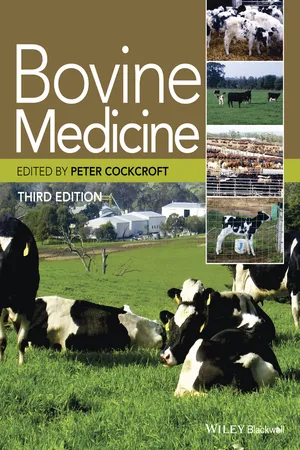
Table of contents
- Cover
- Title Page
- Copyright
- Table of Contents
- Dedication
- Contributors
- Preface
- Section I: Modern Cattle Practice
- Section II: Practice Management and Professional Skills
- Section III: Clinical Skills
- Section IV: Herd Health
- Section V: Dairy Cattle Herd Health
- Section VI: Beef Cattle Herd Health
- Appendix I: Vade Mecum of Cattle Conditions
- Index
- End User License Agreement
