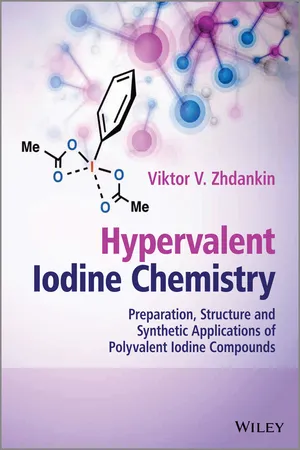
Hypervalent Iodine Chemistry is the first comprehensive text covering all of the main aspects of the chemistry of organic and inorganic polyvalent iodine compounds, including applications in chemical research, medicine, and industry.
Providing a comprehensive overview of the preparation, properties, and synthetic applications of this important class of reagents, the text is presented in the following way:
The introductory chapter provides a historical background and describes the general classification of iodine compounds, nomenclature, hypervalent bonding, structural features, and the principles of reactivity of polyvalent iodine compounds.
Chapter 2 gives a detailed description of the preparative methods and structural features of all known classes of organic and inorganic derivatives of polyvalent iodine.
Chapter 3, the key chapter of the book, deals with the many applications of hypervalent iodine reagents in organic synthesis.
Chapter 4 describes the most recent achievements in hypervalent iodine catalysis.
Chapter 5 deals with recyclable polymer-supported and nonpolymeric hypervalent iodine reagents.
Chapter 6 covers the "green" reactions of hypervalent iodine reagents under solvent-free conditions or in aqueous solutions.
The final chapter provides an overview of the important practical applications of polyvalent iodine compounds in medicine and industry.
This book is aimed at all chemists interested in iodine compounds, including academic and industrial researchers in inorganic, organic, physical, medicinal, and biological chemistry. It will be particularly useful to synthetic organic and inorganic chemists, including graduate and advanced undergraduate students. It comprehensively covers the green chemistry aspects of hypervalent iodine chemistry, making it especially useful for industrial chemists.
Introduction and General Overview of Polyvalent Iodine Compounds
1.1 Introduction
Iodine is a very special element. It is the heaviest non-radioactive element in the Periodic Table classified as a non-metal and it is the largest, the least electronegative and the most polarizable of the halogens. It formally belongs to the main group, p-block elements; however, because of the large atom size, the bonding description in iodine compounds differs from the light main group elements. In particular, the interatomic π-bonding, typical of the compounds of light p-block elements with double and triple bonds, is not observed in the compounds of polyvalent iodine. Instead, a different type of bonding occurs due to the overlap of the 5p orbital on the iodine atom with the appropriate orbitals on the two ligands (L) forming a linear L–I–L bond. Such a three-center-four-electron (3c-4e) bond is commonly referred to as a “hypervalent bond” [1]. The hypervalent bond is highly polarized and is longer and weaker than a regular covalent bond and the presence of hypervalent bonding leads to special structural features and reactivity pattern characteristic of polyvalent iodine compounds. In current literature, synthetically useful derivatives of polyvalent iodine are commonly named as hypervalent iodine reagents. The reactivity pattern of hypervalent iodine in many aspects is similar to the reactivity of transition metals and the reactions of hypervalent iodine reagents are commonly discussed in terms of oxidative addition, ligand exchange, reductive elimination and ligand coupling, which are typical of transition metal chemistry.
Iodine was first isolated from the ash of seaweed by the industrial chemist B. Courtois in 1811 and was named by J. L. Gay Lussac in 1813 [2,3]. Its name derives from the Greek word
(iodes) for violet, reflecting the characteristic lustrous, deep purple color of resublimed crystalline iodine. Various inorganic derivatives of polyvalent iodine in oxidation states of +3, +5 and +7 were prepared as early as the beginning of the nineteenth century. For example, iodine trichloride was first discovered by Gay Lussac as the result of treating warm iodine or iodine monochloride with an excess of chlorine [4]. In the same paper [4], the preparation of potassium iodate by the action of iodine on hot potash lye was described. The inorganic chemistry of polyvalent iodine has been summarized in numerous well-known texts [3, 5–8]. A detailed review on the history of iodine and all aspects of its chemistry and applications commemorating two centuries of iodine research was published in 2011 by Kuepper and coauthors [9].
Most of the world's production of iodine comes from the saltpeter deposits in Chile and natural brines in Japan. In Chile, calcium iodate is found in caliche deposits extracted from open pit mines in the Atacama Desert. Applying an alkaline solution to the caliche yields sodium iodate and iodine is obtained from the sodium iodate by reduction with sulfur dioxide. In Japan, iodine is a by-product of the production of natural gas, which is extracted from brine deposits a mile or two below ground. Iodine is recovered from the brines by one of the following two methods. In the blowout process elemental iodine is liberated as a result of the reaction of chlorine with sodium iodide in the brines. Elemental iodine is blown out of the brine with air and then purified in subsequent reaction steps. The second method, ion exchange, involves recovery of dissolved iodine from oxidized brines using anion-exchange resins packed in columns. In 2010, Chile produced 18 000 metric tons of iodine, compared to Japan's output of 9800 metric tons. Chile has reserves of 9 million metric tons, some 60% of the world's total reserves of iodine [10].
Iodine plays an important role in many biological organisms and is an essential trace element for humans. In the human body, iodine is mainly present in the thyroid gland in the form of thyroxine, a metabolism-regulating hormone. In natural organic compounds, iodine occurs exclusively in the monovalent state. The first polyvalent organic iodine compound, (dichloroiodo)benzene, was prepared by the German chemist C. Willgerodt in 1886 [11]. This was rapidly followed by the preparation of many others, including (diacetoxyiodo)benzene [12] and iodosylbenzene [13] in 1892, 2-iodoxybenzoic acid (IBX) in 1893 [14] and the first examples of diaryliodonium salts reported by C. Hartmann and V. Meyer in 1894 [15]. In 1914 Willgerodt published a comprehensive book describing nearly 500 polyvalent organoiodine compounds known at that time [16].
Research activity in the area of polyvalent organoiodine compounds during the period between 1914 and 1970s was relatively low and represented mainly by valuable contributions from the laboratories of I. Masson, R. B. Sandin, F. M. Beringer, K. H. Pausacker, A. N. Nesmeyanov and O. Neilands. Only three significant reviews were published during this period, most notably the reviews by Sandin [17] and Banks [18] published in Chemical Reviews in 1943 and 1966, respectively and a comprehensive tabulation of the physical properties of polyvalent iodine compounds published in 1956 by Beringer [19].
Since the early 1980s interest in polyvalent organoiodine compounds has experienced a renaissance. This resurgence of interest in multivalent organic iodine has been caused by the discovery of several new classes of polyvalent organoiodine compounds and, most notably, by the development of useful synthetic applications of some of these compounds, which are now regarded as valuable organic reagents known under the general name of hypervalent iodine reagents. The foundation of modern hypervalent iodine chemistry was laid in the 1980s by the groundbreaking works of G. F. Koser, J. C. Martin, R. M. Moriarty, P. J. Stang, A. Varvoglis and N. S. Zefirov.
Important contributions to the development of hypervalent iodine chemistry in the 1990s were made by the research groups of A. Varvoglis, N. S. Zefirov, L. M. Yagupolskii, A. R. Katritzky, R. A. Moss, J. C. Martin, D...
Table of contents
Cover
Title Page
Copyright
Preface
Chapter 1: Introduction and General Overview of Polyvalent Iodine Compounds
Chapter 2: Preparation, Structure and Properties of Polyvalent Iodine Compounds
Chapter 3: Hypervalent Iodine Reagents in Organic Synthesis
Chapter 4: Hypervalent Iodine Catalysis
Chapter 5: Recyclable Hypervalent Iodine Reagents
Chapter 6: Reactions of Hypervalent Iodine Reagents in Green Solvents and under Solvent-Free Conditions
Chapter 7: Practical Applications of Polyvalent Iodine Compounds
Index
Trusted by 375,005 students
Access to over 1.5 million titles for a fair monthly price.
Study more efficiently using our study tools.
Frequently asked questions
Yes, you can cancel anytime from the Subscription tab in your account settings on the Perlego website. Your subscription will stay active until the end of your current billing period. Learn how to cancel your subscription
No, books cannot be downloaded as external files, such as PDFs, for use outside of Perlego. However, you can download books within the Perlego app for offline reading on mobile or tablet. Learn how to download books offline
Perlego offers two plans: Essential and Complete
Essential is ideal for learners and professionals who enjoy exploring a wide range of subjects. Access the Essential Library with 800,000+ trusted titles and best-sellers across business, personal growth, and the humanities. Includes unlimited reading time and Standard Read Aloud voice.
Complete: Perfect for advanced learners and researchers needing full, unrestricted access. Unlock 1.5M+ books across hundreds of subjects, including academic and specialized titles. The Complete Plan also includes advanced features like Premium Read Aloud and Research Assistant.
Both plans are available with monthly, semester, or annual billing cycles.
We are an online textbook subscription service, where you can get access to an entire online library for less than the price of a single book per month. With over 1.5 million books across 990+ topics, we’ve got you covered! Learn about our mission
Look out for the read-aloud symbol on your next book to see if you can listen to it. The read-aloud tool reads text aloud for you, highlighting the text as it is being read. You can pause it, speed it up and slow it down. Learn more about Read Aloud
Yes! You can use the Perlego app on both iOS and Android devices to read anytime, anywhere — even offline. Perfect for commutes or when you’re on the go. Please note we cannot support devices running on iOS 13 and Android 7 or earlier. Learn more about using the app
Yes, you can access Hypervalent Iodine Chemistry by Viktor V. Zhdankin in PDF and/or ePUB format, as well as other popular books in Scienze fisiche & Chimica organica. We have over 1.5 million books available in our catalogue for you to explore.