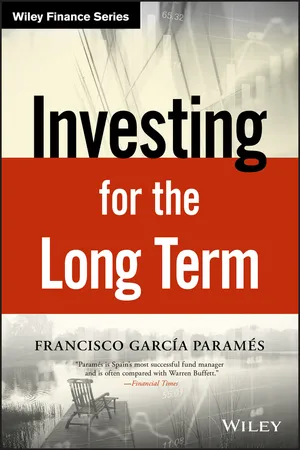
Investing for the Long Term
eBook - ePub

Investing for the Long Term

  1. English
  2. ePUB (mobile friendly)
  3. Available on iOS & Android
eBook - ePub

Investing for the Long Term

About this book

Make the smartest choices you can with this must-have read for investors by one of the world's legendary value investors

World-renowned investor Francisco Garcƭa ParamƩs shares his advice and tips on making smart investments in this must-have book for those looking to make smarter choices for their portfolio. Investing for the Long Term is divided in two parts. The first is formed by three chapters covering Francisco's education and first steps, his initial experience as an investor working alone, and the team work after 2003. This riveting section covers the end of the biggest bull market of the 20th century and the technological and financial crashes of 2000 and 2008. How the team dealt with all that is an interesting personal account that can help you deal with similar situations, should they occur.

The second part of the book covers the cornerstones of Francisco's philosophy. It starts with a chapter in Austrian economics, in his view the only sensible approach to economics, which has helped him enormously over the years. It follows with an explanation of why one has to invest in real assets, and specifically in shares, to maintain the purchasing power of ones savings, avoiding paper money (fixed income) at all costs. The rest of the book shows how to invest in shares.

  • Discover the amazing investing principles of one of the most successfully fund managers in the world
  • Examine how one man and his company weathered the two of modern times' biggest economic crashes
  • Learn how to safely invest your savings

Value investing and effective stock-picking underlie some of the world's most successful investment strategies, which is why Investing for the Long Term is a must-have read for all investors, young and old, who wish to improve their stock selection abilities.

Frequently asked questions

Yes, you can cancel anytime from the Subscription tab in your account settings on the Perlego website. Your subscription will stay active until the end of your current billing period. Learn how to cancel your subscription.
No, books cannot be downloaded as external files, such as PDFs, for use outside of Perlego. However, you can download books within the Perlego app for offline reading on mobile or tablet. Learn more here.
Perlego offers two plans: Essential and Complete
  • Essential is ideal for learners and professionals who enjoy exploring a wide range of subjects. Access the Essential Library with 800,000+ trusted titles and best-sellers across business, personal growth, and the humanities. Includes unlimited reading time and Standard Read Aloud voice.
  • Complete: Perfect for advanced learners and researchers needing full, unrestricted access. Unlock 1.4M+ books across hundreds of subjects, including academic and specialized titles. The Complete Plan also includes advanced features like Premium Read Aloud and Research Assistant.
Both plans are available with monthly, semester, or annual billing cycles.
We are an online textbook subscription service, where you can get access to an entire online library for less than the price of a single book per month. With over 1 million books across 1000+ topics, we’ve got you covered! Learn more here.
Look out for the read-aloud symbol on your next book to see if you can listen to it. The read-aloud tool reads text aloud for you, highlighting the text as it is being read. You can pause it, speed it up and slow it down. Learn more here.
Yes! You can use the Perlego app on both iOS or Android devices to read anytime, anywhere — even offline. Perfect for commutes or when you’re on the go.
Please note we cannot support devices running on iOS 13 and Android 7 or earlier. Learn more about using the app.
Yes, you can access Investing for the Long Term by Francisco Parames in PDF and/or ePUB format, as well as other popular books in Business & Finance. We have over one million books available in our catalogue for you to explore.

Information

Publisher
Wiley
Year
2018
Print ISBN
9781119431190
eBook ISBN
9781119431206
Edition
1
Subtopic
Finance

PART One
The Backstory

CHAPTER 1
A Bit About My Early Years

I will start at the beginning, resisting the temptation to spare my own blushes. I feel it would not be natural to share my experience as an investor without first revealing a little about myself. There won't be any major surprises, but I think it is the natural order of things. I feel this is the way to do it.

ORIGINS

I grew up in an average and pretty normal family. My father was a naval engineer, a civil servant. He retired as Director of Maritime Industries in the Ministry of Industry, after having confronted the once famous ā€˜naval restructuring’ of the 1980s and being Professor of Projects in the Naval Engineering School. My mother was a housewife, mother of five children and an excellent cook. I cannot clearly recall them wanting to impart great life lessons to me; perhaps they tried, but I proved not at all receptive and confounded their best intentions. My introverted personality inhibited such ā€˜important’ conversations.
Even so, when I look at how I approach life, with the benefit of time, I do see some important traits that I inherited from them. For example, I have this inexplicable belief in the need to do the right thing. My father ā€˜did the right thing’ regardless of the circumstances and, without a shadow of a doubt, I share the same conviction. Likewise, these days I find the need to pass on my mother's folk wisdom to my own children, even though I used to laugh about it. Clearly this comes from them, whether genetically or by imitating their behaviour, which was always exemplary. Either way, they live on in me.
My childhood studies were normal. I always passed on time, with the exception of the university entrance exams, which I passed at the second time of trying. My grades were never exceptional because, except for occasional periods, no particular topic appealed to me. Gym was the class that I liked the most during this period, meanwhile physics was always totally incomprehensible. Recently I had another go, reading Richard Feynman, Physics Nobel Prize winner, but with no success.
Perhaps my aversion to physics was a premonition. One of the gravest errors of a cross-section of economic theory – as we will see – is applying natural science techniques, specifically physics, to social sciences, including economics, treating human behaviour as if it were an equation to be solved.
Overall, mine was a childhood without upheaval or apparent trauma, and not a hint of a financial whizz-kid, wheeling and dealing with my classmates. Nothing remarkable, like any other life.
However, when I turned 16 I developed a love of reading, which has gone on to become a core personality trait and a key constant in my life. Nowadays, when I see my 13-year-old son compulsively reading 500-page books, it surprises me how little I read at that age. Until 16 I didn't read books, because it wasn't part of my lifestyle, although I did at least read my father's newspaper nearly every day, and this helped me to stay informed about what was going on in the world.
In terms of global issues, I was especially interested in the existence of the Berlin Wall, which prevented people from leaving their country. I was astonished that people were prepared to die to change sides of the wall. It was then that I started to understand how freely organised markets are more effective at satisfying the needs of the masses, including the worse off. I sensed that what was happening on the other side of the wall was not pleasant, and it was incomprehensible to me how the intellectual world was not more critical of the wall and all it stood for in the face of such clear evidence. Later on I understood why; Aron, von Mises, and other thinkers cleared it up for me.
I became hooked on reading through the son of one of my father's friends. One night he spoke to me about how books represented a limitless world where it was possible to dis...

Table of contents

  1. Cover
  2. Table of Contents
  3. Foreword
  4. Introduction
  5. PART One: The Backstory
  6. PART Two: Theory: The Underpinnings of Investment
  7. Conclusions and Future
  8. APPENDIX I: 26 Small Ideas and One Guiding Principle
  9. APPENDIX II: Reading Material and Wealth Creation
  10. References
  11. Further Reading
  12. Index
  13. End User License Agreement