Internet of Things and Data Analytics Handbook
eBook - ePub

Internet of Things and Data Analytics Handbook

  1. English
  2. ePUB (mobile friendly)
  3. Available on iOS & Android
eBook - ePub

Internet of Things and Data Analytics Handbook

About this book

This book examines theInternet of Things (IoT) andData Analytics from atechnical, application, and business point of view.

Internet of Things and Data Analytics Handbook describes essential technical knowledge, building blocks, processes, design principles, implementation, and marketing for IoT projects.It providesreaders with knowledge in planning, designing, and implementing IoT projects. The book is written by experts on the subject matter, including international experts from nine countries in the consumer and enterprise fields of IoT.The text starts with an overview and anatomy of IoT, ecosystem of IoT, communication protocols, networking, and available hardware, both present and future applications and transformations, and business models. The text also addresses big data analytics, machine learning, cloud computing, and consideration of sustainability that are essential to be both socially responsible and successful. Design and implementation processes are illustrated with best practices and case studies in action. In addition, the book:

  • Examines cloud computing, data analytics, and sustainability and how they relate to IoT
  • overs the scope of consumer, government, and enterprise applications
  • Includes best practices, business model, and real-world case studies
Hwaiyu Geng, P.E., is a consultant with Amica Research ( www.AmicaResearch.org, Palo Alto, California), promoting green planning, design, and construction projects. He has had over 40 years of manufacturing and management experience, working with Westinghouse, Applied Materials, Hewlett Packard, and Intel on multi-million high-tech projects. He has written and presented numerous technical papers at international conferences. Mr. Geng, a patent holder, is also the editor/author of Data Center Handbook (Wiley, 2015).

Frequently asked questions

Yes, you can cancel anytime from the Subscription tab in your account settings on the Perlego website. Your subscription will stay active until the end of your current billing period. Learn how to cancel your subscription.
No, books cannot be downloaded as external files, such as PDFs, for use outside of Perlego. However, you can download books within the Perlego app for offline reading on mobile or tablet. Learn more here.
Perlego offers two plans: Essential and Complete
  • Essential is ideal for learners and professionals who enjoy exploring a wide range of subjects. Access the Essential Library with 800,000+ trusted titles and best-sellers across business, personal growth, and the humanities. Includes unlimited reading time and Standard Read Aloud voice.
  • Complete: Perfect for advanced learners and researchers needing full, unrestricted access. Unlock 1.4M+ books across hundreds of subjects, including academic and specialized titles. The Complete Plan also includes advanced features like Premium Read Aloud and Research Assistant.
Both plans are available with monthly, semester, or annual billing cycles.
We are an online textbook subscription service, where you can get access to an entire online library for less than the price of a single book per month. With over 1 million books across 1000+ topics, we’ve got you covered! Learn more here.
Look out for the read-aloud symbol on your next book to see if you can listen to it. The read-aloud tool reads text aloud for you, highlighting the text as it is being read. You can pause it, speed it up and slow it down. Learn more here.
Yes! You can use the Perlego app on both iOS or Android devices to read anytime, anywhere — even offline. Perfect for commutes or when you’re on the go.
Please note we cannot support devices running on iOS 13 and Android 7 or earlier. Learn more about using the app.
Yes, you can access Internet of Things and Data Analytics Handbook by Hwaiyu Geng in PDF and/or ePUB format, as well as other popular books in Technology & Engineering & Electrical Engineering & Telecommunications. We have over one million books available in our catalogue for you to explore.

PART I
INTERNET OF THINGS

1
INTERNET OF THINGS AND DATA ANALYTICS IN THE CLOUD WITH INNOVATION AND SUSTAINABILITY

HWAIYU GENG
Amica Research, Palo Alto, CA, USA

1.1 INTRODUCTION

In January 2016, the US NASA’s Global Climate Change reported [1]: “Earth’s 2015 surface temperatures were the warmest since modern record keeping began in 1880, according to independent analyses by the National Aeronautics and Space Administration (NASA) and the National Oceanic and Atmospheric Administration (NOAA).”
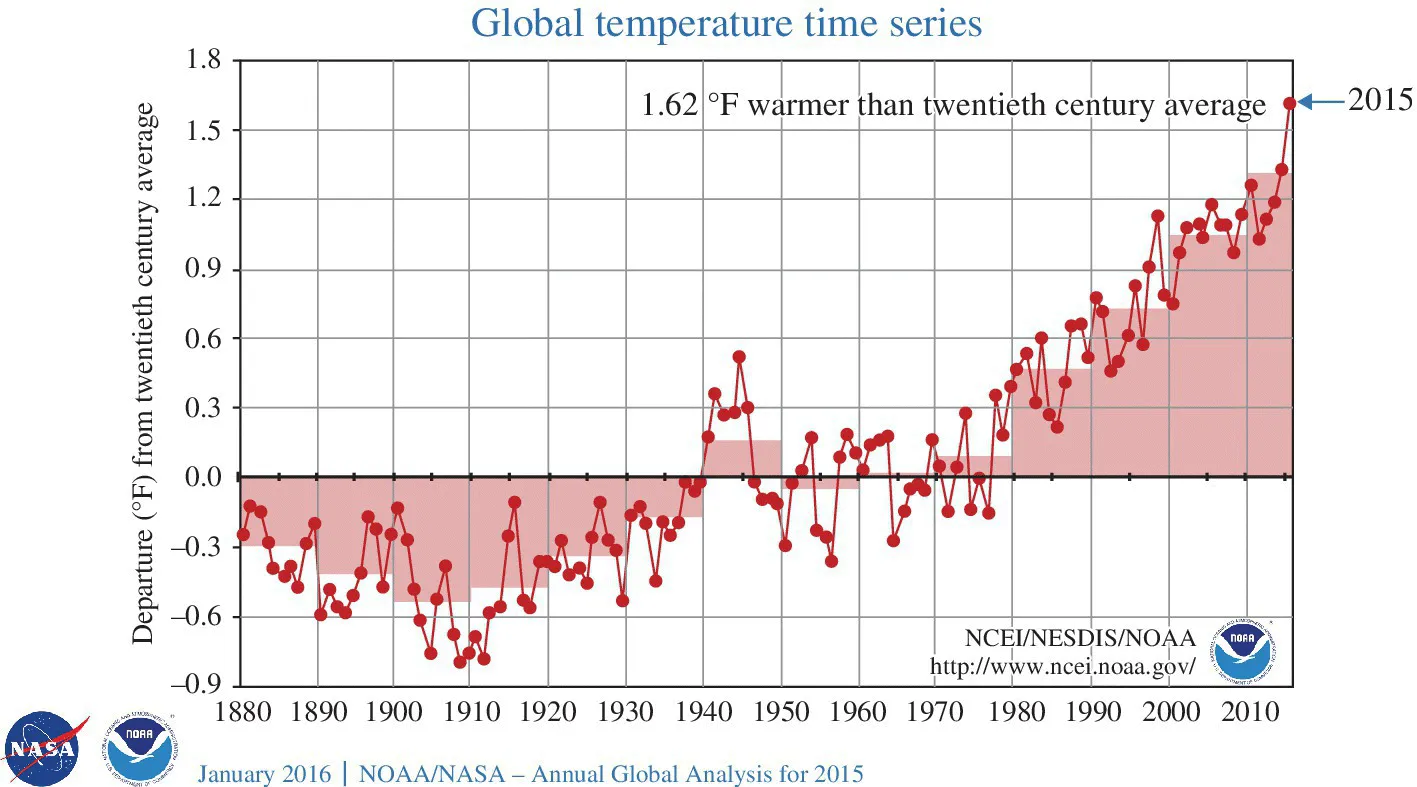
The planet’s average surface temperature has risen about 1.8°F (1.0°C) since the late 19th century, a change largely driven by increased carbon dioxide and other human‐made emissions into the atmosphere (Figure 1.1).
Graph of year vs. departure from twentieth century average illustrating wave plots with markers and an arrow depicting planet Earth’s warmest year (2015) since modern record keeping began in 1880.
FIGURE 1.1 2015 was planet Earth’s warmest year since modern record keeping began in 1880, according to a new analysis by NASA’s Goddard Institute for Space Studies.
Source: NASA and NOAA.
Note: NASA’s data showed that each month in first half of 2016 was the warmest respective month globally in the modern temperature record.
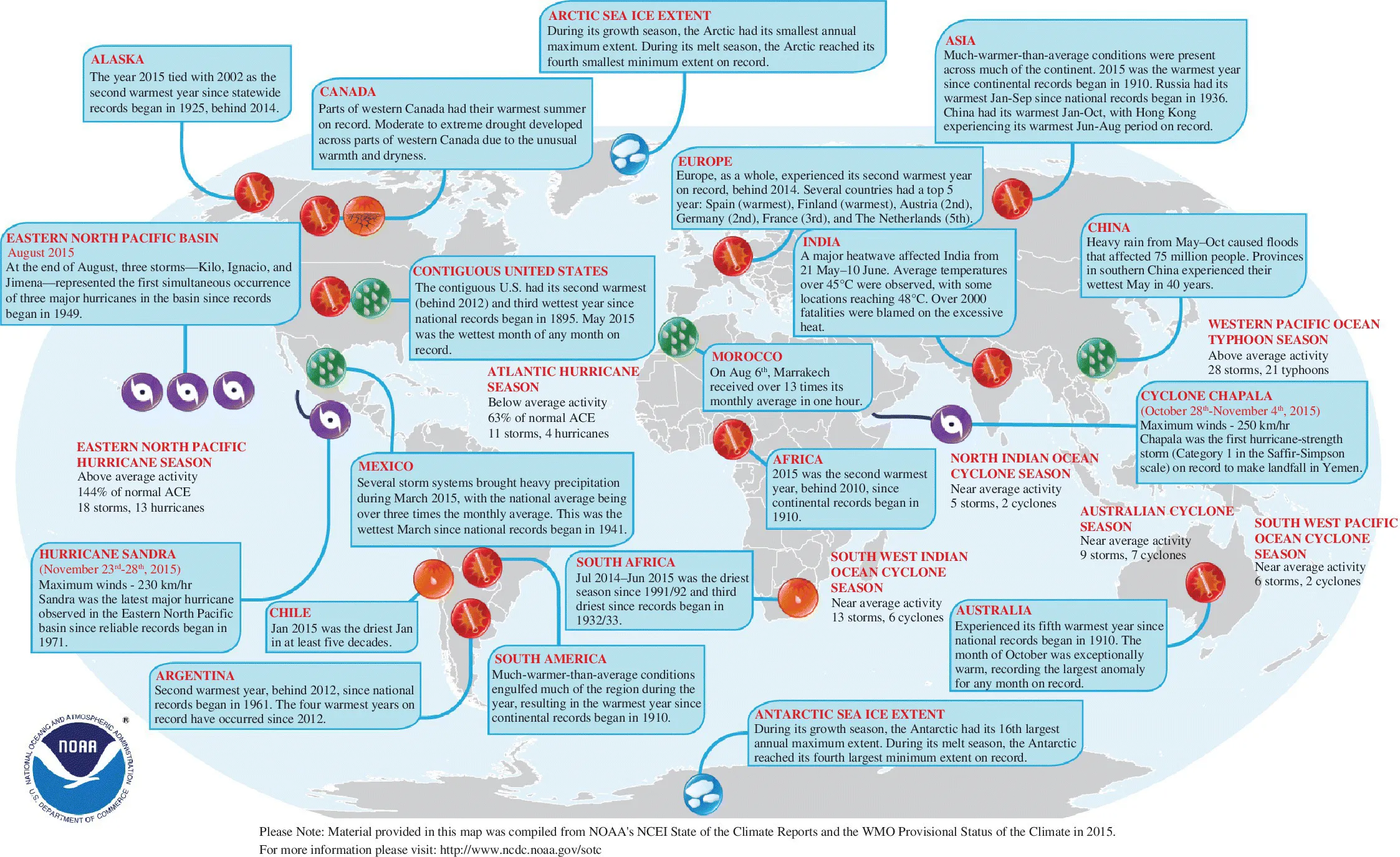
The World Bank issued a report in 2012 [2] describing what the world would be like if it warmed by 4°C (7.2°F): “The 4°C world scenarios are devastation: the inundation of coastal cities, increasing risks of food production potentially leading to higher malnutrition rates; many dry regions becoming dryer, wet regions wetter, unprecedented heat waves in many regions, especially in the tropical substantially exacerbated water scarcity in many region, increase frequency of high‐intensity tropical cyclones and irreversible loss of biodiversity, including coral reef system.” Figure 1.2 shows significant climate anomalies and events in 2015 by major regions or countries. Significant temperature increases and global warming are caused by CO2 greenhouse effect .
World map illustrating significant climate anomalies and events in 2015 by major regions or countries such as Alaska, Canada, Asia, China, India, Morocco, Africa, Mexico, Chile, and Argentina.
FIGURE 1.2 Selected significant climate anomalies and events in 2015.
Source: NOAA.
Researchers have proven that increasing greenhouse gases (GHGs) and global warming are due to human activities. Human beings generate all kinds of heat from homes, transportations, manufacturing, and data centers that host daunting Internet‐related activities [4].

1.2 THE IoT AND THE FOURTH INDUSTRIAL REVOLUTION

The first Industrial Revolution (IR) started in Britain around late eighteenth century when steam power and water power transferred manual labor from homes to powered textile machines in factories. The second IR came in the early twentieth century when internal combustion engines and electrical power generation were invented that led to mass production of T‐Model cars by Ford Motor Company. The first two IRs contributed to the higher living standards for mankind. The third IR took place in 1990s when electronics, personal computers, and information technology were used in the automated production systems. Along with technological advancements, the IRs introduced air and water pollution as well as global warming.
The Internet of Things (IoTs) and data analytics are the most significant emerging technologies in recent years that have a disruptive and transformational effect to every industry around the world. The IoT is a technology digitizing the physical world [5]. The IoT is a prominent driver to the fourth IR that will have impacts across the business and industry continuum around the world. Business executives and informed citizens are positively anticipating of the fourth IR and digital revolution with low impacts on employment [6].
Applying it into the realm of our lives opens up a host of new opportunities and challenges for consumers, enterprises, and governments. IoT products and digital services enable improvements in productivity and time to market and create thousands of businesses and millions of jobs. Our living standard is improved but at a cost of higher energy consumption that directly impacts our environment. The IoT technology will revolutionize our life and must be implemented with considerations of our quality of life and sustainability.

1.3 INTERNET OF THINGS TECHNOLOGY

The IoT has been successfully adopted in many commercial applications. Wearables and cell phones offer tracking on personalized data such as daily steps, heart rate, calorie burned that result in improving one’s health and fitness. Nest, best known as a smart thermostat with machine learning algorithm, centers on the IoT by controlling home temperature through a smartphone from afar [7]. Nest’s security system allows you to monitor your home 24/7 through handheld devices. The US Intelligent Transportation Systems (ITS) [8] and connected vehicles improve transportation safety and traffic control. Long‐Term Evolution (LTE), or 4G LTE, advises drivers on traffic patterns to avoid jams and reduce fuel consumption that also reduces GHGs.
“The emergence of the Nexus of Forces (mobile, social, cloud, and information) and digital business” are driving forces of “Megatrends” according to Gartner’s researches. The megatrends include IoT, smart machines and mobility, digital business, digital workplace and digital marketing, cloud, and big data and analytics [9].
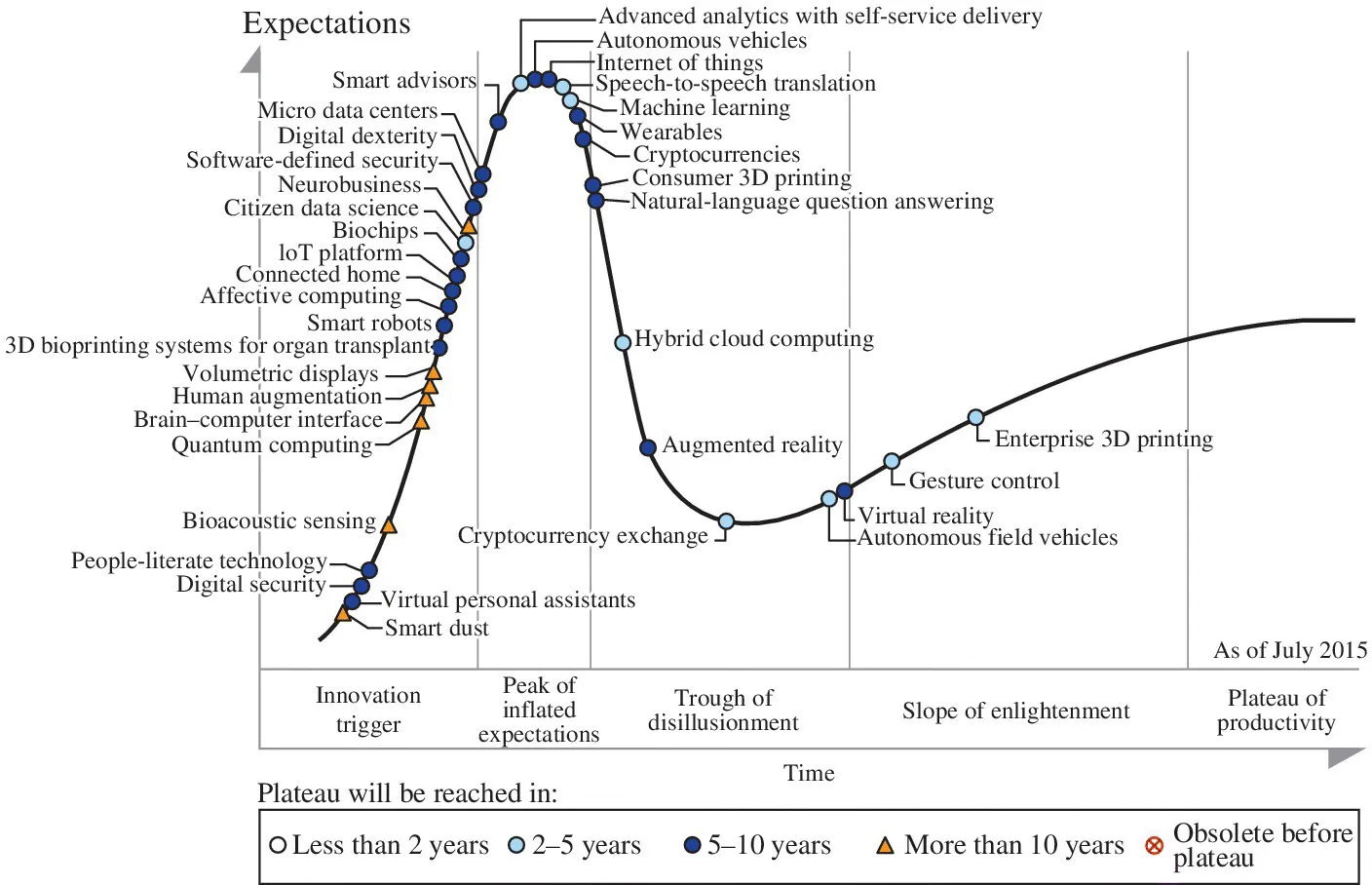
There are hype and reality (Figure 1.3) with many unexplored opportunities that could apply the IoT technology and reduce GHGs. Examples include: (1) using 3D printing to build needed products just‐in‐time without inventory and with minimal transportation [10]; (2) connected homes that apply the IoT to monitor and control heating and cooling of a house, lighting, entertainment, security, and turn‐on appliances when electricity rate is low. Amazon is anticipated to use drones to deliver packages that operate with clean battery power that will reduce CO2 emission. In data centers, hundreds of temperature sensors are deployed and connected wirelessly to monitor and improve cooling efficiency, thus reducing energy consumption [4]. Wireless sensor networks are installed for structural health monitoring (SHM) that consumes minimal energy during data collection [11].
Hype cycle for emerging technologies as of July 2015 illustrating a wave plot with markers depicting 2–5 years, 5–10 years, more than 10 years, and obsolete before plateau.
FIGURE 1.3 Hype cycle for emerging technologies, 2015.
Source: Gartner (August 2015).
In 2015 United Nations Climate Change Conference held in Paris, there is one word you won’t find in the negotiating documents: military. Although there are no official figures on the amount of GHGs generated from wars, the temperature curve in Figure 1.1 reflects a spike in 1940s when the World War II and explosion of atomic bombs took place. It is needless to say operating armored vehicles, bombers, battleships, and bombings in military actions generate enormous heat and emission that are unwarrantedly creating heat to our environment. We have long been taught to help each other, share, keep our hands to ourselves, and work things out. War is an unacceptable behavior that is contradictory to what we have been teaching to our future generations. It creates GHGs that are harmful to our environment.

1.3.1 Definition of IoT/CPS

The term “Internet of Things,” also known as “cyber–physical systems (CPS),” a...

Table of contents

  1. COVER
  2. TITLE PAGE
  3. TABLE OF CONTENTS
  4. LIST OF CONTRIBUTORS
  5. FOREWORD
  6. TECHNICAL ADVISORY BOARD MEMBERS
  7. PREFACE
  8. ACKNOWLEDGMENTS
  9. ABOUT THE COMPANION WEBSITE
  10. PART I: INTERNET OF THINGS
  11. PART II: INTERNET OF THINGS TECHNOLOGIES
  12. PART III: DATA ANALYTICS TECHNOLOGIES
  13. PART IV: SMART EVERYTHING
  14. PART V: IoT/DATA ANALYTICS CASE STUDIES
  15. PART VI: CLOUD, LEGAL, INNOVATION, AND BUSINESS MODELS
  16. INDEX
  17. END USER LICENSE AGREEMENT