Stories for Work
eBook - ePub

Stories for Work

The Essential Guide to Business Storytelling

  1. English
  2. ePUB (mobile friendly)
  3. Available on iOS & Android
eBook - ePub

Stories for Work

The Essential Guide to Business Storytelling

About this book

Learn the science and master the art of telling a great story

Stories for Work walks you through the science of storytelling, revealing the secrets behind great storytellers and showing you how to master the art of storytelling in business. Stories hold a unique place in our psyche, and the right story at the right time can be a game-changer in business; whether tragedy, triumph, tension or transition, a good story can captivate the listener and help you achieve your goals. In this book, author Gabrielle Dolan draws from a decade of training business leaders in storytelling to show you what works, why it works, when it works best and what never works. You'll learn how to create your own stories — authentically yours, crafted to attain your goal — and develop an instinct for sharing when the time is right. In-depth case studies feature real-world people in real-world businesses, showing how storytelling has changed the way they work, motivate and lead — providing clear examples of the power of this enormously effective skill.

Storytelling gives you an edge. Whether you're after a promotion, a difficult client, a big sale or leading through transition, a great story can help you smooth the road and seal the deal. This book is your personal coach for masterful storytelling, with expert guidance and lessons learned from real-world business leaders.

  • Learn why storytelling grabs attention and helps your message get through
  • Master the four types of stories used in business settings
  • Infuse your stories with the personal to highlight your vision and values
  • Craft a selection of stories to pull out at pivotal business moments

The oral tradition has ancient roots that unite all humans, and despite our myriad modern distractions, we still respond to a well-told story. Stories for Work helps you put this dynamic to work for you in any business scenario.

Frequently asked questions

Yes, you can cancel anytime from the Subscription tab in your account settings on the Perlego website. Your subscription will stay active until the end of your current billing period. Learn how to cancel your subscription.
No, books cannot be downloaded as external files, such as PDFs, for use outside of Perlego. However, you can download books within the Perlego app for offline reading on mobile or tablet. Learn more here.
Perlego offers two plans: Essential and Complete
  • Essential is ideal for learners and professionals who enjoy exploring a wide range of subjects. Access the Essential Library with 800,000+ trusted titles and best-sellers across business, personal growth, and the humanities. Includes unlimited reading time and Standard Read Aloud voice.
  • Complete: Perfect for advanced learners and researchers needing full, unrestricted access. Unlock 1.4M+ books across hundreds of subjects, including academic and specialized titles. The Complete Plan also includes advanced features like Premium Read Aloud and Research Assistant.
Both plans are available with monthly, semester, or annual billing cycles.
We are an online textbook subscription service, where you can get access to an entire online library for less than the price of a single book per month. With over 1 million books across 1000+ topics, we’ve got you covered! Learn more here.
Look out for the read-aloud symbol on your next book to see if you can listen to it. The read-aloud tool reads text aloud for you, highlighting the text as it is being read. You can pause it, speed it up and slow it down. Learn more here.
Yes! You can use the Perlego app on both iOS or Android devices to read anytime, anywhere — even offline. Perfect for commutes or when you’re on the go.
Please note we cannot support devices running on iOS 13 and Android 7 or earlier. Learn more about using the app.
Yes, you can access Stories for Work by Gabrielle Dolan in PDF and/or ePUB format, as well as other popular books in Business & Business Communication. We have over one million books available in our catalogue for you to explore.

Information

Publisher
Wiley
Year
2017
Print ISBN
9780730343295
eBook ISBN
9780730343271

Part I
Shaping your stories

Storytelling has been around since the dawn of time and humans have always communicated using stories. Evidence of this is seen from the paintings left behind by our cave-dwelling ancestors to the Aboriginal culture and Dreamtime storytelling, which continues to be passed down generation to generation.
It's only recently, however, that modern business has started to realise the power and potential of this ancient art.
In a world of information overload and short attention spans, business people are looking for a more effective way to get their messages across and to help them stand out from all the ‘noise'. Combine this with an appreciation of being more authentic in the way we lead, and it is no surprise that storytelling has emerged as a powerful tool.
In this part, I take you through exactly why storytelling is so powerful in business, drilling down into the science behind it. I also cover the four main types of stories you will need, and how to find, construct and share your stories.
While the art of storytelling is an ancient form, the applications of storytelling in business are just being discovered.

Chapter 1
The science of storytelling

Sure, you might already be aware that telling a story makes good sense, but it is more than that. It is actually based on good science. In this chapter I take you through this science, explaining how stories build trust and heighten emotions.

The brain behind the story

Our brain has different parts, and each part has a different job. The left side of our brain, for example, helps us think logically and organise our thoughts, while the right side helps us experience emotions and recall personal memories. We also have a ‘reptile brain’ that makes us act instinctively and a ‘mammal brain’ that helps us connect in relationships. And our brains have a neocortex, which is connected to a complex series of nerves and networks called the ‘limbic system’. This is responsible for the development of the bond we feel between ourselves and another (like the mother–child bond).
In his international best-selling book Emotional Intelligence, Daniel Goleman explains that our evolved neocortex is the reason our emotions are so powerful. He says,
“As the root from which the newer brain grew, the emotional areas are intertwined via myriad connecting circuits to all parts of the neocortex. This gives the emotional centres immense power to influence the functioning of the rest of the brain.
When we tell stories all the different parts and areas of our brain are stimulated and start to work together, combining words and logic and emotions and sensory images, so we see the whole picture and communicate our experience. Essentially, with all this activity going on, our emotions go into overdrive.
This means that stories provoke our emotions. Good stories make us feel something as we listen to them — excitement, anger, sadness, empathy or enthusiasm. Consequently, feeling these emotions means we feel something towards the person telling the story, which helps create connection — the bond like the ones our neocortex helps develop.

We love a good story

In the 2014 Harvard Business Review article ‘Why your brain loves good storytelling’, neuroeconomist Paul Zak revealed the powerful impact the love hormone oxytocin has on the brain when we tell stories.
Oxytocin is also often referred to as the ‘trust hormone’. Our bodies release it when we are with people we love and trust, when we hug, or even when we shake hands in a business meeting. And it’s released when we listen to stories. Oxytocin being released signals to the brain that everything is okay and it is safe to approach others — essentially, that we won’t be attacked or eaten, as would have been the risk back in the day.
So not only does a good story make us feel different emotions and a connection to the storyteller but, at the same time, the love hormone oxytocin is also signalling that we can be trusted, which in turn helps build our credibility.

Stories build trust and credibility

Neuroscientist Uri Hasson opened his 2016 TED talk with the following:
“Imagine if we invented a device that could record my memories, my dreams, my ideas and transmit them to your brain. That would be a game-changing technology, right? But, in fact, we already possess this device and it’s called the human communication system and effective storytelling.
Hasson’s research shows that even across different languages, our brains show similar activity when we hear a story, becoming what he calls ‘aligned’ or ‘synchronised’.
In one study, listeners lay in the dark waiting to hear a story spoken out loud. The moment the story started, the auditory cortex of the listeners’ brains, the area that processes sound, became active and aligned. Hassan calls this ‘neural entrainment’.
It was only when the listeners heard the story in a coherent way that alignment started to happen. This did not happen if the story was played backwards, or the words or sentences were scrambled. But the story was still understood in a similar way when it was told in Russian to a group of Russian listeners as it was when told in English to a group of English listeners.
The participants were also shown a clip from the BBC TV series Sherlock. Months later, one participant was asked to tell another about the scene they watched. The results showed that the brain of the person telling the story aligned with the same activity their brain showed when they watched the show some months earlier. Furthermore, the brain of the participant who was listening to the story also aligned in a similar way.
So what does all this prove? Listening to a story being told is effectively like reliving that story as if it were yours. What better way to create common ground and a shared understanding with someone? And this is especially the case if you’re making a presentation to an audience of 1000 strangers or even facilitating a one-on-one coaching session.

Emotions drive our decisions

Just some of the questions running through the minds of our audience when we are talking to them include the following:
  • Do I buy from you?
  • Do I get behind this change?
  • Do I accept the role with you?
  • Do I believe you?
  • Do I take your advice?
  • Do I follow you?
  • Do I respect you?
Our audience will be forming these types of questions whether we’re trying to get them to buy-in to an organisational change or motivating them towards next year’s goals.
Usually, we try to influence them with a PowerPoint presentation of facts and figures or an outline of the pros and cons of whatever it is we want them to feel excited about. These strategies are all based on logic. Yet, science says that we make up our minds to the types of questions I listed based on our emotions and how we feel about something.
Research by neuroscientist Antonio Damasio shows emotion plays a significant role in our ability to make decisions. While many of us believe logic drives our choices, the reality is that we have already made an emotional decision and we then use logic to justify the choice — to ourselves and to others.
Damasio’s research involved examining people with damage to their frontal lobe, which is the area of the brain where emotions are generated and that helps to regulate personality. Except for their inability to feel or express emotions, the participants had normal intellectual capacity in terms of working memory, attention, language comprehension and expression. However, they were unable to make decisions.
The vast majority of participants could describe in logical terms what they thought they should be doing, but they found it difficult to actually make a decision, including making a simple choice like deciding what to eat. This indecision came from them going ...
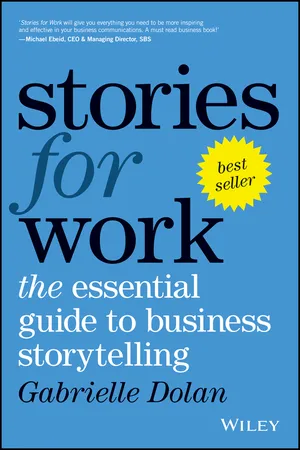
Table of contents

  1. Cover
  2. Epigraph
  3. Title Page
  4. About the author
  5. Acknowledgements
  6. Introduction
  7. Part I: Shaping your stories
  8. Part II: Sharing your stories
  9. Part III: Storytelling case studies
  10. Conclusion
  11. Next steps
  12. Index
  13. Connect and share
  14. EULA