Bridging the gap between the multitude of advanced research articles and the knowledge newcomers to the field are looking for, this is a timely and comprehensive monograph covering the interdisciplinary topic of intramolecular charge transfer (ICT). The book not only covers the fundamentals and physico-chemical background of the ICT process, but also places a special emphasis on the latest experimental and theoretical studies that have been undertaken to understand this process and discusses key technological applications. After outlining the discovery of ICT molecules, the authors go on to discuss several important substance classes. They present the latest techniques for studying the underlying processes and show the interplay between charge transfer and the surrounding medium. Examples taken from nonlinear optics, viscosity and polarity sensors, and organic electronics testify to the vast range of applications. The result is a unique information source for experimentalists as well as theoreticians, from postgraduate students to researchers.
Trusted by 375,005 students
Access to over 1.5 million titles for a fair monthly price.
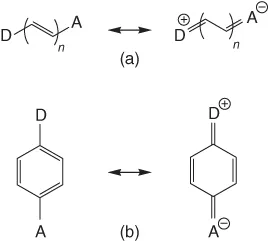
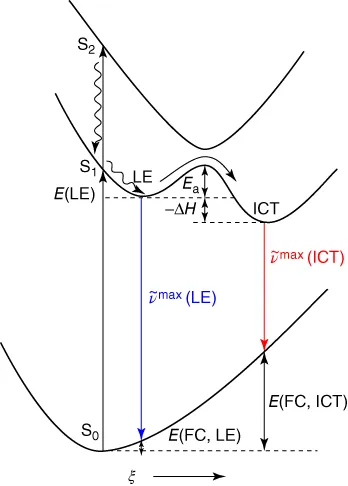
Charge transfer is a fundamental step in many chemical and biological processes, including photosynthesis and metabolism [1–4]. The recent technological applications of charge-transfer–based materials include organic-light-emitting diodes (OLEDs), solar energy conversion, fluorescence sensing, nonlinear optical (NLO) materials, and so on [5–7]. The charge-transfer process may be divided into two broad categories. The transfer of charge from an electron-rich donor moiety to an electron-poor acceptor part located in different molecules is known as intermolecular charge-transfer process. However, if the donor and the acceptor belong to the same molecule, the phenomenon is called intramolecular charge-transfer (ICT) process. The ICT process generally occurs in the photoexcited state which a molecule reaches due to absorption of light of proper wavelength. The photoexcitation facilitates transfer of an electron from one part of a molecule/ion to its other part in the excited state, which makes the charge distribution in the excited state markedly different from that in the ground state. The through-bond ICT occurs in molecules in which the donor and the acceptor groups are connected through a π-electron bridge (Figure 1.1). In some rare cases, an intramolecular through-space charge transfer is observed, where the transfer of charge through the conjugative path is denied but donor and acceptor groups are in a favorable position for charge transfer. Although the intermolecular interaction mediated by through-space charge transfer dictates the properties of many π-stacked molecular systems, studies of intramolecular through-space charge transfer is scarce. In π-conjugated organic molecules comprising electron donor (D) and acceptor (A) subunits, the process has attracted a lot of attention due to their immense technological implications in organic electronics and photovoltaics [5–14]. Materials based on such organic molecules are potential candidates for use in OLEDs, field-effect transistors, dye-sensitized solar cells, to name a few. In this book, our focus is mainly on the excited-state ICT in stable organic molecules as well as in inorganic complexes. A few examples of the electron-transfer process in biomolecules have also been discussed. The signatures of ICT, spectroscopic techniques, and theoretical tools employed to study this process are also mentioned. It is now known that excited-state ICT in organic molecules may give rise to dual emission in its electronic spectrum. The peak seen at the blue end of the emission spectrum is generally believed to be arising from a locally excited (LE) state of the molecule, while the peak at the red end is generally assumed to bear the signature of an ICT species formed in the excited state. The ICT process generally occurs in polar solvents and the Stokes-shifted ICT fluorescence is observed due to solvent stabilization in the excited state [15]. In Figure 1.2, the potential energy surfaces (PES) for the ground state S0 and the first two excited states (S1, S2) have been depicted along with the LE and ICT states. The vertical coordinate represents energy, while the horizontal coordinate (ξ) comprises all molecular changes accompanying the LE → ICT reaction, such as changes in bond lengths and bond angles. In the given example, excitation of the molecule leads it to the S2 state, which relaxes through internal conversion to the equilibrated LE state. The ICT reaction proceeds from the LE to the ICT state that has a reaction barrier Ea and an enthalpy difference of ΔH. Fluorescence from the LE and ICT states reaches the corresponding Franck–Condon states E(FC, LE) and E(FC, ICT). This gives rise to dual fluorescence with emission maxima of
max(LE) and
max(ICT), respectively. Lippert and coworkers reported the dual fluorescence in 4-N,N-dimethylaminobenzonitrile (DMABN) for the first time in 1962 [16]. The debate continued regarding the origin of the dual emission of DMABN for some years. Most of the studies accepted that the observed dual emission from DMABN is due to excited-state ICT from the dimethylamine to the cyano group through the π-electron bridge. Later on, many congeners of DMABN were put under the scanner for deciphering or decoding the nature of the ICT process and its dynamics. Many experimental or theoretical studies or both have been devoted to investigate the charge-transfer mechanism in different organic molecules. The early experimental and theoretical results on the ICT process support a twisted intramolecular charge-transfer state (called TICT state) [16]. In the framework of the TICT model, the dual emission of an ICT probe originates from the primary excited, called LE, state as well as from the ICT state. The ICT state is accessible only by an adiabatic photoreaction from the LE state that includes rotational motion around the bond connecting the donor and acceptor moieties. If there is no energy barrier between the LE and ICT states, the excited-state relaxation can occur extremely rapidly, resulting in emission from the ICT species only. Although the TICT mechanism is till date the most popular concept in describing the structure of the excited state, this model was challenged by several groups. Later on, several other models, like planar intramolecular charge transfer (PICT), rehybridized intramolecular charge transfer (RICT), and wagging intramolecular charge transfer (WICT), were proposed by several groups to explain their experimental results. For example, Domcke and coworkers put forward a RICT model to account for the formation of the ICT state of DMABN and its analogs. Later on, the formation of a charge-transfer state from a rigid molecule, N-phenylpyrrole (PP) and its free analog, fluorazene phenylpyrrole (FPP) put a question mark on the validity of the TICT model. The similarity in spectral signatures of these molecules could not be explained using the TICT model. This led to the proposal of a PICT mechanism to explain the spectroscopic response of the aforesaid molecules. There are several other examples that support the fact that the ICT state of the molecule does not need to be twisted. The origin and drawbacks of some of these models have been described in Chapter 2.
Figure 1.1 The intramolecular charge-transfer processes (a) in a (poly)ene system and (b) in an aromatic donor–acceptor molecule. Donor (D) to acceptor (A) charge transfer occurs in the excited state through the π-electron bridge to form an ICT state of higher dipole moment.
Figure 1.2 Schematic representation of intramolecular charge transfer (ICT) process in a model system. In the given scheme, excitation leads the molecule to the S2 state from which it reaches the S1-LE state through internal conversion. The ICT state is accessible through the S1-LE state. Emission form both the LE and ICT states leads to dual emission from the molecule.
(Druzhinin et al. 2010 [15]. Reproduced with permission of American Chemical Society.)
Another point regarding the formation of the ICT state that is still under intense debate is the pathways of the charge-transfer process, that is, the mechanism through which the ICT process in a molecule occurs. Several high-level calculations and state-of-the-art experimental techniques have been used to settle this issue. In spite of several studies that describe the PES of the ICT process, this issue is yet to be settled amicabl...
Table of contents
Cover
Title Page
Copyright
Table of Contents
Preface
Chapter 1: Introduction
Chapter 2: Brief History of ICT Molecules
Chapter 3: New Theoretical and Experimental Techniques for Studying the ICT Process
Chapter 4: Medium Effect on ICT Process: Theory and Experiments
Chapter 5: Nonlinear Optical Response of ICT Molecules
Chapter 6: Recent Technological Applications of ICT Molecules and Prospect of Designing New Molecules
Chapter 7: Summary and Outlook
Index
End User License Agreement
Frequently asked questions
Yes, you can cancel anytime from the Subscription tab in your account settings on the Perlego website. Your subscription will stay active until the end of your current billing period. Learn how to cancel your subscription
No, books cannot be downloaded as external files, such as PDFs, for use outside of Perlego. However, you can download books within the Perlego app for offline reading on mobile or tablet. Learn how to download books offline
Perlego offers two plans: Essential and Complete
Essential is ideal for learners and professionals who enjoy exploring a wide range of subjects. Access the Essential Library with 800,000+ trusted titles and best-sellers across business, personal growth, and the humanities. Includes unlimited reading time and Standard Read Aloud voice.
Complete: Perfect for advanced learners and researchers needing full, unrestricted access. Unlock 1.5M+ books across hundreds of subjects, including academic and specialized titles. The Complete Plan also includes advanced features like Premium Read Aloud and Research Assistant.
Both plans are available with monthly, semester, or annual billing cycles.
We are an online textbook subscription service, where you can get access to an entire online library for less than the price of a single book per month. With over 1.5 million books across 990+ topics, we’ve got you covered! Learn about our mission
Look out for the read-aloud symbol on your next book to see if you can listen to it. The read-aloud tool reads text aloud for you, highlighting the text as it is being read. You can pause it, speed it up and slow it down. Learn more about Read Aloud
Yes! You can use the Perlego app on both iOS and Android devices to read anytime, anywhere — even offline. Perfect for commutes or when you’re on the go. Please note we cannot support devices running on iOS 13 and Android 7 or earlier. Learn more about using the app
Yes, you can access Intramolecular Charge Transfer by Ramprasad Misra,Shankar P. Bhattacharyya in PDF and/or ePUB format, as well as other popular books in Ciencias físicas & Química física y teórica. We have over 1.5 million books available in our catalogue for you to explore.