- Includes comprehensive coverage of the complex phenomenon of homicide and its various forms
- Features original contributions from an esteemed team of global experts and scholars with chapters highlighting the authors' original research
- Represents the first internationally-focused collection of the latest research on the nature and causes of homicide
- Covers both the causes and dynamics of homicide, as well as policies and practices intended to address it
eBook - ePub
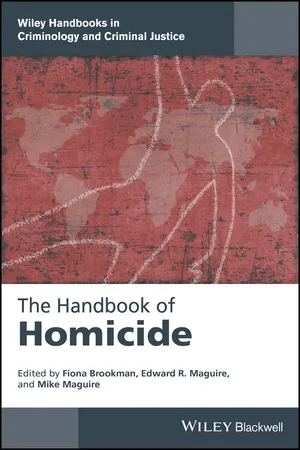
The Handbook of Homicide
- English
- ePUB (mobile friendly)
- Available on iOS & Android
eBook - ePub
The Handbook of Homicide
About this book
The Handbook of Homicide presents a series of original essays by renowned authors from around the world, reflecting the latest scholarship on the nature, causes, and patterns of homicide, as well as policies and practices for its investigation and prevention.
Information
Part I
Homicide in Context
1
Murderous Thoughts: The Macro, Micro, and Momentary in Theorizing the Causes and Consequences of Criminal Homicide
Helen Innes, Sarah Tucker, and Martin Innes
Introduction
“Who shall heal murder? What is done, is done.”Lord Byron, “Cain: A Mystery” (1826: 433)
Our culture is replete with representations of murder as the prototypical crime. For as captured in the above quotation, there is an intrinsic, irrevocable, and irreversible sense of harm involved in the act of one person deliberately killing another. Stories of the causes and consequences of murder provide the basic ingredients for the kind of morality tales that anthropologists suggest are necessary conditions for the production of a sense of collective identity and belonging. Following Mary Douglas (1966), such narratives function as social devices through which “the pure” and “dangerous” are delineated, providing resources for many of the stories that we tell ourselves about ourselves in the ordering of social reality (Geertz 1973).
In contra‐distinction to these cultural representations of criminal homicide, social research has consistently evidenced that the modal homicide is not the “coldblooded” calculated act so beloved of fiction writers, but rather a “hot blooded” conflict most often involving protagonists well known to each other (e.g., Polk 1994; Collins 2008). In this sense, such incidents are the epitome of C. Wright‐Mills’s (1959) private troubles that travel to become public issues.
Our aim in this chapter is to discuss how social and criminological theory can help to illuminate and interpret such issues, explaining both how and why criminal homicides happen and the social implications that flow from these patterns. To frame and organize this discussion, we draw a distinction between theoretical accounts that focus upon the causes of criminal homicides and those that attend more to the consequences of such actions. Cutting across this meta‐distinction we argue that broadly speaking there are three principal theoretical frames applicable to such an endeavor: the macro, the micro, and the momentary.
The distinction between macro‐ and micro‐theoretical approaches is well rehearsed across the social sciences (Giddens 1984). The former focus upon how structural forces shape and influence patterns of human behavior and action. Micro‐accounts privilege and emphasize the ability of individuals and groups to exercise agency, power, and a degree of self‐determination. One of the most influential movements in late twentieth‐ and early twenty‐first‐century social theory was the derivation of positions that, in different ways, sought to bridge macro and microexplanations (Parker 2000; Mouzelis 2008). Following this lead, in this chapter we seek to advance the view that attending to key “moments” in a case of criminal homicide can shed unique insights that are unobtainable when the issues are perceived from either a “pure” macro or micro vantage point. The concept of the “moment” seeks to recognize that there are specific intersecting points in space and time where especially influential and consequential processes occur to construct and define the situation as homicide. Such processes directly configure how the events and situations associated with a specific case come to be constructed and reconstructed through sequences of differently oriented actions and reactions. Attending to these moments, where structure and agency intersect in interesting ways, can be extremely useful in distilling forms of cause and consequence that are of interest to the student of society.
Table 1.1 summarizes how we adopt these frames to organize our discussion of social theory and criminal homicide, enabling a structured analysis of a large amount of potentially relevant material according to whether their primary accent is upon accounting for the causes or consequences of murder. The cells in the table list the “headline” themes and issues to be addressed by the sections of this chapter.
Table 1.1 Theoretical approaches applied to the causes and consequences of criminal homicide.
| Causes | Consequences | |
| Macro “structural” How social forces structure situations | The civilizing process; Socioeconomic inequality and poverty; Gangs and gun culture; Anomie. | Crime Drop; Concentrated risk; Legislative and policing reform; Cultures of control and governing through crime. |
| Micro “processual” How individual‐level processes are framed by situations to produce patterns of harmful behavior that can be generalized (“types of homicide”) | Emotion and “forward panic”; Honor/respect; Interaction dynamics of types of homicide. | Aftermath and secondary victims; Shaming and perpetrator’s families. |
| Momentary “post‐event accounting processes” How post‐event accounting processes applied in time and space to specific case studies construct and reconstruct its contributing factors | Police murder investigations; Retroactive social control; Legal scrutiny and definitional processes. | Moral panics; Signal crimes; Miscarriages of justice. |
Before expanding upon these issues, the chapter commences with a brief commentary on the status of theory in the social sciences. This is to recognize a range of different theoretical standpoints that can be, and have been, used to think about murder and criminal homicide. These are founded upon different epistemological foundations and ...
Table of contents
- Cover
- Title Page
- Table of Contents
- Notes on Contributors
- Introduction
- Part I: Homicide in Context
- Part II: Understanding Different Forms of Homicide
- Part III: Homicide around the Globe
- Part IV: Investigating Homicide
- Part V: Reducing and Preventing Homicide
- Index
- End User License Agreement
Trusted by 375,005 students
Access to over 1.5 million titles for a fair monthly price.
Study more efficiently using our study tools.
Frequently asked questions
Yes, you can cancel anytime from the Subscription tab in your account settings on the Perlego website. Your subscription will stay active until the end of your current billing period. Learn how to cancel your subscription
No, books cannot be downloaded as external files, such as PDFs, for use outside of Perlego. However, you can download books within the Perlego app for offline reading on mobile or tablet. Learn how to download books offline
Perlego offers two plans: Essential and Complete
- Essential is ideal for learners and professionals who enjoy exploring a wide range of subjects. Access the Essential Library with 800,000+ trusted titles and best-sellers across business, personal growth, and the humanities. Includes unlimited reading time and Standard Read Aloud voice.
- Complete: Perfect for advanced learners and researchers needing full, unrestricted access. Unlock 1.5M+ books across hundreds of subjects, including academic and specialized titles. The Complete Plan also includes advanced features like Premium Read Aloud and Research Assistant.
We are an online textbook subscription service, where you can get access to an entire online library for less than the price of a single book per month. With over 1.5 million books across 990+ topics, we’ve got you covered! Learn about our mission
Look out for the read-aloud symbol on your next book to see if you can listen to it. The read-aloud tool reads text aloud for you, highlighting the text as it is being read. You can pause it, speed it up and slow it down. Learn more about Read Aloud
Yes! You can use the Perlego app on both iOS and Android devices to read anytime, anywhere — even offline. Perfect for commutes or when you’re on the go.
Please note we cannot support devices running on iOS 13 and Android 7 or earlier. Learn more about using the app
Please note we cannot support devices running on iOS 13 and Android 7 or earlier. Learn more about using the app
Yes, you can access The Handbook of Homicide by Fiona Brookman, Edward R. Maguire, Mike Maguire, Fiona Brookman,Edward R. Maguire,Mike Maguire in PDF and/or ePUB format, as well as other popular books in Social Sciences & Criminology. We have over 1.5 million books available in our catalogue for you to explore.