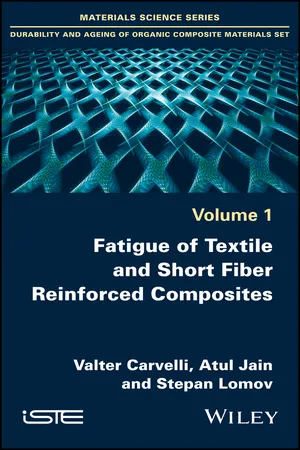
This book covers several aspects of the fatigue behavior of textile and short fiber reinforced composites. The first part is dedicated to 2D and 3D reinforced textile composites and includes a systematic description of the damage evolution for quasi-static and tensile-tensile fatigue loadings. Acoustic emissions and digital image correlation are considered in order to detect the damage modes' initiation and development. The acoustic emission thresholds of the quasi-static loading are connected to the "fatigue limit" of the materials with distinctions for glass and carbon reinforcements.
The second part is devoted to the fatigue behavior of injection molded short fiber reinforced composites. Experimental evidence highlights the dependence of their fatigue response on various factors: fiber and matrix materials, fiber distribution, environmental and loading conditions are described. A hybrid (experimental/simulations) multi-scale method is presented, which drastically reduces the amount of experimental data necessary for reliable fatigue life predictions.
eBook - ePub
Fatigue of Textile and Short Fiber Reinforced Composites
- English
- ePUB (mobile friendly)
- Available on iOS & Android
eBook - ePub
Fatigue of Textile and Short Fiber Reinforced Composites
About this book
Information
PART 1
Fatigue of Textile Composites
1
Fatigue Behavior and Damage Evolution of 2D and 3D Textile-Reinforced Composites
1.1. Introduction
The application of textile-reinforced composites in several industrial applications requires in-depth knowledge of the material’s fatigue performance. Several parameters affect the fatigue response of textile composites: fiber and matrix material, fiber volume fraction, environmental conditions (temperature, moisture absorption, etc.), loading conditions (average stress, minimum to maximum stress ratio R, cycling frequency, etc.) and, last but not least, the architecture of the reinforcement. The latter and the material of fibers are mainly considered in this part of the book, acknowledging that the other factors are equally important.
Tension–tension loading is the most commonly used experimental test to investigate the influence of those parameters on the fatigue behavior of composite materials and, in particular, of textile-reinforced composites. Thus, only the tensile fatigue loading condition is considered in this chapter. We are aware that it is not an exhaustive, complete investigation of the fatigue response. Other cyclic loadings are quite important for several applications. Some of the loading conditions most investigated and available in the literature (see database collections [VAL 15]), are uniaxial tension–compression [KAW 15], compression–compression [MOU 07] and multiaxial tension–torsion [INO 00, QUA 14].
As observed for some composite materials (see, e.g., [TAL 12, VAL 07]), the damage modes under tensile fatigue loading are analogous to those imparted with a quasi-static tensile load. This means that the effect of a quasi-static increment of the tensile force produces the same damage evolution as an increase in the number of fatigue cycles.
Accordingly, a complete fatigue investigation must include, in the authors’ opinion, three steps. The first is an in-depth investigation of the prefatigue quasi-static tensile behavior for the knowledge of the relevant mechanical properties, and understanding of the initiation and development of the damage mechanisms. The second is a wide range, in term of load levels, of tensile cyclic loading for drawing a fatigue life diagram covering from low to high number of fatigue life cycles. Moreover, observation of the damage development during cyclic loading is supposed for comparison with the monitoring during quasi-static loading. Finally, the third step is dedicated to postfatigue quasi-static tensile tests of specimens previously subjected to different number of cycles and fatigue loading levels. This provides an overview on the effect of the fatigue loading on the degradation of the mechanical properties and on the modification of the initiation and development of the damage mechanisms.
The chapter gives an overview on the three steps investigation for two-dimensional (2D) and three-dimensional (3D) glass and carbon textile reinforced composites. In particular, the experimental results refer to epoxy resin reinforced with:
- – plain weave E-glass textile (PWG);
- – single-ply non-crimp 3D orthogonal weave E-glass textile (3DW);
- – 3D rotary braided carbon textile (3DB);
- – non-crimp stitched and unstitched carbon fabrics (NCFs).
This set of reinforcements covers a broad range. The general phenomena and features, identified in the studies reported in the chapter, are likely to be present in other instances of textile-reinforced composites, encountered in various applications (aeronautic, automotive, wind energy, etc.).
For each composite, after the features of the material and some peculiar experimental details, a comprehensive description is presented dealing with the three steps described namely:
- – the main quasi-static tensile properties, adopted for preparing the fatigue tests; the detection of the stress–strain level for damage initiation and development and observation of the damage progression during loading;
- – the fatigue life diagram and some damage metric representations; the damage observation and evolution for different stress levels;
- – the residual quasi-static tensile mechanical properties to assess the effect of the imparted fatigue damage on the postfatigue performance and damage mechanisms.
The discussed investigations are based on the same experimental procedure and had several common testing devices and measurement techniques. They are first presented in the following section.
The understandings on fatigue of textile composites collected in this chapter have benefited from years of collaboration with A.E. Bogdanovich, whose depth of knowledge and vast experience of textile reinforcements for composites enriched our research [CAR 10a, CAR 13, IVA 09a, KAR 11, LOM 09].
1.2. Experimental methodologies
The results and discussion in this part of the book are focused only on quasi-static tensile and tension–tension cyclic loading, acknowledging that they only provide partial insights about the behavior of the considered materials. However, these loading conditions are considered to be of primary importance and the first step for any investigation related to the fatigue behavior of composite materials [HAR 03, ANO 15].
This section summarizes the main features of the experimental setup common to the investigations presented in the chapter, including the methodology and devices for damage detection and observation. Peculiarities are mentioned in the following sections dedicated to each of the considered composite materials.
Typically, a prismatic shape of the tensile specimen with overall length 250 mm, gauge length 150 mm and width 25 mm is used. This is prescribed by a number of international standards, for example ISO 527-4, ISO 13003, ASTM D3039, ASTM D3479, JIS K 7083. An appropriate preparation of the clamping zones...
Table of contents
- Cover
- Table of Contents
- Title
- Copyright
- Preface
- PART 1: Fatigue of Textile Composites
- PART 2: Fatigue of Short Fiber Reinforced Composites
- Index
- End User License Agreement
Trusted by 375,005 students
Access to over 1.5 million titles for a fair monthly price.
Study more efficiently using our study tools.
Frequently asked questions
Yes, you can cancel anytime from the Subscription tab in your account settings on the Perlego website. Your subscription will stay active until the end of your current billing period. Learn how to cancel your subscription
No, books cannot be downloaded as external files, such as PDFs, for use outside of Perlego. However, you can download books within the Perlego app for offline reading on mobile or tablet. Learn how to download books offline
We are an online textbook subscription service, where you can get access to an entire online library for less than the price of a single book per month. With over 1.5 million books across 990+ topics, we’ve got you covered! Learn about our mission
Look out for the read-aloud symbol on your next book to see if you can listen to it. The read-aloud tool reads text aloud for you, highlighting the text as it is being read. You can pause it, speed it up and slow it down. Learn more about Read Aloud
Yes! You can use the Perlego app on both iOS and Android devices to read anytime, anywhere — even offline. Perfect for commutes or when you’re on the go.
Please note we cannot support devices running on iOS 13 and Android 7 or earlier. Learn more about using the app
Please note we cannot support devices running on iOS 13 and Android 7 or earlier. Learn more about using the app
Yes, you can access Fatigue of Textile and Short Fiber Reinforced Composites by Valter Carvelli,Atul Jain,Stepan Lomov in PDF and/or ePUB format, as well as other popular books in Technology & Engineering & Materials Science. We have over 1.5 million books available in our catalogue for you to explore.