The book outlines first the importance of Extra Cellular Matrix (ECM), which is a natural surface for most of cells. In the following chapters the influence of biological, chemical, mechanical, and physical properties of surfaces in micro and nano-scale on stem cell behavior are discussed including the mechanotransduction. Biomimetic and bioinspired approaches are highlighted for developing microenvironment of several tissues, and surface engineering applications are discussed in tissue engineering, regenerative medicine and different type of biomaterials in various chapters of the book.
This book brings together innovative methodologies and strategies adopted in the research and development of Advanced Surfaces in Stem Cell Research. Well-known worldwide researchers deliberate subjects including:
Extracellular matrix proteins for stem cell fate
The superficial mechanical and physical properties of matrix microenvironment as stem cell fate regulator
Effects of mechanotransduction on stem cell behavior
Modulation of stem cells behavior through bioactive surfaces
Influence of controlled micro and nanoengineered surfaces on stem cell fate
Nanostructured polymeric surfaces for stem cells
Laser surface modification techniques and stem cells applications
Plasma polymer deposition: a versatile tool for stem cell research
Application of bioreactor concept and modeling techniques in bone regeneration and augmentation treatments
Substrates and surfaces for control of pluripotent stem cell fate and function
Application of biopolymer-based, surface modified devices in transplant medicine and tissue engineering
Silk as a natural biopolymer for tissue engineering
Stem cell-based regenerative medicine aims to repair and regenerate injured and/or diseased tissues by implanting a combination of cells, biomaterials, and soluble factors. Unfortunately, due to an incomplete understanding and knowledge of the interactions between biomaterials and specific stem cell types, and the inability to control the complex signaling pathways ensured by these interactions, the ability to design functional tissue and organ substitutes has been limited. The greatest challenge remains the ability to control stem cells’ fate outside of the cell’s natural microenvironment or “niche”. Stem cell fate is known to be regulated by signals from the microenvironment, such as extracellular matrix (ECM) including glycosaminoglycans and proteoglycans to which stem cells adhere. They represent an essential player in stem cell microenvironment because they can directly or indirectly modulate the maintenance, proliferation, self-renewal, and differentiation of stem cells. The interactions between stem cells and the ECM play a critical role in living tissue development, repair, and regeneration as well. The design of artificial ECM and/or binding site is important in tissue engineering because artificial ECM and/or binding regulates cellular behaviors. Identification of binding sites and key motifs in ECM proteins that interact with cellular receptors can allow researchers to generate small peptides that can mimic the function of large ECM proteins.
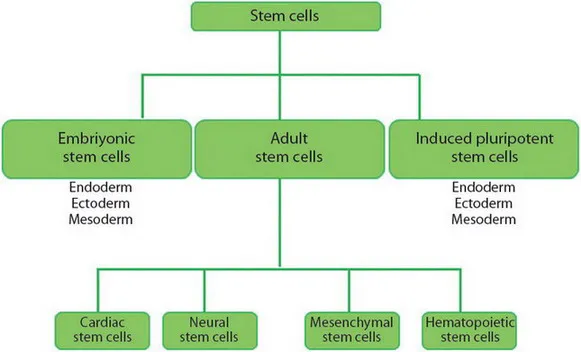
Stem cells have two distinct abilities: self-renewal of themselves and differentiation into tissue/organ-specific cells. Based on their differentiation potential, they can be classified as totipotent, pluripotent, multipotent, or unipotent cells. The totipotent fertilized egg exhibits the stem cell that gives rise to all embryonic and extra-embryonic structures of the developing embryo [1]. Human embryonic stem cells (hESCs) derived from the inner cell mass of the blastocyst have the ability to self-renew over a long period without undergoing senescence [1]. Consequently, cells with higher regeneration capacity and plasticity are needed which lead to use of pluripotent stem cells. Identifying suitable source of stem cells is elemental for regeneration of any tissue. Mature and differentiated multipotent stem cells are easily available but least preferred due to their limited cell division and differentiation capacity. Indeed, the number of stem cells in adults is very low, and it depletes with age. Bone marrow (BM)-derived stem cells first described by Friedenstein et al. are still the most frequently investigated cell type [2]. These cells are lineage-restricted, and in contrast to hESCs, multipotent adult stem cells undergo replicative senescence and their lifespan in culture is limited. The existence of multipotent postnatal stem cells has been reported in BM, peripheral blood, umbilical cord, umbilical cord blood (UCB), Wharton’s jelly, placenta, neuronal, and adipose tissues [3–7]. Takahashi and Yamanaka developed a new technique by describing the reprogramming of human somatic fibroblasts into primitive pluripotent stem cells by over-expressing OCT4, SOX2, KLF4, and MYC [8]. These human induced pluripotent stem cells are similar to hESCs in the sense that they also express pluripotency genes, have telomerase activity, and are able to differentiate into all cell types of the three embryonic germ layers (endoderm, ectoderm, and mesoderm) (Figure 1.1).
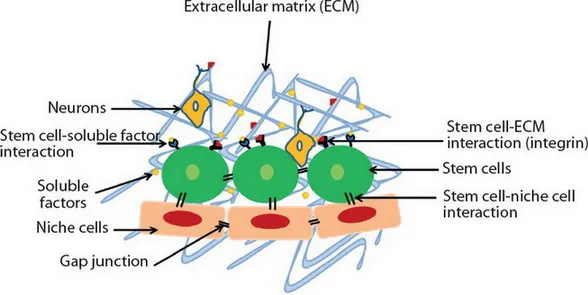
Stem cell niche consists of stem cells, supporting cells, extracellular matrix (ECM), soluble factors, and nervous systems. All these factors have an important role in stem cell niche; however, ECM that holds stem cells in a niche and controls their cellular processes plays a critical role in the control of stem cell fate [9]. Since its first definition originally proposed in 1978 by Schofield for the hematopoietic stem cell (HSC) microenvironment, the concept of the niche has increased in complexity [10]. Niches are highly specialized for each type of stem cell, with a defined anatomical localization, and they are composed by stem cells and by supportive stromal cells (which interact each other through cell surface receptors, gap junctions and soluble factors), together with the ECM in which they are located (Figure 1.2). In addition, secreted or cell surface factors, signaling cascades and gradients, as well as physical factors such as shear stress, oxygen tension, and temperature, promote to control stem cell behavior [11].
Figure 1.2 Stem cell niche. Adapted from Jhala et al. [9].
Stem cell niche cells mesenchymal and HSCs play an important role in many regeneration processes in human body. HSCs are blood forming cells which were recognized more than 50 years ago [12]. They are produced during embryogenesis in a complex developmental process in several anatomical sites (the yolk sac, the aorta-gonad-mesonephros region, the placenta, and the fetal liver), after which HSCs colonize the BM at birth [13]. These cells are divided into two major progenitor lineages; common myeloid (CMP) and common lymphoid progenitors (CLP). CMPs give rise to megakaryocyte (MK)/erythroid and granulocyte/macrophage progenitors developing into platelet producing MKs, erythrocytes, mast cells, neutrophils, eosinophils, monocytes, and macrophages. CLPs will mature into B-lymphocytes, T-lymphocyt...
Table of contents
Cover
Title page
Copyright page
Preface
Chapter 1: Extracellular Matrix Proteins for Stem Cell Fate
Chapter 2: The Superficial Mechanical and Physical Properties of Matrix Microenvironment as Stem Cell Fate Regulator
Chapter 3: Effects of Mechanotransduction on Stem Cell Behavior
Chapter 4: Modulation of Stem Cells Behavior Through Bioactive Surfaces
Chapter 5: Influence of Controlled Micro- and Nanoengineered Environments on Stem Cell Fate
Chapter 6: Recent Advances in Nanostructured Polymeric Surface: Challenges and Frontiers in Stem Cells
Chapter 7: Laser Surface Modification Techniques and Stem Cells Applications
Chapter 8: Plasma Polymer Deposition: A Versatile Tool for Stem Cell Research
Chapter 9: Three-dimensional Printing Approaches for the Treatment of Critical-sized Bone Defects
Chapter 10: Application of Bioreactor Concept and Modeling Techniques to Bone Regeneration and Augmentation Treatments
Chapter 12: Substrates and Surfaces for Control of Pluripotent Stem Cell Fate and Function
Chapter 13: Silk as a Natural Biopolymer for Tissue Engineering
Chapter 14: Applications of Biopolymer-based, Surface-modified Devices in Transplant Medicine and Tissue Engineering
Chapter 15: Stem Cell Behavior on Microenvironment Mimicked Surfaces
Index
End User License Agreement
Trusted by 375,005 students
Access to over 1.5 million titles for a fair monthly price.
Study more efficiently using our study tools.
Frequently asked questions
Yes, you can cancel anytime from the Subscription tab in your account settings on the Perlego website. Your subscription will stay active until the end of your current billing period. Learn how to cancel your subscription
No, books cannot be downloaded as external files, such as PDFs, for use outside of Perlego. However, you can download books within the Perlego app for offline reading on mobile or tablet. Learn how to download books offline
Perlego offers two plans: Essential and Complete
Essential is ideal for learners and professionals who enjoy exploring a wide range of subjects. Access the Essential Library with 800,000+ trusted titles and best-sellers across business, personal growth, and the humanities. Includes unlimited reading time and Standard Read Aloud voice.
Complete: Perfect for advanced learners and researchers needing full, unrestricted access. Unlock 1.5M+ books across hundreds of subjects, including academic and specialized titles. The Complete Plan also includes advanced features like Premium Read Aloud and Research Assistant.
Both plans are available with monthly, semester, or annual billing cycles.
We are an online textbook subscription service, where you can get access to an entire online library for less than the price of a single book per month. With over 1.5 million books across 990+ topics, we’ve got you covered! Learn about our mission
Look out for the read-aloud symbol on your next book to see if you can listen to it. The read-aloud tool reads text aloud for you, highlighting the text as it is being read. You can pause it, speed it up and slow it down. Learn more about Read Aloud
Yes! You can use the Perlego app on both iOS and Android devices to read anytime, anywhere — even offline. Perfect for commutes or when you’re on the go. Please note we cannot support devices running on iOS 13 and Android 7 or earlier. Learn more about using the app
Yes, you can access Advanced Surfaces for Stem Cell Research by Ashutosh Tiwari, Bora Garipcan, Lokman Uzun, Ashutosh Tiwari,Bora Garipcan,Lokman Uzun in PDF and/or ePUB format, as well as other popular books in Technologie et ingénierie & Science des matériaux. We have over 1.5 million books available in our catalogue for you to explore.