Since the first edition of Fracking was published, hydraulic fracturing has continued to be hotly debated. Credited with bringing the US and other countries closer to "energy independence," and blamed for tainted drinking water and earthquakes, hydraulic fracturing ("fracking") continues to be one of the hottest topics and fiercely debated issues in the energy industry and in politics.
Covering all of the latest advances in fracking since the first edition was published, this expanded and updated revision still contains all of the valuable original content for the engineer or layperson to understand the technology and its ramifications. Useful not only as a tool for the practicing engineer solve day-to-day problems that come with working in hydraulic fracturing, it is also a wealth of information covering the possible downsides of what many consider to be a very valuable practice. Many others consider it dangerous, and it is important to see both sides of the argument, from an apolitical, logical standpoint.
While induced hydraulic fracturing utilizes many different engineering disciplines, this book explains these concepts in an easy to understand format. The primary use of this book shall be to increase the awareness of a new and emerging technology and what the various ramifications can be. The reader shall be exposed to many engineering concepts and terms. All of these ideas and practices shall be explained within the body. A science or engineering background is not required.
Chapter 1 Environmental Impact – Reality and Myth and Nero Did Not Fiddle While Rome Burned
In today’s society, it is really easy for organizations – be it the general media, political groups, local organizations, unions, or religious associations – to spread their beliefs to the public and push whatever agenda or ideals they may have. These beliefs could be successfully put forward with good intentions, successfully put forth with bad intentions, or, in many cases, put forward with good intentions, but have a negative result. Sadly, it seems human nature dictates that the first opinion heard or the opinion heard the loudest and with the most hyperbole will be what the public comes to believe. In time, once something is believed by enough people and stated as “fact” long enough, the general public will no longer even bother looking into facts, and it will become part of the fabric of beliefs in our society – for instance, a few examples of this phenomenon are: 1) one, in fact, cannot see the Great Wall of China from the moon (not even close); 2) the Sherlock Holmes character never once said “Elementary, my dear Watson”; and 3) Nero didn’t play the violin while his city burned. The violin wasn’t invented yet.
Now, upon reading this, the hope is that many will stop reading (but of course come back) to fact-check that what is written here is true. That is exactly the point to push: as previously stated many times, the point is not to give opinions or try to sway beliefs, the point is to merely give facts described in the most straightforward and clear way possible and hopefully give enough background knowledge to initiate further study. Following this and further study, hopefully one can make up his or her own educated opinion on fracking … and that Nero actually funded relief money from his own savings to help his subjects.
As far as hydraulic fracturing is concerned, the aspect given the most attention by press and most concerned organizations is the impact it may have on the environment. The question of environmental impact through fracking is, to say the least, a very emotional topic and by far the most polarizing issue; however, a great deal of analysis indicates that the most significant environmental risks attributed to fracking are similar to risks long associated with all drilling operations, including groundwater contamination due to inadequate cementing and/or well construction, risks associated with trucking, leaks from tanks and piping, and spills from waste handling. This all-encompassing blame has given industry all of the ammunition needed to claim that effects attributed to hydraulic fracturing are overstated, not based on good science, or related to processes other than hydraulic fracturing.
Due to the great ongoing controversy over alleged impacts from fracking, many public groups have become deeply suspicious of the trustworthiness and overall motives of the oil and gas industry. These suspicions are continuously intensified by two things:
ongoing mistrust of data and findings due, in great part, to semantics, and
by the industry initially refusing to disclose the chemical makeup of fracking fluids and the additives used to enhance hydraulic fracturing.
1.1 The Tower of Babel and How it Could be the Cause of Much of the Fracking Debate
Almost everyone has heard the story, or has a general understanding, of the Tower of Babel from the Old Testament. In the Biblical account of this story, humanity was attempting, as a unified group, to build a tower in Mesopotamia to reach the heavens, only to have their efforts brought to a halt by one of the most effective means imaginable. The efforts of this united group of people were not thwarted by military force, or by weather, or even by sickness and injury; their efforts in this undertaking were thwarted by speech. The simple fact of this story is that building of the tower came to a halt once the unified people were confounded by speech and no longer able to communicate to work together. Now far be it for this work to compare modern day hydraulic fracturing with the construction, and subsequent stop in construction, of the Tower of Babel, but much of the confusion, name-calling, and general mistrust between groups on this subject can be attributed to a difference in communication. Maybe once this communication gap is bridged, more effective talks can be established between industry and the concerned public in place of wasting time on mistrust and name-calling. Hopefully, this work can help to bridge that gap.
It can be easily considered that a very large portion of negativity toward hydraulic fracturing is actually attributable to processes other than hydraulic fracturing. In the discussions between industry and the public, a great deal of this problem can boil down to an issue of semantics: the oil and gas industry has a narrow view of what fracking entails (including just those processes related to the actual process of fracking while on location conducting the fracking operation), while the general public is more inclined to include many more activities commonly related to fracking (water and sand trucking, product and equipment transport and storage, water disposal) under the heading of “fracking.” This can cause misunderstandings and skewed data, in that many of the processes included by the general public are utilized in many, if not all, drilling practices, and are hard to put solely under the heading of “fracking,” when in actuality they could just as easily be under the heading “completions” or “production.”
This topic has been discussed many times in the media, in town hall meetings, as well as on various concerned citizens’ blogs to the point of exhaustion. There are many proven environmental impacts caused by drilling operations and processes related to drilling. There are also many concerns raised about any industrial effort. Any time that man and machine are working, there are countless opportunities for an environmental issue to emerge. It is the nature of the beast. It has been suggested by many that the advent of industry in England as well as the northeast of the United States changed the seasons, the combination of drought and unmanaged farming led to the Midwestern Dust Bowl of last century, and the increase in exhaust emissions from automobile exhaust has led to unsafe levels of pollutants in all cities. These are facts. Facts can almost assuredly not be disproven by industry, and can be a concern by the public in their feelings on gas well completion and production activities. However, by the same token, there have been over a million wells that have gone through the process of hydraulic fracturing. With such a great opportunity for environmental impact, one would think that the process would surely have poisoned the water. With the current issue of semantics, public concerns can include many drilling processes, while industry can fall back on the fact that the industry definition of fracking has never impacted fresh water in the ways commonly claimed by the media for public consumption. The debate can rage on, with both sides being right and both sides being wrong, while never taking steps to come together on a common goal. The goal of this work is not to shine light on the mistakes of the drilling industry or show how citizens can make false claims; the goal is to educate and share insight. If the one message that can be taken away from this work is how to drive this technology safely, then the goal shall be reached.
Chapter 2 Production Development
Before an investigation is begun into the production of a well site, it is important to understand what the product is. There are several types of ‘product’ that are obtained at the well site. Gas reservoirs are classified as conventional or unconventional for the following reasons:
Conventional reservoirs: Wells in conventional gas reservoirs produce from sand carbonates (lime stones and dolomites) that contain the gas in interconnected pore spaces that allow flow to the wellbore. Gas in the pore scan will move from one pore to another through smaller pore-throats that create permeable flow through the reservoir. In conventional natural gas reservoirs, the gas is often sourced from organic-rich shale proximal to the more porous and permeable sandstone or carbonate.
Unconventional reservoirs: Wells in unconventional reservoirs produce from low permeability (tight) formations such as tight sands and carbonates, coal, and shale. In unconventional gas reservoirs, the gas is often sourced from the reservoir rock itself (tight gas sandstone and carbonates are an exception). Because of the low permeability of these formations, it is typically necessary to stimulate the reservoir to create additional permeability. Hydraulic fracturing of a reservoir is the preferred stimulation method for gas shale. Differences between the three basic types of unconventional reservoirs include:
Tight Gas: Wells produce from regional low-porosity sandstones and carbonate reservoirs. The natural gas is sourced (formed) outside the reservoir and migrates into the reservoir over time (millions of years). Many of these wells are drilled horizontally, and most are hydraulically fractured to enhance production.
Coal Bed Natural Gas (CBNG): Wells produce from the coal seams, which act as source and reservoir of the natural gas. Wells frequently produce water as well as natural gas. Natural gas can be sourced by thermogenic alterations of coal or by biogenic action of indigenous microbes on the coal. There are some horizontally drilled CBNG wells, and some that receive hydraulic fracturing treatments. However, some CBNG reservoirs are also underground sources of drinking water, and as such, there are restrictions on hydraulic fracturing. CBNG wells are mostly shallow, as the coal matrix does not have the strength to maintain porosity under the pressure of significant overburden thickness.
Shale Gas: Wells produce from low permeability shale formations that are also the source for the natural gas. The natural gas volumes can be stored in a local macro-porosity system (fracture porosity) within the shale, or within the micro-pores of the shale or it can be adsorbed onto minerals or organic matter within the shale. Wells maybe drilled either vertically or horizontally, and most are hydraulically fractured to stimulate production. Shale gas wells can be similar to other conventional and unconventional wells in terms of depth, production rate, and drilling.
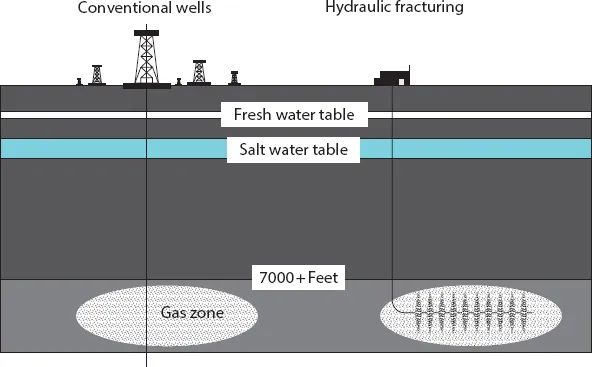
The following is a comparison of conventional well structure and hydraulic fracturing.
Drilling conventional wells and those to be used in hydraulic fracturing begin in much the same ways. The basic well construction steps are:
An initial length of steel pipe, called conductor casing, is inserted into a vertical wellbore soon after drilling begins. This is done to stabilize the well as it passes through the shallow sediments and soils near the surface.
Once conductor casing is set, operators continue drilling and insert a second casing, called surface casing, from the ground surface and extending past the depth of all drinking water aquifers.
After allowing the cement behind the casings to set (cementing is described in detail in the following section), operators continue drilling for approximately 10 to 50 feet before stopping to test the integrity of the cement process by pressurizing the well.
In horizontal wells, after drilling the horizontal section of the well, operators run a string of production casing into the well and cement it in place.
Operators then perforate the production casing using small explosive charges at intervals along the horizontal wellbore where they intend to hydraulically fracture the shale.
Acid stage; consisting of several thousand gallons of water mixed with a dilute acid such as hydrochloric or muriatic acid: This serves to clear cement debris in the wellbore and provide an open conduit for other frack fluids by dissolving carbonate minerals and opening fractures near the wellbore.
Pad stage; consisting of approximately 100,000 gallons of slickwater without proppant material: The slickwater pad stage fills the wellbore with the slickwater solution (described below), opens the formation, and helps to facilitate the flow and placement of proppant material.
Figure 2.1 Comparison of Well Sites.
Prop sequence stage; which may consist of several sub-stages of water combined with proppant material (consisting of a fine mesh sand or ceramic material, intended to keep open, or “prop,” the fractures created and/or enhanced during the fracturing operation after the pressure is reduced): This stage may collectively use several hundred thousand gallons of water. Proppant ...
Table of contents
Cover
Title page
Copyright page
Dedication
Preface
List of Contributors
An Introduction to Hydraulic Fracturing
Chapter 1: Environmental Impact – Reality and Myth and Nero Did Not Fiddle While Rome Burned
Chapter 2: Production Development
Chapter 3: Fractures: Their Orientation and Length
Chapter 4: Casing and Cementing
Chapter 5: Pre-Drill Assessments
Chapter 6: Well Construction
Chapter 7: Well Operations
Chapter 8: Failure and Contamination Reduction
Chapter 9: Frack Fluids and Composition
Chapter 10: So Where Do the Frack Fluids Go?
Chapter 11: Common Objections to Drilling Operations
Chapter 12: Air Emissions Controls
Chapter 13: Chemicals and Products on Locations
Chapter 14: Public Perception, the Media, and the Facts
Chapter 15: Notes from the Field
Chapter 16: Migration of Hydrocarbon Gases
Chapter 17: Subsidence as a Result of Gas/Oil/Water Production
Chapter 18: Effect of Emission of CO2 and CH4 into the Atmosphere
Chapter 19: Fracking in the USA
Appendix A: Chemicals Used in Fracking
Appendix B: State Agency Web Addresses
Bibliography
Index
End User License Agreement
Trusted by 375,005 students
Access to over 1.5 million titles for a fair monthly price.
Study more efficiently using our study tools.
Frequently asked questions
Yes, you can cancel anytime from the Subscription tab in your account settings on the Perlego website. Your subscription will stay active until the end of your current billing period. Learn how to cancel your subscription
No, books cannot be downloaded as external files, such as PDFs, for use outside of Perlego. However, you can download books within the Perlego app for offline reading on mobile or tablet. Learn how to download books offline
Perlego offers two plans: Essential and Complete
Essential is ideal for learners and professionals who enjoy exploring a wide range of subjects. Access the Essential Library with 800,000+ trusted titles and best-sellers across business, personal growth, and the humanities. Includes unlimited reading time and Standard Read Aloud voice.
Complete: Perfect for advanced learners and researchers needing full, unrestricted access. Unlock 1.5M+ books across hundreds of subjects, including academic and specialized titles. The Complete Plan also includes advanced features like Premium Read Aloud and Research Assistant.
Both plans are available with monthly, semester, or annual billing cycles.
We are an online textbook subscription service, where you can get access to an entire online library for less than the price of a single book per month. With over 1.5 million books across 990+ topics, we’ve got you covered! Learn about our mission
Look out for the read-aloud symbol on your next book to see if you can listen to it. The read-aloud tool reads text aloud for you, highlighting the text as it is being read. You can pause it, speed it up and slow it down. Learn more about Read Aloud
Yes! You can use the Perlego app on both iOS and Android devices to read anytime, anywhere — even offline. Perfect for commutes or when you’re on the go. Please note we cannot support devices running on iOS 13 and Android 7 or earlier. Learn more about using the app
Yes, you can access Fracking by Michael D. Holloway in PDF and/or ePUB format, as well as other popular books in Physical Sciences & Energy. We have over 1.5 million books available in our catalogue for you to explore.