The dominance of trusted intermediaries could be weakened by blockchain, a distributed ledger technology, one of the functions of which is to constitute timestamped proofs by replacing inter-individual trust with algorithmic trust.
Blockchain self-executing smart contracts allow us to rethink the practice in the domain of e-commerce, interbank communication, fundraising (and ICOs), justice (timestamping evidence, acts authenticated by blockchain) and businesses in numerous sectors (entertainment, AI, health, real estate, tourism, transport, etc.) which attempt to propose new services by benefiting from blockchains.
This book aims to put into perspective the technical innovations and the uses brought about by blockchain, by identifying that which has a medium- or long-term impact, all while taking into account the social, economic, judicial and administrative resistances that are likely to develop.
- English
- ePUB (mobile friendly)
- Available on iOS & Android
eBook - ePub
About this book
Information
Part 1
The Blockchain: a Tool for Non-centralization and Disintermediation
Introduction to Part 1
As a secure, non-centralized, peer-to-peer ledger technology, the blockchain makes it possible to restructure entire parts of socioeconomic operating modes.
Even if many of the Blockchain projects, including the Bitcoin project, do obviously seem to be anarchist crypto projects, a current of thought called cypherpunk developed in the 1990s in the United States, with the computerization and advent of the Internet.
Several articles have been published by this group of cypherpunks, including a Crypto Anarchist Manifesto written by Timothy C. May, an engineer and cryptographer. According to this manifesto written in 1988:
“Computer technology is on the verge of providing the ability for individuals and groups to communicate and interact with each other in a totally anonymous manner. Two persons may exchange messages, conduct business, and negotiate electronic contracts without ever knowing the True Name, or legal identity, of the other. […] The technology for this revolution — and it surely will be both a social and economic revolution — has existed in theory for the past decade. The methods are based upon public-key encryption, zero-knowledge interactive proof systems, and various software protocols for interaction, authentication, and verification” [MAY 88].
Projects such as those by Wei Dai with b-money [DAI 98] created in 1998 and referred to in the Bitcoin seminal document [NAK 09, note 1] have attempted to implement monetary projects based on block mining. One difficulty with this type of project was to develop a model to generate money and reward the provision of computing power. For Wei Dai, computing power is increasing rapidly and its cost cannot always be identified due to the limited, false, or dated information available, creating a real problem for the protocol1. The Bitcoin protocol proposes to solve this problem of counterpart to computing power by an incentive system based on the issuing of new crypto-assets and transaction fees.
Since the creation of the Bitcoin protocol in 2009, the blockchain technology has already undergone several phases of evolution. Initially, the blockchain with Bitcoin mainly allowed a timestamping mechanism for non-centralized transactions using a peer-to-peer network and it was only with the appearance of the second generation of blockchain, focused on the deployment of smart contracts, such as the Ethereum blockchain created in 2014 [BUT 13], that the prospects for disintermediation were really felt. Currently, the projects, referred to by some as third-generation blockchain projects, focus on scalability, interoperability between blockchains and the implementation of machine learning elements within decision-making processes.
The main characteristics of the blockchain and the resulting changes in uses will be discussed in this section, focusing the analysis on non-centralization (Chapter 1), disintermediation (Chapter 2), and prospects for the evolution and improvement of the blockchain (Chapter 3).
1
Non-centralized Architecture
The blockchain and the distributed registry technology allow us to solve the problem of certification of the transaction chain, without using a centralized system, to a trusted third party.
The term “decentralized”, frequently used to refer to the blockchain or its applications, does not seem entirely appropriate to refer to the blockchain architecture. Indeed, decentralization is a movement from the center to subentities. In political science, for example, decentralization is a process by which entities, generally local, are given their own powers previously held by a central power, unlike deconcentration, a process by which the central power delegates powers at the local level to its representatives.
The blockchain architecture is not decentralized; it is part ab initio of parallel centralized or partially decentralized models, so the terms “distributed” or “non-centralized” seem more appropriate. The term “non-centralized” was preferred for this book because it explicitly marks an alternative to a centralized model and avoids a debate that has no place in this book between decentralized and distributed systems.
This typology, which is very frequently used not only on blogs [EAG 17] but also in books on the blockchain [RAV 16], is generally associated with a diagram that presents the difference between centralization, decentralization, and distribution, based on a book by Paul Baran on distributed systems [BAR 62].
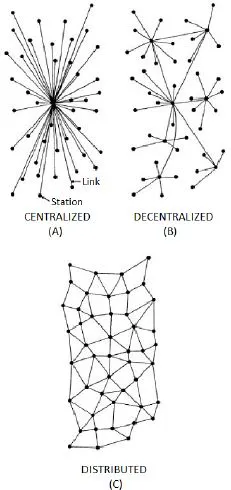
Figure 1.1. Paul Baran’s distributed system typology.
Source: [BAR 62, p. 4]
The diagram depicting centralization shows only one central point, the decentralization diagram shows a central point and several central sub-points, and the diagram on distribution shows one distribution mode among others, with a connection between the nearest nodes only (see Figure 1.1).
This schema is, wrongly, regularly used to present the blockchain as a decentralized model and to contrast the blockchain with distributed registers (of which the Bitcoin blockchain, for example, is a sub-category). The authors, using this schema to demonstrate that blockchains are decentralized and not distributed generally, later indicate that what makes the strength of a decentralized system compared to a centralized system is that there is no central point and that if a node fails the system persists1. Based on this schema (and on the concept of decentralization in general), this approach is wrong; there is indeed a central point and if it is missing, the system no longer works.
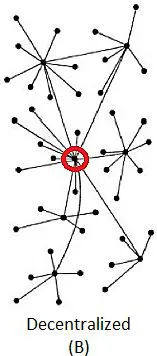
Figure 1.2. Decentralized system. For a color version of this figure, see www.iste.co.uk/quiniou/blockchain.zip
To repeat this diagram, the centralization point is surrounded; if it is faulty, none of the central sub-points are connected anymore.
It should be noted that the use of the notion of decentralization in the blockchain ecosystem has become widespread with Ethereum and smart contracts. For example, the Bitcoin seminal document did not refer to it and used the notions of peer-to-peer and lack of central authority, which is fundamentally different [NAK 09]. Vitalik Buterin, the founder of Ethereum, also indicated on his blog that there was confusion about the use of the notion of decentralization in the blockchain ecosystem and that the above-mentioned schema was “unfortunately too widespread” [BUT 17].
Blockchain networks, such as Bitcoin, are actually designed according to a particular form of distributed architecture, a peer-to-peer architecture, which could be transcribed by the diagram below. It is this network architecture, in which all nodes theoretically have a copy of the registry and participate in consensus,...
Table of contents
- Cover
- Table of Contents
- Introduction
- Part 1: The Blockchain: a Tool for Non-centralization and Disintermediation
- Part 2: Blockchain Technology for a New Socio-economic Paradigm
- Conclusion
- References
- Index
- End User License Agreement
Trusted by 375,005 students
Access to over 1.5 million titles for a fair monthly price.
Study more efficiently using our study tools.
Frequently asked questions
Yes, you can cancel anytime from the Subscription tab in your account settings on the Perlego website. Your subscription will stay active until the end of your current billing period. Learn how to cancel your subscription
No, books cannot be downloaded as external files, such as PDFs, for use outside of Perlego. However, you can download books within the Perlego app for offline reading on mobile or tablet. Learn how to download books offline
Perlego offers two plans: Essential and Complete
- Essential is ideal for learners and professionals who enjoy exploring a wide range of subjects. Access the Essential Library with 800,000+ trusted titles and best-sellers across business, personal growth, and the humanities. Includes unlimited reading time and Standard Read Aloud voice.
- Complete: Perfect for advanced learners and researchers needing full, unrestricted access. Unlock 1.5M+ books across hundreds of subjects, including academic and specialized titles. The Complete Plan also includes advanced features like Premium Read Aloud and Research Assistant.
We are an online textbook subscription service, where you can get access to an entire online library for less than the price of a single book per month. With over 1.5 million books across 990+ topics, we’ve got you covered! Learn about our mission
Look out for the read-aloud symbol on your next book to see if you can listen to it. The read-aloud tool reads text aloud for you, highlighting the text as it is being read. You can pause it, speed it up and slow it down. Learn more about Read Aloud
Yes! You can use the Perlego app on both iOS and Android devices to read anytime, anywhere — even offline. Perfect for commutes or when you’re on the go.
Please note we cannot support devices running on iOS 13 and Android 7 or earlier. Learn more about using the app
Please note we cannot support devices running on iOS 13 and Android 7 or earlier. Learn more about using the app
Yes, you can access Blockchain by Matthieu Quiniou in PDF and/or ePUB format, as well as other popular books in Business & Management. We have over 1.5 million books available in our catalogue for you to explore.