The book features comparative perspectives on the field of chemical ecology, present and future, offered by scientists from a wide variety of disciplines. The scientists contributing to this book –biologists, ecologists, biochemists, chemists, biostatisticians – are interested in marine, freshwater and terrestrial ecosystems and work on life forms ranging from micro-organisms to mammals, including humans, living in areas from the tropics to polar regions.
Here, they cross their analyses of the present state of chemical ecology and its perspectives for the future. Those presented here include complex, multispecies communities and cover a wide range both of organisms and of the types of molecules that mediate the interactions between them. Up to now, no book has presented a solid scientific treatment of a wide range of examples. This book illustrates a diverse panel of the most advanced aspects of this rapidly expanding field.
Chemical mediation is a widely used mode of communication that contributes significantly to the organization and functioning of biodiversity. Identifying and classifying species are prerequisites for the study of biodiversity, and as with other morphological or molecular characteristics, the study of traits of organisms related to the production of semiochemicals is regularly used today in integrative taxonomy. One of the important facets of chemical ecology is the study of communication mediated by organic compounds (volatile or not) in the same species (reproduction, meeting sexual partners, etc.) and between species (pollination, predation, parasitism, etc.) with honest or deceptive signals. Identifying the compounds emitted, and understanding their modes of action and their roles in the interactions between individuals and between species, are the objectives of this young pluridisciplinary science, which aims to discover this hidden language of nature [PIC 06, RAG 08]. This interspecies chemical mediation sometimes also allows the creation of complex interactive networks, structuring biodiversity around certain organisms, which often play keystone roles in ecosystems [HOS 10, IVA 11a, IVA 11b]. Ephemeral or stable, from attractive to repulsive, this communication is based on an infinite multitude of combinations of organic compounds, where the game for each species consists of emitting, detecting or even masking a scent.
1.1. Systematic and integrative taxonomy from chemical ecology
A good understanding of biodiversity is a prerequisite for numerous disciplines, such as biology, ecology and even the study of chemical communication between different species. Systematics is the science devoted to the discovery, the interpretation and the classification of biological diversity. This term designates both the methods implemented and the results of their application, and can, therefore, lead to the “classification of living things” in general. Systematics includes taxonomy, which describes living organisms based on their characteristics, most often morphological and/or molecular (sequencing of DNA or RNA is widely used, notably to characterize the infinitely small), and groups these organisms into taxa. Because it is crucial for analyzing and conserving biodiversity so that each taxon has a name, and a specific name never designates multiple taxa, the taxonomic descriptions must be as precise and detailed as possible, integrating complementary types of characteristics. Today, this integrative taxonomy is considered to be the most rigorous approach in systematics because it integrates all the taxonomic, morphological and ecological traits for which scientific information exists to characterize the taxa considered. This method is also the most adaptable, since a small number of the most important traits in the ecology of species concerned may be selected to determine whether two sets of individuals belong to the same species.
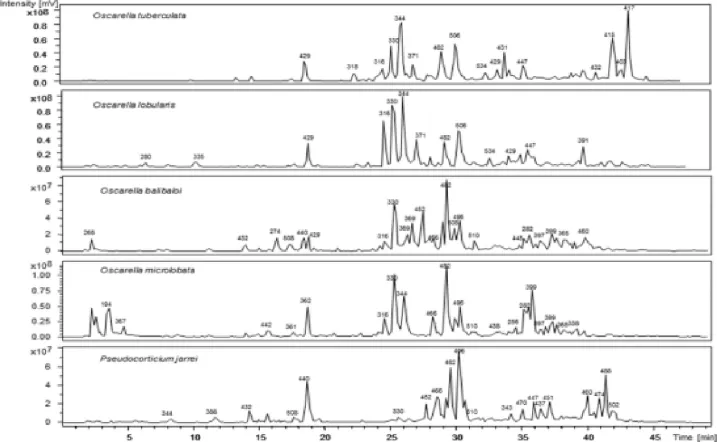
Like the morphological or molecular characteristics of an organism, its chemical composition – i.e. its metabolome – can be used as a characteristic (or a set of characteristics) in taxonomy or systematics. Chemotaxonomy (also called chemosystematics) seeks to understand the relationship between the chemical composition of organisms, their taxonomic identity and their systematic classification. The metabolome can be studied as a signature of evolution, and the metabolomic revolution is transforming chemosystematics by making it possible to quickly compare a large number of such chemical signatures (Figure 1.1) [BAG 10a, CAR 12]. The analysis of portions of the metabolome also provides classifications similar to those supplied by molecular systematics based on the analysis of portions of the genome. Thus, it provides support for hypothetical classifications. Chemotaxonomy can also be used to discriminate “sister” species, notably for difficult taxonomic groups in which closely related species are often “cryptic”, owing to the small size of organisms, the absence of morphological variability or, on the contrary, excessive variability.
In the case of sponges of the class Homoscleromorpha, the absence of variation in morphological characteristics classically used in sponge systematics (skeletal spicules) led researchers to search for other informative characteristics. Discovery of variability in up to six different types of characteristics has dismantled the “myth of the cosmopolitan species Oscarella lobularis”, and 15 species of this genus have now been described [IVA 11a, IVA 11b]. Metabolomic approaches combined with traditional and molecular systematics have recently allowed the proposal of a new systematic classification of Homoscleromorpha sponges, and integrative taxonomy is now used to describe many other species of this class of sponges [BOU 14, RUI 14, CAC 15] (see Chapter 7).
Figure 1.1.Metabolomic fingerprints showing interspecific variability of the chemical signal emitted by different sponges of the family Oscarellidae, Class Homoscleromorpha: HPLC-ESI (þ) MS (BPC) with indications of m/z values above the peaks of the major compounds (from [CAR 12])
In the case of Mediterranean orchids, the morphological similarity of the described species sometimes makes their recognition difficult, notably by stakeholders in conservation efforts. Thus, in 2010, 20.6% of the orchid species found in metropolitan France were considered to be supported by “insufficient data” by the IUCN, mainly as a result of problems with taxonomic identification [SCH 14]. Using the integrative taxonomy approach and taking into account, in one analysis, numerous scientifically established taxonomic characteristics (morphology, molecular characteristics, distributional range, flowering period, odor emitted and identity of pollinators), it has progressively become possible, in genus after genus, to clearly identify the taxonomically difficult species. In this context, the variation in the odors emitted by these remarkable flowers is particularly important, because odors of some species attract specific pollinators, whereas those of other species attract a greater diversity of pollinators. These differences have implications for reproductive isolation. Pollinator differences related to variation in floral odor, together with other traits analyzed in the framework of integrative taxonomy, show, for example, how the three described species of the fly orchid group, very close morphologically, can be definitely considered to be distinct species. They differ at the level of their molecular genetics, their habitat preferences, their morphology, the floral scents they emit and their specific pollinators [TRI 13]. Demonstration of these differences shows the importance of implementing conservation programs, because two of these species have restricted distributions (Ophrys aymoninii, endemic to the Grand Causses region in France; O. subinsectifera, endemic to the Franco-Spanish Pyrenees).
1.2. Scent communication between sexual partners
Another facet of chemical ecology concerns communication between members of the same species. Recent discoveries have shown that certain plants of the African savanna communicate among themselves the arrival of large herbivores; the first plant that suffers their attacks quickly emits a volatile bouquet perceived by neighbors of the same species, which then quickly synthesize protective tannins. In the time it takes an elephant or a giraffe to graze on several leaves, individuals of the same species in the vicinity have already become repulsive [WAR 02].
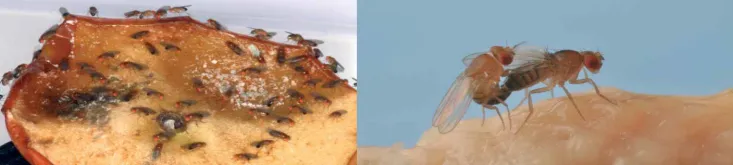
However, chemical communication within the same species is most developed in animals, especially at the time of reproduction. Reproduction conditions the capacity of species to settle in an environment and colonize it. In animals, scents have a generally determinant role in the recognition, detection (sometimes at long distance) and choice of a sexual partners. To find soul mates, insects have developed amazing olfactory abilities. This is the case with many night-flying moths that are capable of detecting a sexual partner at very long distances. For example, female silkworms (Bombyx mori) use bombykol to attract males from within a radius of many kilometers. The males of such species are often equipped with long branching antennae that detect the volatile substances emitted by females [BUT 61]. In Drosophila fruit flies, couples find each other on a ripe fruit (Figure 1.2) on which they both come to find food and to use as breeding sites. The mature fruits visited by these flies generally emit phenylacetic acid and phenylacetaldehyde, compounds which act as aphrodisiac stimulants in these small flies. During copulation, the male transmits to the female a pheromone (cis-vaccenyl acetate); as a result, future contenders detecting this compound in an already fertilized female can avoid her and optimize their partner selection. Although the production of these perfumes and the molecular mechanisms by which they are detected present differences between vertebrates and invertebrates, how their nervous systems code and decode signals is sometimes strikingly similar. For example, the Asian elephant uses the same sexual pheromone as numerous butterflies [RAS 96]!
Figure 1.2.A ripe fruit constitutes the ideal place for interaction between male and female drosophila (Drosophila melanogaster) flies (left photo: Jean-Pierre Farine). This food source and breeding site is a substrate particularly adapted for finding a sexual partner (right photo: Sonia Dourlot)
Although the molecules of sexual communication are less well known for vertebrates than for insects, the chemical mediation used by vertebrates includes both small volatile molecules perceived by olfaction and detectable at a distance (such as exo-brevicomin in the mouse) and heavier molecules perceived through co...
Table of contents
Cover
Table of Contents
Title
Copyright
Foreword
Introduction
1 Biodiversity and Chemical Mediation
2 Chemical Ecology: An Integrative and Experimental Science
3 Scents in the Social Life of Non-Human and Human Primates
4 Microbiota and Chemical Ecology
5 From Chemical Ecology to Ecogeochemistry
6 Omics in Chemical Ecology
7 Metabolomic Contributions to Chemical Ecology
8 Chemical, Biological and Computational Tools in Chemical Ecology
9 Academic and Economic Values of Understanding Chemical Communication
Conclusion: Looking Forward: the Chemical Ecology of Tomorrow
Glossary
List of Authors
Index
End User License Agreement
Trusted by 375,005 students
Access to over 1.5 million titles for a fair monthly price.
Study more efficiently using our study tools.
Frequently asked questions
Yes, you can cancel anytime from the Subscription tab in your account settings on the Perlego website. Your subscription will stay active until the end of your current billing period. Learn how to cancel your subscription
No, books cannot be downloaded as external files, such as PDFs, for use outside of Perlego. However, you can download books within the Perlego app for offline reading on mobile or tablet. Learn how to download books offline
Perlego offers two plans: Essential and Complete
Essential is ideal for learners and professionals who enjoy exploring a wide range of subjects. Access the Essential Library with 800,000+ trusted titles and best-sellers across business, personal growth, and the humanities. Includes unlimited reading time and Standard Read Aloud voice.
Complete: Perfect for advanced learners and researchers needing full, unrestricted access. Unlock 1.5M+ books across hundreds of subjects, including academic and specialized titles. The Complete Plan also includes advanced features like Premium Read Aloud and Research Assistant.
Both plans are available with monthly, semester, or annual billing cycles.
We are an online textbook subscription service, where you can get access to an entire online library for less than the price of a single book per month. With over 1.5 million books across 990+ topics, we’ve got you covered! Learn about our mission
Look out for the read-aloud symbol on your next book to see if you can listen to it. The read-aloud tool reads text aloud for you, highlighting the text as it is being read. You can pause it, speed it up and slow it down. Learn more about Read Aloud
Yes! You can use the Perlego app on both iOS and Android devices to read anytime, anywhere — even offline. Perfect for commutes or when you’re on the go. Please note we cannot support devices running on iOS 13 and Android 7 or earlier. Learn more about using the app
Yes, you can access Chemical Ecology by Anne-Geneviève Bagnères, Martine Hossaert-McKey, Anne-Geneviève Bagnères,Martine Hossaert-McKey in PDF and/or ePUB format, as well as other popular books in Biological Sciences & Biochemistry. We have over 1.5 million books available in our catalogue for you to explore.