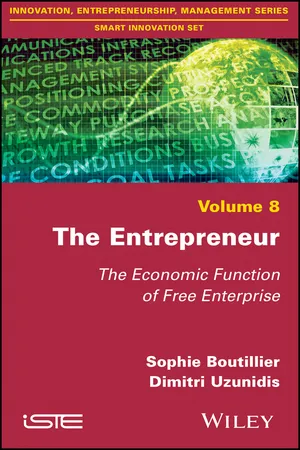
This book presents the economic theories with regards to the entrepreneur of yesterday and those of more recent years, on which issue research has been developing exponentially since the last third of the 20th Century. Much of this book will be devoted to contemporary theories. This presentation of economic theories of the entrepreneur leads us to wonder about the structural development of the free enterprise system in the short and the long term. The proliferation of entrepreneurial initiatives leads in effect to a profound transformation of modes of production and work, for example under the current phenomenon of uberization economy.
eBook - ePub
The Entrepreneur
The Economic Function of Free Enterprise
- English
- ePUB (mobile friendly)
- Available on iOS & Android
eBook - ePub
About this book
Information
1
From Term to Concept: the Entrepreneur and his Economic Function
1.1. Etymological and conceptual bases of the entrepreneur
The term “entrepreneur” entered economic theory during the 18th Century (initially in the writings of Richard Cantillon), but it is much older than that. It took some time for the word to take on today’s meaning of a person who creates a (frequently innovative) business; the original meaning of “entrepreneur” was an individual who behaves actively, one who acts. For this reason, the French verb “entreprendre” denoted warlike action. A brief summary of the history of the term reveals that it developed in the same way in several cultures. The same word is used in both French and English: entrepreneur. It comes from the Latin phrase “inter prehendere”, meaning “seize with the hand”, in the sense of physically mastering something.
The French words “entrepreneur” and “entreprise”, which come from the verb “entreprendre”, can be traced back to the 16th Century. Their meaning and the way they are used have both evolved considerably over the centuries, according to usage and practice. Before the 16th Century, during the Middle Ages, the word “entrepreneur” denoted an individual who indulged in speculative activities. The word did not yet denote manufacturers, tradesmen or businessmen, but more generally a person who entered into a contract with a monarch to build a public building or provide supplies for armies. The same is true of the meaning of the French word “entreprise”, which comes from the vocabulary of war [VER 82]. Waging war requires a complex organization to manage technologies and equipment. For the French military engineer Vauban (1633–1707), the siege of a town was similar to an enterprise, the aim being to achieve the target with as little human loss as possible, while monitoring the attacking army’s food and armor supplies. In short, “(…) an entrepreneur was a person who had a contractual relationship with the government for a service or for the provision of goods”1. This requires financial risk-taking, because the total sum allocated for the completion of the work is fixed before the contract is executed.
Outside the military domain, the word “entrepreneur” had a more general sense in the 16th Century, meaning “a person who undertakes something” or, in a more general sense again, an active individual. Le dictionnaire universel du commerce, published in Paris in 1723, defines “entrepreneur” and “entreprendre” as follows:
- – “Entreprendre”: to be responsible for the success of a business, a negotiation, a manufacturing process, a building, etc.;
- – “Entrepreneur”: a person who undertakes a piece of work. The compound words “entrepreneur de manufacture” (manufacturer entrepreneur) and “entrepreneur de bâtiment” (building contractor) are used to denote a manufacturer and a master mason respectively.
According to various sources, the words have evolved over the centuries, without changing dramatically. In 1755, in the Encyclopédie, which aimed to bring together all available scientific and technical knowledge in a new world characterized by new creative ambitions, D’Alembert and Diderot defined an entrepreneur as someone who undertakes a piece of work: “entrepreneur de manufacture” (manufacturer entrepreneur), “entrepreneur en bâtiment” (building contractor). Entrepreneurs are mainly found in the industrial sector, a transformative field by definition. Yet, Diderot and D’Alembert’s work on this project was certainly entrepreneurial, connected as it was to the Enlightenment period, of which they were the most illustrious representatives. However, a few years later, in E. Littré’s 1889 publication Dictionnaire de la langue française, the definition of “entrepreneur” is very vague: “a person who undertakes something”.
Thus, in the French language, outside the military domain, the word “entrepreneur” denoted an individual who directs and supervises work, particularly someone who has all the skills necessary to fulfill the contract that he has obtained from the monarch. However, there appears to have been a division of labor between those who would later be called capitalists and managers. In 1729, in La science des ingénieurs, Bernard F. de Belidor distinguished between the respective contributions of the “entrepreneur” and the “engineer” to the completion of major works – for example, the construction of a fortress. According to the terms of the contract, the entrepreneur provides the raw materials and all other forms of input necessary for the completion of the project. The engineer is in charge of the technical aspects.
However, despite the vagueness of the definition of the entrepreneur, one thing has remained consistent for centuries: entrepreneurs and risk-taking go hand in hand. Until the end of the 18th Century and the dissolution of the guilds, economic activity in France and Europe was monitored by guilds, which fixed production, employment and trade conditions. If the entrepreneur is often depicted as a charlatan or deviant who does not respect the established social and economic order, it is because he tries to conduct business by bypassing the guilds, arousing the hostility of the people and some economists. The development of home-based work, the first step towards the Industrial Revolution, by tradesmen during this period was a way of opposing the rigid regulations imposed by the guilds.
The same was true in England, the cradle of the first Industrial Revolution, where the equivalent of the French word “entrepreneur” during the 16th and 17th Centuries was “undertaker” and sometimes “adventurer”. In Johnson’s Dictionary, published in 1755, the word “adventurer” is defined as “he that seeks occasions of hazard; he that puts himself in the hands of chance”. There are many mentions of “merchant adventurers”, which generally refers to individuals who indulge in speculation. Gradually, the word took on another meaning and became more precise. But according to Péron [PER 03], Barnhart’s etymological dictionary notes that the word “entrepreneur”, spelled “entreprenoure”, first appeared in 1475, followed by the simplified spelling “entrepreneur” in 1485, and the word then disappeared for almost 350 years, resurfacing in 1852 with its current spelling and meaning. According, once more, to [PER 03, pp. 30–31], the Oxford English Dictionary gives a very broad and vague definition: “the entrepreneur assumes many forms. It may be a private businessman, a partnership, a joint stock company, or a municipality.” However, an entrepreneur in trade and business was defined as a “mass of business” in the 1670s and a “promoter” in the 1450s, when it involved the development of projects [PER 03].
It is surprising that the English have had to turn to the French language to define an entrepreneur, given that the spirit of entrepreneurship is recognized more as a British than a French quality. Indeed, in Strategic Lessons from the Leader Who Built an Empire, Alain Axelrod (in [PER 03]) sees Elizabeth I as an entrepreneur because she conducted some high-risk ventures (conquest of new territories), but also because she understood communication and knew how to share her enthusiasm with those around her. Another obvious example is the conquest of North America by a majority of Anglo-Saxons. Thus, the success of Benjamin Franklin (1706-1790) still corresponds to the image that we have of the entrepreneur today – an entrepreneur, a scientist and a politician all at the same time. Furthermore, in the USA, entrepreneurship was a powerful way of integrating the extremely diverse populations who arrived regularly in the country. As is quite rightly highlighted by Frayssé [FRA 03], “the colonization of America was the fruit of entrepreneurial activities. Religious sects, commercial companies, ad hoc companies, individuals such as William Penn2, etc. were all the result of one founding act: moving towards the new, the ‘new world’, the ‘new England’. They wanted to discover new outlets, new sources of raw materials, and above all new scopes for their abilities, in all areas (economic, social, political and spiritual)”. For immigrants (who were at first essentially peasants) arriving on American soil, becoming an entrepreneur was a way of both integrating themselves into this new society and climbing the social ladder. They often began by opening a small grocery shop or accepting outsourcing contracts, then expanded from there. Furthermore, successful immigrant entrepreneurs played a vital role in spreading the values of American capitalism [GER 03].
In mid-18th-Century England, an “undertaker” was a businessman, whatever his activities. Gradually, this word was replaced by “capitalist”. The economists of the 18th and 19th Centuries tended to confuse “entrepreneurs” with “capitalists”. However, the word “capitalist” also has a long history. During the 17th Century, it denoted wealthy individuals, but it gained a more precise meaning in the 18th Century. According to Braudel [BRA 79], “capitalists” owned “public papers”, transferable se...
Table of contents
- Cover
- Table of Contents
- Title
- Copyright
- Foreword
- Introduction
- 1 From Term to Concept: the Entrepreneur and his Economic Function
- 2 Quantifying Entrepreneurship, Understanding the Entrepreneurial Role
- 3 Classical Economics of the Entrepreneur
- 4 Contemporary Theories of the Entrepreneur
- 5 Towards a Socioeconomics of the Entrepreneur: An Overview
- Conclusion
- Bibliography
- Index
- End User License Agreement
Trusted by 375,005 students
Access to over 1.5 million titles for a fair monthly price.
Study more efficiently using our study tools.
Frequently asked questions
Yes, you can cancel anytime from the Subscription tab in your account settings on the Perlego website. Your subscription will stay active until the end of your current billing period. Learn how to cancel your subscription
No, books cannot be downloaded as external files, such as PDFs, for use outside of Perlego. However, you can download books within the Perlego app for offline reading on mobile or tablet. Learn how to download books offline
Perlego offers two plans: Essential and Complete
- Essential is ideal for learners and professionals who enjoy exploring a wide range of subjects. Access the Essential Library with 800,000+ trusted titles and best-sellers across business, personal growth, and the humanities. Includes unlimited reading time and Standard Read Aloud voice.
- Complete: Perfect for advanced learners and researchers needing full, unrestricted access. Unlock 1.5M+ books across hundreds of subjects, including academic and specialized titles. The Complete Plan also includes advanced features like Premium Read Aloud and Research Assistant.
We are an online textbook subscription service, where you can get access to an entire online library for less than the price of a single book per month. With over 1.5 million books across 990+ topics, we’ve got you covered! Learn about our mission
Look out for the read-aloud symbol on your next book to see if you can listen to it. The read-aloud tool reads text aloud for you, highlighting the text as it is being read. You can pause it, speed it up and slow it down. Learn more about Read Aloud
Yes! You can use the Perlego app on both iOS and Android devices to read anytime, anywhere — even offline. Perfect for commutes or when you’re on the go.
Please note we cannot support devices running on iOS 13 and Android 7 or earlier. Learn more about using the app
Please note we cannot support devices running on iOS 13 and Android 7 or earlier. Learn more about using the app
Yes, you can access The Entrepreneur by Sophie Boutillier,Dimitri Uzunidis in PDF and/or ePUB format, as well as other popular books in Business & Entrepreneurship. We have over 1.5 million books available in our catalogue for you to explore.