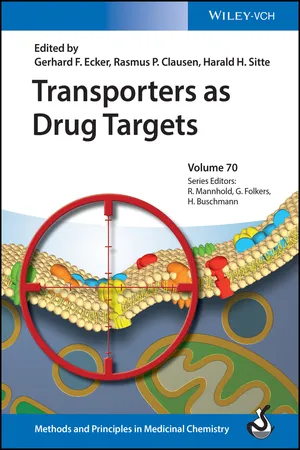
As opposed to other books on the topic, this volume is unique in also covering emerging transporter targets.
Following a general introduction to the importance of targeting transporter proteins with drugs, the book systematically presents individual transporter classes and explains their pharmacology and physiology. The text covers all transporter families with known or suspected importance as drug targets, including neurotransmitter transporters, ABC transporters, glucose transporters and organic ion transporters. The final part discusses recent advances in structural studies of transport proteins, assay methods for transport activity, and the systems biology of transporters and their regulation.
With its focus on drug development issues, this authoritative overview is required reading for researchers in industry and academia targeting transport proteins for the treatment of disease.
eBook - ePub
Transporters as Drug Targets
- English
- ePUB (mobile friendly)
- Available on iOS & Android
eBook - ePub
Transporters as Drug Targets
About this book
Information
1
Insights into Transporter Classifications: an Outline of Transporters as Drug Targets
Michael Viereck,1 Anna Gaulton,2 and Daniela Digles1
1University of Vienna, Department of Pharmaceutical Chemistry, Althanstrasse 14, 1090 Vienna, Austria
2EMBL – European Bioinformatics Institute, Wellcome Trust Genome Campus, Hinxton, Cambridge, CB10 1SD, UK
1.1 Introduction
Classifications are a useful tool to get an overview of a topic. They show instances grouped together that share common properties according to the creator of the classification, and as in the case of hierarchical classifications, they allow to draw conclusions on the relation of different classes. In the case of the identification of drug targets (including transporters as the main drug target), several publications show classifications as a helpful tool.
Imming et al. [1] categorized drugs according to their targets, to get an estimate on the number of known drug targets, including channels and transporters. Drugs on the market were connected to a target only if it was described as the main target in the literature. For transport proteins (including uniporters, symporters, and antiporters), this identified six different types of transporter groups that are relevant as drug targets. These are the cation-chloride cotransporter (CCC) family (SLC 12), Na+/H+ antiporters (SLC 9), proton pumps, Na+/K+ ATPases, the eukaryotic (putative) sterol transporter (EST) family, and the neurotransmitter/Na+ symporter (NSS) family (SLC 6). These families mainly belong to either ATPases or solute carriers (SLC). Whether the EST family is treated as transport protein or not depends on the classification used.
Rask-Andersen et al. [2] used a manually curated and extended version of the DrugBank [3] data from 2009 to analyze drug targets. They identified 435 therapeutic effect-mediating targets, where the third largest group (67) is of transporter proteins (including 35 ion channels). These transport proteins are mainly targeted by antihypertensive drugs, diuretics, anaesthetics, and antiarrhythmic drugs. In a more recent study [4], they analyzed the Drugs in the Clinical Trials Database by CenterWatch to investigate the targets of new drug candidates. Transporter proteins in this data set were classified using the transporter classification (TC) system established by Saier et al. [5].
This chapter will first give an overview on selected existing transporter classifications and then describe our process of creating a combined classification scheme for the ChEMBL [6] database. Finally, the investigation of the counts of drugs and diseases for one example protein superfamily is provided, to show the usefulness of classifications in characterizing related proteins and to give a first overview on the topic of this book, focusing on transporters as drug targets.
1.2 Available Transporter Classifications
As a consequence of the significance of the transport process for every living organism, already numerous classification schemes for membrane transport proteins of several organisms exist. Quite a few focus only on specific families, for instance, the SLC superfamily or the ABC transporter superfamily. Table 1.1 shows a selection of membrane transport protein databases with a focus on human proteins. To keep the table concise, databases focusing on different organisms (e.g., the plant membrane protein database Aramemnon [7], the yeast transport protein database YTPdb [8], or ABCdb [9], a database about bacterial ABC systems) are not included, even though bacterial or protozoal channels and transporters can also be promising drug targets [10,11].
Table 1.1 Selection of transporter collections with a focus on human membrane transport proteins.
| Database | Description | URL | Included proteins | Limited to organisms |
| Bioparadigms SLC Series [12] | Online resource of the 52 human solute carrier families | slc.bioparadigms.org/ | Solute carriers | Homo sapiens |
| ChEMBL [6] | Large-scale bioactivity database for drug discovery | https://www.ebi.ac.uk/chembldb/target/browser | Proteins with bioactivity data | — |
| Human ABC transporters [13] | Basic information about human ABC transporters | www.nutrigene.... |
Table of contents
- Cover
- Methods and Principles in Medicinal Chemistry
- Title Page
- Copyright
- Preface
- A Personal Foreword
- Chapter 1: Insights into Transporter Classifications: an Outline of Transporters as Drug Targets
- Chapter 2: New Trends in Antidepressant Drug Research
- Chapter 3: The Molecular Basis of the Interaction Between Drugs and Neurotransmitter Transporters
- Chapter 4: γ-Aminobutyric Acid and Glycine Neurotransmitter Transporters
- Chapter 5: ABC Transporters: From Targets to Antitargets and Back
- Chapter 6: ABC Transporters Involved in Cholestasis
- Chapter 7: Recent Advances in Structural Modeling of ABC Transporters
- Chapter 8: PET Imaging of ABC Transporters at the Blood–Brain Barrier
- Chapter 9: The Systems Biology of Transporters – Targeting the Regulatory System for Transporters (FXR/RXR)
- Chapter 10: ANO1 as a Novel Drug Target
- Chapter 11: Ligand Discovery for the Nutrient Transporters ASCT2 and LAT-1 from Homology Modeling and Virtual Screening
- Chapter 12: Organic Anion Transporting Polypeptides as Drug Targets
- Index
- End User License Agreement
Trusted by 375,005 students
Access to over 1.5 million titles for a fair monthly price.
Study more efficiently using our study tools.
Frequently asked questions
Yes, you can cancel anytime from the Subscription tab in your account settings on the Perlego website. Your subscription will stay active until the end of your current billing period. Learn how to cancel your subscription
No, books cannot be downloaded as external files, such as PDFs, for use outside of Perlego. However, you can download books within the Perlego app for offline reading on mobile or tablet. Learn how to download books offline
Perlego offers two plans: Essential and Complete
- Essential is ideal for learners and professionals who enjoy exploring a wide range of subjects. Access the Essential Library with 800,000+ trusted titles and best-sellers across business, personal growth, and the humanities. Includes unlimited reading time and Standard Read Aloud voice.
- Complete: Perfect for advanced learners and researchers needing full, unrestricted access. Unlock 1.5M+ books across hundreds of subjects, including academic and specialized titles. The Complete Plan also includes advanced features like Premium Read Aloud and Research Assistant.
We are an online textbook subscription service, where you can get access to an entire online library for less than the price of a single book per month. With over 1.5 million books across 990+ topics, we’ve got you covered! Learn about our mission
Look out for the read-aloud symbol on your next book to see if you can listen to it. The read-aloud tool reads text aloud for you, highlighting the text as it is being read. You can pause it, speed it up and slow it down. Learn more about Read Aloud
Yes! You can use the Perlego app on both iOS and Android devices to read anytime, anywhere — even offline. Perfect for commutes or when you’re on the go.
Please note we cannot support devices running on iOS 13 and Android 7 or earlier. Learn more about using the app
Please note we cannot support devices running on iOS 13 and Android 7 or earlier. Learn more about using the app
Yes, you can access Transporters as Drug Targets by Gerhard F. Ecker, Rasmus P. Clausen, Harald H. Sitte, Gerhard F. Ecker,Rasmus P. Clausen,Harald H. Sitte, Raimund Mannhold,Gerd Folkers,Helmut Buschmann in PDF and/or ePUB format, as well as other popular books in Medicine & Pharmacology. We have over 1.5 million books available in our catalogue for you to explore.