
Hydrocarbons in Basement Formations
eBook - ePub

Hydrocarbons in Basement Formations

  1. English
  2. ePUB (mobile friendly)
  3. Available on iOS & Android
eBook - ePub

Hydrocarbons in Basement Formations

About this book

Petroleum and natural gas still remain the single biggest resource for energy on earth. Even as alternative and renewable sources are developed, petroleum and natural gas continue to be, by far, the most used and, if engineered properly, the most cost-effective and efficient, source of energy on the planet. Contrary to some beliefs, the industry can, in fact, be sustainable, from an environmental, economic, and resource perspective. Petroleum and natural gas are, after all, natural sources of energy and do not have to be treated as pariahs. This groundbreaking new text describes hydrocarbons in basement formations, how they can be characterized and engineered, and how they can be engineered properly, to best achieve sustainability.

Covering the basic theories and the underlying scientific concepts, the authors then go on to explain the best practices and new technologies and processes for utilizing basement formations for the petroleum and natural gas industries. Covering all of the hottest issues in the industry, from oil shale, tar sands, and hydraulic fracturing, this book is a must-have for any engineer working in the industry.

This textbook is an excellent resource for petroleum engineering students, reservoir engineers, supervisors & managers, researchers and environmental engineers for planning every aspect of rig operations in the most sustainable, environmentally responsible manner, using the most up-to-date technological advancements in equipment and processes.
Frequently asked questions

Yes, you can cancel anytime from the Subscription tab in your account settings on the Perlego website. Your subscription will stay active until the end of your current billing period. Learn how to cancel your subscription.
No, books cannot be downloaded as external files, such as PDFs, for use outside of Perlego. However, you can download books within the Perlego app for offline reading on mobile or tablet. Learn more here.
Perlego offers two plans: Essential and Complete
  • Essential is ideal for learners and professionals who enjoy exploring a wide range of subjects. Access the Essential Library with 800,000+ trusted titles and best-sellers across business, personal growth, and the humanities. Includes unlimited reading time and Standard Read Aloud voice.
  • Complete: Perfect for advanced learners and researchers needing full, unrestricted access. Unlock 1.4M+ books across hundreds of subjects, including academic and specialized titles. The Complete Plan also includes advanced features like Premium Read Aloud and Research Assistant.
Both plans are available with monthly, semester, or annual billing cycles.
We are an online textbook subscription service, where you can get access to an entire online library for less than the price of a single book per month. With over 1 million books across 1000+ topics, we’ve got you covered! Learn more here.
Look out for the read-aloud symbol on your next book to see if you can listen to it. The read-aloud tool reads text aloud for you, highlighting the text as it is being read. You can pause it, speed it up and slow it down. Learn more here.
Yes! You can use the Perlego app on both iOS or Android devices to read anytime, anywhere — even offline. Perfect for commutes or when you’re on the go.
Please note we cannot support devices running on iOS 13 and Android 7 or earlier. Learn more about using the app.
Yes, you can access Hydrocarbons in Basement Formations by M. R. Islam,M. E. Hossain,A. O. Islam in PDF and/or ePUB format, as well as other popular books in Physical Sciences & Energy. We have over one million books available in our catalogue for you to explore.

Information

Year
2018
Print ISBN
9781119294221
eBook ISBN
9781119294481
Edition
1
Subtopic
Energy

Chapter 1
Introduction

1.1 Summary

Hydrocarbons and their transformations play major roles in sustaining today’s civilization. Petroleum fluids are essential for providing chemical and energy sectors with raw materials that are needed for practically all aspects of modern living ranging from transportation to health and medicine. After water, crude oil is the most abundant naturally occurring fluid on earth. However, the modern era has few direct applications of crude oil and practically none of the produced petroleum is processed, either through refining or gas processing, prior to final use. Unfortunately, all modern techniques for refining are also known to be inherently damaging to the environment. In the information age, environmental sustainability has become the most important concern and there is a growing urge to find either an alternative to petroleum fluids or any technology that ‘minimizes’ the environmental impact. While some progress has been made in developing alternate energy sources, few, if any, present a truly sustainable option. More importantly, no realistic alternate source, sustainable or otherwise, for millions of tons of chemical raw materials for the chemical/medical industries has been suggested. In this regard, basement reservoirs offer an unprecedented opportunity. However, the true benefit of the petroleum fluids produced from basement reservoirs cannot be appreciated without thorough scientific understanding of their nature. This is the first textbook that makes a scientific investigation into the nature of basement rock, the origin of the petroleum that impregnates these rocks and how to properly characterize the behavior of these rock/fluid systems. It is shown with clarity that basement fluids are amenable to sustainable petroleum usage and with careful management skills they can become the hallmark of a sustainable source of both energy and chemical raw materials. This textbook explains the fundamental features of the hydrocarbons in the basement, geological aspects of fractures and types of fractures, and a novel reservoir characterization technique. Two dominant theories of the origin of basement fluids are presented in detail and arguments made in supporting the validity of these theories within a specific domain. It covers almost all seismic techniques including geological techniques, geophysical tools, micro log analysis and borehole techniques, with a focus on fracture networks. A guideline for scientific characterization is presented in order to determine the ranking of petroleum fluids. This book deals with the interpretation and modeling of the fracture network as well as risk analysis and reserve estimation of these kinds of reservoirs.

1.2 Is Sustainable Petroleum Technology Possible?

Even though petroleum continues to be the world’s most diverse, efficient, and abundant energy source, due to “grim climate concerns”, global initiatives are pointing toward a “go green” mantra. When it comes to defining ‘green’, numerous schemes are being presented as ‘green’ even though all it means is the source of energy is not carbon. In fact the ‘left’, often emboldened with ‘scientific evidence’, blames carbon for everything, forgetting that carbon is the most essential component of plants. The ‘right’, on the other hand, deny climate change altogether, stating that it is all part of the natural cycle and there is nothing unusual about the current surge in CO2 in the atmosphere. Both sides ignore the real science behind the process. The left doesn’t recognize the fact that artificial chemicals added during the refining process make the petroleum inherently toxic.
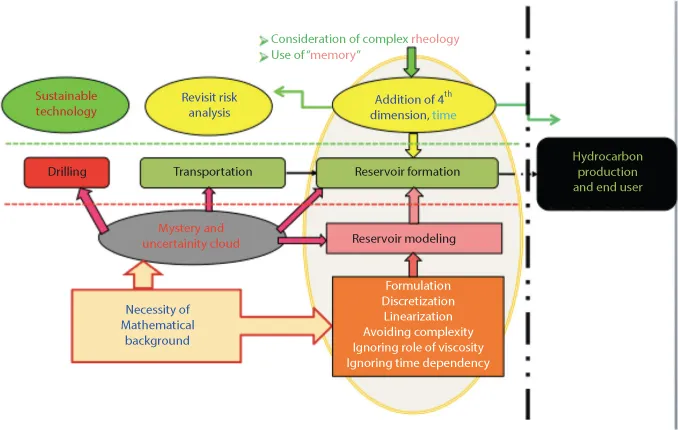
The study of sustainability is a complex science as it involves subsurface and surface, natural and artificial materials, with very high ratio of unknowns over known information (Figure 1.1). Any false step in the process shown in Figure 1.1 can trigger unsustainability. Both the science and the mathematics of the process have been deficient at best.
Figure 1.1 Various steps involved in petroleum technology.
In 2010, we (Islam et al., 2010) used detailed pathway analysis to identify flaws of various energy production schemes, including petroleum resource development. The source of alteration of CO2 quality that renders the CO2 unabsorbable by the ecosystem was identified for each case. CO2 emission data from the pre-industrial age all the way to the current era are then analyzed, showing a clear correlation between CO2 concentration in the atmosphere with ‘corrupt’ CO2 emission, which itself was a function of the fuel source, the path it travels, isotope numbers, and age of the fuel source. Various energy technologies were ranked based on their long-term sustainability. It was shown that petroleum is the most environmentally benign among the energy sources investigated, followed by biofuel, solar, wind, and nuclear. When the artificial chemicals are replaced with natural substitutes at various phases of petroleum processing, petroleum wastes become useful materials that can be recycled in the ecosystem in a zero-waste mode. Not only the by-products, including CO2 emissions, are benign, they are in fact beneficial to the environment. Each of these wastes can then become raw materials for value-added new products. Finally the paper offers guidelines for ‘greening’ of petroleum operations as well as the economics of zero-waste petroleum production and long-term environmental sustainability. So, if petroleum products are benign and offer the greatest hope for sustainable technology, which type of petroleum reservoirs are the best of the best? In this book, we disclose the facts about basement reservoirs and demonstrate that basement reservoir fluids are the most beneficial with the greatest possibility of value addition, as long as their processing is done targeting a particular application, uniquely suited for these fluids. Such a study was only possible after scientific characterization of the rock and fluid system.

1.3 Why is it Important to Know the Origin of Petroleum?

Petroleum fluids are synonymous with ‘fossil fuel’ or any fluid with organic origin. It turns out, invoking such a premise limits the ability of properly characterizing petroleum fluids, including the true source. This is particularly true for basement reservoirs that are known to have little resemblance to conventional fossil fuel. It is no surprise that oil and gas fields in crystalline basement are discovered mostly by accident, usually when the unassuming operator notices hydrocarbon shows. Yet, these reservoirs can be prolific and the overall estimate of petroleum reserve can go up with revamping of techniques to track basement reservoirs. The standard definition of crystalline basement by petroleum geologists is any metamorphic or igneous rock unconformably overlain by a sedimentary sequence. A somewhat more ‘scientific’ definition is given by Lartdes et al. (1960): “the only major difference between basement rock and the overlying sedimentary rock oil deposits is that in the former case the original oil-yielding formation (source rock) cannot underlie the reservoir.” This definition extends the limit of exploratory geological and geophysical studies significantly. However, this definition is still limiting as it suggests that a basement reservoir may be the result of hydrocarbon migration from sedimentary rock to older porous metamorphic or igneous rocks to form a basement reservoir, the likes of which were found in Japan, Mexico and the Maracaibo Basin of Venezuela (Schutter, 2003). As pointed out by Petford & McCafrey (2003), this narration is a mistake. The 1999 Gulf discovery of Suban gas field after penetration sufficiently deeply in the basement rocks proved this point. Similarly, literature is deficient in giving sufficient consideration to mixed convection heating from igneous rocks that can contribute to the maturation process in sediments that have been heated rapidly by magmatic intrusion (e.g., Saxby & Stephenson 1987; Stagpoole & FunnelI 200I; Schutter 2003), making excellent cap rocks (Chert et al., 1999).
The accurate knowledge of the source of the basement oil is pivotal for two reasons. First, this would create an impetus for broadening the exploration base for basement reservoirs. Secondly, the quality of oil will likely be linked to the source and thereby would open up different opportunities for processing for environmental integrity. The possible sources of basement fluids are investigated for both organic (Chapter 2) and nonorganic (Chapter 3) origins. Even more significant discussion is presented in Chapter 5 that shows scientific characterization of these reservoirs must include the accurate source of these fluids, in order to properly identify long-term pathways of various components present as well as applicability of the hydrocarbons in question.

1.4 What is the Likelihood of an Organic Source?

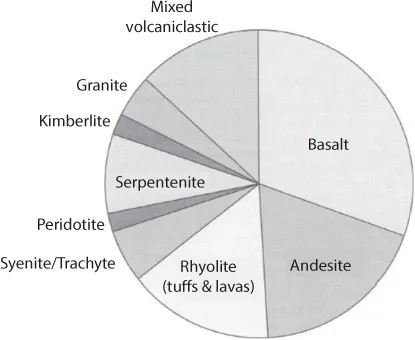
Not long ago, an organic source was the only one considered for defining petroleum fluids. Even though igneous rocks posed an interesting dilemma in terms of how organic matters accumulated there, there was no shortage of dogmatic interpretation of geologic history. However, more questions arise than answers exist concerning hydrocarbons in and around igneous rocks. Figure 1.2 shows the distribution of hydrocarbons in and around igneous rocks. This figure shows that the highest reported occurrences are in basalts, followed by andesite and rhyolite tufts and lavas. Although volcanic rocks in this survey constitute close to three-quarters of all hydrocarbon-bearing lithotypes, the majority of production and global reserves appears to be confined predominantly to fractured and weathered granitic rocks (Petford & McCafrey, 2003).
Figure 1.2 The distribution of hydrocarbons in and around igneous rocks according to lithology (from Schutter 2003).
In order to make a non-controversial conclusion regarding the source of this hydrocarbon, one would need to have more data on magma composition as well as the process of hydrocarbon generation in an inorganic setting. However, logical inference allowed us to determine with moderate certainty how much oil is organic in the basement reservoirs.
Chapter 2 establishes a systematic framework for the study of the sources of basement hydrocarbons practical applications that arise. This should include consideration of the relationship to possible source rocks, the maturation history, the possible migration pathways, the possible reservoir characteristics and the type of traps likely to be present. In Chapter 2, the fundamental features of the hydrocarbons in basement reservoirs are discussed, along with the source of hydrocarbon, mechanism of formation and types of basement reservoirs are defined and discussed. Logical explanations are provided for each aspect of the theories presented. Finally, the framework of scientific investigation of the origin of hydrocarbons is laid out in order to facilitate the study of sustainability and the true nature of hydrocarbons.

1.5 What is...

Table of contents

  1. Cover
  2. Title page
  3. Copyright page
  4. Dedication
  5. Foreword
  6. Chapter 1: Introduction
  7. Chapter 2: Organic Origin of Basement Hydrocarbons
  8. Chapter 3: Non-organic Origin of Basement Hydrocarbons
  9. Chapter 4: Characterization of Basement Reservoirs
  10. Chapter 5: Case Studies of Fractured Basement Reservoirs
  11. Chapter 6: Scientific Characterization of Basement Reservoirs
  12. Chapter 7: Overview of Reservoir Simulation of Basement Reservoirs
  13. Chapter 8: Conclusions and Recommendations
  14. Chapter 9: References and Bibliography
  15. Index
  16. End User License Agreement