The book investigates the meaning of RRI if little or no valid knowledge about consequences of innovation and technology is available. It proposes a hermeneutical turn to investigate narratives about possible futures with respect to their contemporary meaning instead of regarding them as anticipations of the future.
- English
- ePUB (mobile friendly)
- Available on iOS & Android
eBook - ePub
The Hermeneutic Side of Responsible Research and Innovation
About this book
Information
1
What Makes New Science and Technology Meaningful to Society?
Intensive and sometimes controversial debates about new forms of technology, especially those embodying a visionary perspective, have become a dominant field of communication between science, technology and society in the past decades. They make up the largest portion of the debates in the field of responsible research and innovation (RRI). In this introductory chapter, I ask how the social and ethical interest in new technology arises – in other words, how scientific and technical developments in the laboratory or in modeling are given real social meaning. The directions I examine in this book exist in a practical context. The objective is to clarify RRI studies and discussions about their roots and thus to contribute to a more transparent democratic debate over the direction and utilization of scientific and technological progress. The generation of sociotechnical meaning, which – according to my thesis – is essential for making new technology interesting for RRI debates, is not a task for scientists and engineers alone but requires public involvement.
1.1. Motivation and objectives
The debate on responsible research and innovation (RRI) [OWE 13a, VAN 14a] has so far been focusing on a comprehensive understanding of innovation [BES 13], on participatory processes to involve stakeholders, citizens and affected persons in design processes and decision making [SYK 13], on understanding responsibility in industry [IAT 16], and on ethical conceptions of responsibility [GRI 13, GRU 14a, GIA 16]. Furthermore, it is concerned to a large extent with identifying specific characteristics of RRI in order to distinguish it from established approaches to reflection on science and technology, such as technology assessment [GRU 09a], value sensitive design [VAN 13a], science, technology and society (STS) studies [WOO 14] and applied ethics [CHA 97]. Considerable effort is spent on profiling RRI among these approaches [OWE 13b, GRU 11a, VON 12].
These topics are without a doubt central to the further development of RRI. However, other aspects might also be crucial and must not be neglected. A question that has so far attracted hardly any attention is how the issues and challenges that are analyzed, discussed and reflected from different perspectives in the context of RRI come into being. My supposition is that this question is uncharted territory for RRI that is untapped in both an analytical and a practical sense. The goal of the book is to undertake some first steps toward exploring this uncharted territory. To provide a brief outline at the outset, I would like to make five observations at the beginning that should motivate the analyses presented in this book:
- 1) A first observation motivating this book is that RRI debates in the field of NEST1 (new and emerging science and technology) do not focus on those technologies as such. For RRI debates to arise at all, the respective NEST developments such as synthetic biology, human enhancement or autonomous robotics must rather show relevant meanings [VAN 14b] in ethical, cultural, economic, social or political respects. A purely scientific breakthrough or a huge experimental success in laboratory research does not have any societal meaning per se. They may be scientifically or technologically fascinating but will not find resonance beyond unless a further step is done: it is only the sociotechnical combination of scientific and technological advance or projections, on the one hand, and their possible societal consequences and impacts, on the other, which triggers RRI debates. There would not be any RRI interest in NEST developments without the technological advance stories being related to expected, promised or feared societal consequences and implications. Only this second step makes new science and technology meaningful to society and a fascinating and often contested issue in society and its RRI debates. Then, questions will arise as to what might be in store for us or for future society, what might be at stake in ethical, political or social respects and what the NEST developments under consideration could mean in different respects for the future of humans and society. It is precisely these questions on the sociotechnical meaning of NEST that constitute the paramount object of the often controversial RRI debates. Thus, it appears obvious that we must deal explicitly with the issue of how these meanings are created and attributed, what their contents are, how they are communicated and disseminated and what consequences these attributions of meanings have in the RRI debates and beyond, e.g. for public opinion forming and political decision making.
- 2) The second observation guiding the analyses in this book concerns the role of futures for the creation and assignment of meaning, in particular the role of techno-visionary futures in NEST fields. A large body of research literature of the recent years legitimates stating that a major mechanism of assigning meaning to NEST developments is telling stories about the future impact and consequences, the expected benefits and risks of new technology under consideration for the future development of society, humankind or individual life. Techno-futures, in particular techno-visionary futures, play a key role in the attribution of meaning to NEST developments. In these futures, projections of new technology are associated with future images of humans and society, often in a purely hypothetical and thus also speculative manner: “Those anticipations are meaning-giving activities, and their function is to prevent choices being taken blindly, or on the basis of too narrow fantasies of future actions which focus only on a sub-selection of possible follow-up actions and ignore significant groups of stakeholders” [VAN 14b, p. 102].This observation (see Chapter 3) makes it possible to productively use the knowledge acquired in the previous decade about the role of techno-futures and visions [SEL 07, ROA 08, GRU 12a, COE 13, NOR 14] in order to investigate how meaning is assigned to new technologies by relating them to narratives of the future. These narratives involve perceptions, issues being considered as problems, expectations and hopes, worries and anxieties that give rise to questions and controversies. This field of “contested futures” [BRO 00] provides plenty of substance for RRI debates.
- 3) While the observation of the meaning-giving role of futures has already been discussed sporadically over the last years, the issue of how new sciences and technologies are defined and characterized and what the corresponding scoping processes and debates on an adequate characterization add to the meaning of those sciences and technologies has not been explicitly considered yet. Despite the fact that we have witnessed extensive and complex debates on the definition of nanotechnology [SCH 03, DEC 06], on the understanding of synthetic biology compared to other fields of biology and biotechnology [PAD 14], and on the understanding of human enhancement [GRU 12b], there is no conceptual debate on the meaning-giving function of these debates and processes. This seems surprising because obviously answers to questions such as what is substantially different between the NEST developments under consideration and existing lines of research and development are of high importance to attach societal meaning to them (see Chapter 4). Thus, the third observation to be substantiated in this book is that processes and controversies around the definition and characterization of new sciences and technologies are of major relevance for assigning meaning to them.
- 4) At this point, a fourth observation motivating this book becomes apparent. The attribution of meaning to a new technology by relating future stories to it or by proposing specific definitions usually takes place at a very early stage of development. In most cases, it will precede the respective RRI debate or accompany it in its nascent stage, but can then strongly mold the debate’s further development. Whether, for example, enhancement technology is attributed the meaning of offsetting inequalities in the physical and mental attributes of different humans and thus of leading to more fairness, or whether it is supposed to be used to fuel the competition for influential positions in the sense of promoting super-humans illustrates the great difference. Depending on which prevails, the respective NEST field will be assigned to one of these completely different discussions and put in a different context. The example shows that the assignment of meaning can heavily influence public debates and can possibly be crucial to public perception and attitudes by highlighting either chances or risks. At the end of the day, the assignment of meaning may even be decisive for social acceptance or rejection of that technology as well as for policy and decision making on the promotion or regulation of research and development. Thus, the possibly high impact of assigning meaning to NEST developments leads to the postulate of an early critical reconstruction, analysis and assessment of those meaning assignment processes, their results and their communication in order to enlighten the debate and to shed light on blind spots of those processes and debates (see section 1.2).
- 5) The final basic observation guiding the analyses to be provided in this book is that uncovering processes of assigning meaning to NEST developments involves considerable conceptual and methodological challenges. The assignments of meaning via techno-visionary futures, on the one hand, and by processes of definition and characterization, on the other hand, are interpretations, associations and, in the case of futures, partially speculations showing an epistemologically precarious nature and lacking strategies of proving them objectively. Mostly, it is extremely difficult or even impossible to say anything about the validity and reliability of those meaning-giving propositions – which, however, might have a major impact following the fourth observation above. This observation raises the questions of how to provide a well-reflected orientation for society and decision makers involved in NEST debates and policies. Provision of orientation knowledge is at the core of RRI – however, in the situation of lack of valid knowledge, traditional approaches based on consequentialist reasoning do no longer work (see Chapter 3) [GRU 14b]. If RRI and technology assessment nevertheless is to substantially contribute “to achieve better technology in a better society” [RIP 95] by analyzing meaning-giving processes, new approaches have to be developed. The hermeneutic approach sketched in this book will contribute to the development and application of a new type of reasoning and policy advice in debates on future technology beyond traditional consequentialism. Its objective is to allow deciphering the meanings assigned to NEST developments as early as possible in order to allow and support more transparent and enlightened debate.
These five observations are illustrated in Figure 1.1, which presents two elements:
- – first, the creation and development of meaning and its attribution, whether by means of technology futures or characterizations, are regarded a hermeneutic circle: the available meanings on offer are communicated and discussed and, in the process, supplemented or modified. The history of the definition of nanotechnology [SCH 03] is an excellent example of this (see Chapter 5);
- – second, this hermeneutic circle itself must have been created at some point. There must have been acts in which meaning is attributed, representing the first steps, and the hermeneutic circle mentioned above can then develop out of them. For nanotechnology, Richard Feynman’s famous lecture [FEY 59] or the book Engines of Creation [DRE 86] might have been such first steps or at least early steps in the process of creation.
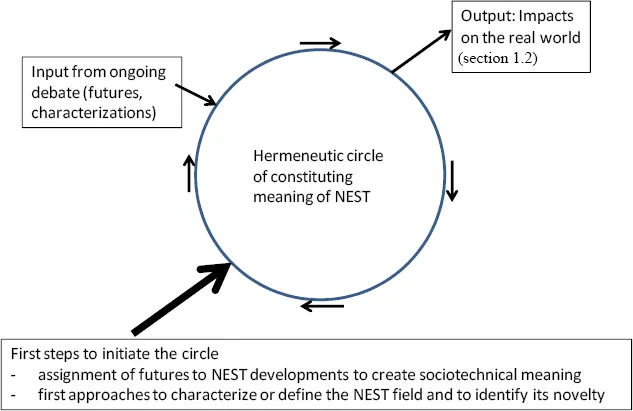
Figure 1.1. The creation of meaning for NEST in a hermeneutic circle, including its stimulus
The illustration makes it clear how great an influence such initial steps can have by decisively molding the ensuing debate and that in the hermeneutic circle these steps can only be gradually modified by alternative suggested meanings. On the other side of the image, so to speak as the output of the hermeneutic circle at a certain point in time, are the real consequences (section 1.2), for example with regard to funding for research or shaping the social debate. Clarification of the workings of the hermeneutic circle, in particular of its beginnings, is therefore a central task for us to be able to discuss the real output in as transparent a manner as possible, for instance, in the framework of public debates.
It is interesting to observe that the concept of hermeneutics – the study of understanding and meaning themselves – has been mentioned from time to time, althoug...
Table of contents
- Cover
- Table of Contents
- Title
- Copyright
- Foreword
- Preface
- 1 What Makes New Science and Technology Meaningful to Society?
- 2 Extending the Object of Responsibility Assessments in RRI
- 3 Assessing Responsibility by Considering Techno-Futures
- 4 Definitions and Characterizations of NEST as Construction of Meaning
- 5 Understanding Nanotechnology: A Process Involving Contested Assignments of Meaning
- 6 Robots: Challenge to the Self-Understanding of Humans
- 7 Enhancement as a Cipher of the Future
- 8 Technology to Combat Climate Change: the Hermeneutic Dimension of Climate Engineering
- 9 Hermeneutic Assessment: Toward an Interdisciplinary Research Program
- Inspiration Behind the Chapters
- Bibliography
- Index
- End User License Agreement
Trusted by 375,005 students
Access to over 1.5 million titles for a fair monthly price.
Study more efficiently using our study tools.
Frequently asked questions
Yes, you can cancel anytime from the Subscription tab in your account settings on the Perlego website. Your subscription will stay active until the end of your current billing period. Learn how to cancel your subscription
No, books cannot be downloaded as external files, such as PDFs, for use outside of Perlego. However, you can download books within the Perlego app for offline reading on mobile or tablet. Learn how to download books offline
Perlego offers two plans: Essential and Complete
- Essential is ideal for learners and professionals who enjoy exploring a wide range of subjects. Access the Essential Library with 800,000+ trusted titles and best-sellers across business, personal growth, and the humanities. Includes unlimited reading time and Standard Read Aloud voice.
- Complete: Perfect for advanced learners and researchers needing full, unrestricted access. Unlock 1.5M+ books across hundreds of subjects, including academic and specialized titles. The Complete Plan also includes advanced features like Premium Read Aloud and Research Assistant.
We are an online textbook subscription service, where you can get access to an entire online library for less than the price of a single book per month. With over 1.5 million books across 990+ topics, we’ve got you covered! Learn about our mission
Look out for the read-aloud symbol on your next book to see if you can listen to it. The read-aloud tool reads text aloud for you, highlighting the text as it is being read. You can pause it, speed it up and slow it down. Learn more about Read Aloud
Yes! You can use the Perlego app on both iOS and Android devices to read anytime, anywhere — even offline. Perfect for commutes or when you’re on the go.
Please note we cannot support devices running on iOS 13 and Android 7 or earlier. Learn more about using the app
Please note we cannot support devices running on iOS 13 and Android 7 or earlier. Learn more about using the app
Yes, you can access The Hermeneutic Side of Responsible Research and Innovation by Armin Grunwald in PDF and/or ePUB format, as well as other popular books in Business & Management. We have over 1.5 million books available in our catalogue for you to explore.