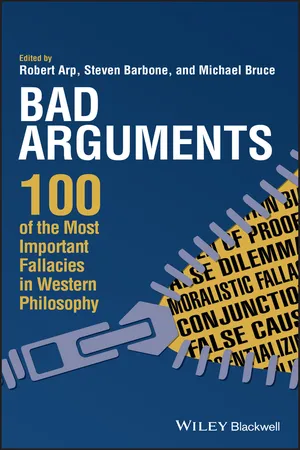
Bad Arguments
eBook - ePub

Bad Arguments

100 of the Most Important Fallacies in Western Philosophy

  1. English
  2. ePUB (mobile friendly)
  3. Available on iOS & Android
eBook - ePub

Bad Arguments

100 of the Most Important Fallacies in Western Philosophy

About this book

A timely and accessible guide to 100 of the most infamous logical fallacies in Western philosophy, helping readers avoid and detect false assumptions and faulty reasoning 

You'll love this book or you'll hate it. So, you're either with us or against us. And if you're against us then you hate books. No true intellectual would hate this book.

Ever decide to avoid a restaurant because of one bad meal? Choose a product because a celebrity endorsed it? Or ignore what a politician says because she's not a member of your party? For as long as people have been discussing, conversing, persuading, advocating, proselytizing, pontificating, or otherwise stating their case, their arguments have been vulnerable to false assumptions and faulty reasoning. Drawing upon a long history of logical falsehoods and philosophical flubs, Bad Arguments demonstrates how misguided arguments come to be, and what we can do to detect them in the rhetoric of others and avoid using them ourselves.

Fallacies—or conclusions that don't follow from their premise—are at the root of most bad arguments, but it can be easy to stumble into a fallacy without realizing it. In this clear and concise guide to good arguments gone bad, Robert Arp, Steven Barbone, and Michael Bruce take readers through 100 of the most infamous fallacies in Western philosophy, identifying the most common missteps, pitfalls, and dead-ends of arguments gone awry. Whether an instance of sunk costs, is ought, affirming the consequent, moving the goal post, begging the question, or the ever-popular slippery slope, each fallacy engages with examples drawn from contemporary politics, economics, media, and popular culture. Further diagrams and tables supplement entries and contextualize common errors in logical reasoning.

At a time in our world when it is crucial to be able to identify and challenge rhetorical half-truths, this bookhelps readers to better understand flawed argumentation and develop logical literacy. Unrivaled in its breadth of coverage and a worthy companion to its sister volume Just the Arguments (2011), Bad Arguments is an essential tool for undergraduate students and general readers looking to hone their critical thinking and rhetorical skills.

Frequently asked questions

Yes, you can cancel anytime from the Subscription tab in your account settings on the Perlego website. Your subscription will stay active until the end of your current billing period. Learn how to cancel your subscription.
No, books cannot be downloaded as external files, such as PDFs, for use outside of Perlego. However, you can download books within the Perlego app for offline reading on mobile or tablet. Learn more here.
Perlego offers two plans: Essential and Complete
  • Essential is ideal for learners and professionals who enjoy exploring a wide range of subjects. Access the Essential Library with 800,000+ trusted titles and best-sellers across business, personal growth, and the humanities. Includes unlimited reading time and Standard Read Aloud voice.
  • Complete: Perfect for advanced learners and researchers needing full, unrestricted access. Unlock 1.4M+ books across hundreds of subjects, including academic and specialized titles. The Complete Plan also includes advanced features like Premium Read Aloud and Research Assistant.
Both plans are available with monthly, semester, or annual billing cycles.
We are an online textbook subscription service, where you can get access to an entire online library for less than the price of a single book per month. With over 1 million books across 1000+ topics, we’ve got you covered! Learn more here.
Look out for the read-aloud symbol on your next book to see if you can listen to it. The read-aloud tool reads text aloud for you, highlighting the text as it is being read. You can pause it, speed it up and slow it down. Learn more here.
Yes! You can use the Perlego app on both iOS or Android devices to read anytime, anywhere — even offline. Perfect for commutes or when you’re on the go.
Please note we cannot support devices running on iOS 13 and Android 7 or earlier. Learn more about using the app.
Yes, you can access Bad Arguments by Robert Arp, Steven Barbone, Michael Bruce, Robert Arp,Steven Barbone,Michael Bruce in PDF and/or ePUB format, as well as other popular books in Philosophy & Logic in Philosophy. We have over one million books available in our catalogue for you to explore.

Information

Part I
Formal Fallacies

Propositional Logic

1
Affirming a Disjunct

Jason Iuliano
You have two choices with Obama. You either believe that he is a man of Christ, or you think he’s a liar.
Penn Jillette
Can you spot the logical error in Penn Jillette’s statement? If so, you’ve identified the fallacy known as affirming a disjunct (AAD). If not, don’t worry. In short order, you’ll see just where Penn’s argument went astray. Let’s begin by considering a straightforward example:
Either Madison likes cats or she likes dogs. I know she likes cats. Therefore, she doesn’t like dogs.
This argument is flawed because it fails to account for the possibility that Madison likes both cats and dogs. Here’s the example mapped out in logical form.
Example Logic
Premise 1 Madison likes cats or she likes dogs. A or B.
Premise 2 Madison likes cats. A.
Conclusion Madison doesn’t like dogs. Not B.
As you can infer from the table above, this fallacy is caused by an ambiguity in the English word or. Because context makes the meaning clear in everyday usage, you might never have thought about this ambiguity before, but you actually use the word or in two very distinct ways. One type of or is known as “inclusive,” and the other type is known as “exclusive.” Since this difference is the key to understanding the fallacy of AAD, let’s take a moment to explore it.
When you were a child, your mother probably had a hard time convincing you to eat your vegetables. At some point, she likely said, “Either you eat your veggies or you’re not getting dessert.” Chances are, you diligently ate your vegetables and your mother brought out dessert a short while later. But why did you understand your mom’s statement as a bargain? What made it clear that if one event happened (i.e., eating your vegetables), then the other would not (i.e., not getting dessert)? The answer lies in your belief that your mother was using an exclusive or.
Now, suppose that you ate your vegetables, but your mom failed to provide dessert. You would’ve approach her and complained, “Mom you promised dessert if I ate my vegetables!” But what if she responded, “No, I didn’t, Sweetie. I said, ‘Either you eat your veggies or you’re not getting dessert.’ You ate your veggies and you didn’t get dessert, so my statement is truthful. You really should listen more carefully.”
Aside from ensuring that you’ll never again eat your vegetables in exchange for dessert, what has your mother taught you? Well, she has given you a valuable lesson in the difference between two types of or.
Let’s break them down, so you’ll never be fooled again. On the one side, there is the inclusive or. This is the or used in classical logic. Take the basic proposition “Either A or B.” If this proposition is using an inclusive or, it is true in three circumstances:
  1. A is True.
  2. B is True.
  3. Both A and B are True.
Therefore, if your mother intended to use this inclusive or, her statement would have been true in three situations:
  1. You eat your veggies.
  2. You don’t get dessert.
  3. You eat your veggies AND you don’t get dessert.
Unlucky for you, it was this third possibility that playe...

Table of contents

  1. Cover
  2. Table of Contents
  3. Introduction
  4. Part I: Formal Fallacies
  5. Propositional Logic
  6. Categorical Logic
  7. Part II: Informal Fallacies
  8. Fallacies of Relevance
  9. Fallacies of Ambiguity
  10. Fallacies of Presumption
  11. Index
  12. End User License Agreement