This book provides a comprehensive view of green communications considering all areas of ICT including wireless and wired networks. It analyses particular concepts and practices, addressing holistic approaches in future networks considering a system perspective. It makes full use of tables, illustrations, performance graphs, case studies and examples making it accessible for a wide audience.
Konstantinos Samdanis1, Peter Rost1, Michela Meo2, Christos Verikoukis3 and Andreas Maeder1
1NEC Europe Ltd, Heidelberg, Germany
2Politecnico di Torino, Torino, Italy
3Telecommunications Technological Centre of Catalonia, Barcelona, Spain
1.1 Origins of Green Communications
Climate change and energy crisis are not just a vague future problems, as their effects are becoming apparent at a rapid pace. Greenhouse emissions, such as
and methane, cause global warming with catastrophic consequences on planet and on the human society as documented in Ref. [1]. The Kyoto protocol to the United Nations Framework Convention on Climate Change (UNFCCC) established in 1997 indicates that mainly the developed countries are responsible for the current levels of greenhouse gases, followed by a strong objective to take action against global warming. In the Conference of the Parties (COP) 17 climate change conference in Durban, 2011 scientists raised concerns that the measures taken so far are not sufficient to avoid global warming beyond
(a limit established in the G8 meeting in L'Aquila in June 2009 to avoid unpredictable environmental damage) and more urgent action is needed. Besides environmental concerns, the energy crisis becomes apparent with claims stating that approximately 50% of the world petroleum resources are already exploited [2], creating major obstacles for power supply with negative consequences on the economy. In general, energy pricing influenced by fuel prices is showing an increasing trend according to the forecast study performed by the Energy Information Administration (EIA) of the US Department of Energy [3].
As the use of Information Communication Technology (ICT) becomes an essential part of human daily lifestyle allowing social and business interaction on a local and global scale, the pace of development and integration of new technologies is performed on an accelerating rate. According to ITU estimations, Internet users reached around 2.7 billion by the end of 2013, almost 40% of the world's population, whereas mobile cellular subscribers approach 7 billion, with the mobile broadband being the most dynamic market with 2.1 billion subscribers globally [4]. Effectively, such enormous adoption of ICT is accompanied by a massive growth of the number of user devices, wireless, indoor, transport, core and data center networks and services, raising significant cost and sustainability concerns. In particular, ICT across a wide range of applications currently accounts for 5.7% of the world's electricity consumption and 1.8% of
emissions [5], stressing the need for enhancing energy efficiency in ICT products. Data from different telecommunication operators globally confirms their huge consumption of electricity as summarized in Ref. [6].
To comprehend the energy consumption of modern telecommunication systems considering the expected scale of increase, a summary of historic and near-future global traffic volumes for the mature markets over the decade 2010–2020 regarding mobile access, wireline and core networks is illustrated in Table 1.1 [7]. From the traffic growth projections, it becomes evident that there is a significant increase on mobile access, but with the wireline access and core networks still carrying the majority of user traffic. Multimedia applications and particularly video is one of the main contributors of such significantly higher traffic volumes, with Cisco Internet traffic projection forecasting that in 2015 the video consumption will reach one million video minutes per second, which is equivalent of 674 days [8]. Such tremendous data growth also as a consequence of the increasing population of users that can afford ICT services, raises new economic and sustainability challenges for network operators, which face the need of expanding their deployed network infrastructure in order to cope with the continuously increasing traffic volumes. Furthermore, the introduction of novel architectures and technologies, for example, machine-to-machine communications, smart grid, automotive, social media, smart cities, adds an extra degree of complexity to the network design, generating a compulsory need for holistic end-to-end approaches for the network operation.
Table 1.1 Traffic projections between 2010 and 2020 for the mobile access, wireline access and core networks modeled by GreenTouch for the Mature Market segment [7]
Mature market traffic projections (PB/month)
Year
Mobile access
Wireline access
Core network
2010
161
7,727
10,707
2015
3,858
33,879
45,402
2020
14,266
74,462
103,085
2020/2010
89x
9.6x
9.6x
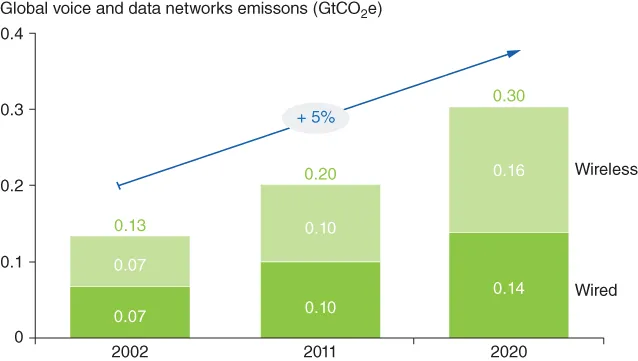
The telecommunication networks' greenhouse emissions growth rate is expected to continuously increase as illustrated in Figure 1.1. Wireless and wireline networks accounted for an equal share on greenhouse emissions between 2002 and 2011 with a footprint of 0.13 and 0.20 gigatons of
equivalent (GtCO2e), respectively. However, the remarkably high data volumes in the mobile communications sector and the launch of fourth-generation (4G) long-term evolution (LTE) networks have the consequence of increasing the wireless greenhouse footprint to 0.16 GtCO2e compared to a wireline equivalent of 0.14 GtCO2e anticipating the adoption of fiber optics that significantly lower the energy consumption.
Figure 1.1 Telecommunication system emissions between 2002 and 2020 showing wireless and wireline contributions [9]
Besides economic and environmental matters, energy efficiency in telecommunication systems is particularly crucial for developing countries providing a means for bridging the digital divide. In such cases, cost is the main barrier and hence energy efficiency may reduce the operational expenses provisioning affordable ICT services. In addition, green communications relying on alternative energy sources may provide the means of equipping remote areas without or with limited power supply creating an environmental friendly ICT adoption in developing countries. Furthermore, energy efficient mechanisms and practices could prove critical for telecommunication systems in disaster situations, where the power generation or the distribution infrastructure is damaged. Specifically, network equipment that supports a low-power mode may sustain a basic operation available only for critical services.
1.2 Energy Efficiency in Telecommunication Systems: Then and Now
The problem of energy efficiency in telecommunication systems is not entirely new. Indeed, energy efficiency has always been a significant issue for maximizing the battery lifetime of handheld devices and wireless sensor nodes that operate autonomously without a power grid supply. Early solutions considering the field of cellular and portable communications focus on wireless and mobile terminals, notebooks, and personal digital assistants (PDAs). The main objective was to establish power saving modes or states, in where devices either operate with minimal power consumption or simply sleep, that is, freeze their prior operating state. Common examples are the idle mode of global system for mobile (GSM) communication devices or the hibernate/standby mode of laptops and PDAs.
Similarly, studies on ad hoc and wireless sensor networks have devoted major efforts on energy optimization with the goal of extending the entire system lifetime. A plethora of different energy saving techniques including device sleeping patterns, clustering and head selection for minimizing the energy expenditure of the ad hoc or sensor system as well as energy-aware routing and data aggregation protocols have been extensively analyzed [10, 11]. However, these studies concentrated primarily on the energy management of each device considering the ad hoc or sensor network in isolation. Probably the most widely studied energy problem concentrates on the transmission efficiency considering medium access control (MAC) protocols, error correction, and radio channel gain techniques [12]. Again the focus concentrates on the device energy efficiency since transmission and radio optimizations simply reduce the device processing and forwarding.
These early efforts attempt to extend the lifetime of devices without a power supply. Fundamentally, this is different from the current trend of green communications and energy efficiency in ICT, which seeks solutions to reduce the energy consumption and the
footprint of network equipment and ICT systems irrespective of power supply limitations usually at off-peak time or when equipment are not in use. Effectively, strategies, mechanisms, and protocols, which stretch along home and enterprise networks, wireless access and cellular networks, transport, and the Internet, are considered with the goal to introduce adaptive operations based on load variations and new equipment design and system architectures with reduced the energy consumption needs.
Such a green communication vision has also got momentum within ICT government and regulatory bodies, especially since the launch of the Kyoto protocol, which aimed to create policies and recommendations for developing and using ICT equipment and systems. Early efforts from the US environmental Protection Agency concentrated on energy efficiency of personal computers (PCs), peripherals, and monitors, establishing a voluntary labeling program referred to as Energy Star in 1992. The European Commission (EC) recognized since 1999 the need for further actions toward energy efficiency and green communications, introducing the code-of-conduct [13] to drive policies and recommend...
Table of contents
Cover
Title Page
Copyright
Table of Contents
List of Contributors
Preface
List of Abbreviations
Chapter 1: Introduction
Chapter 2: Green Communication Concepts, Energy Metrics and Throughput Efficiency for Wireless Systems
Chapter 3: Energy-Efficiency Metrics and Performance Trade-Offs of GREEN Wireless Networks
Chapter 4: Embodied Energy of Communication Devices: Modeling Embodied Energy for Communication Devices
Chapter 5: Energy-Efficient Base Stations
Chapter 6: Energy-Efficient Mobile Network Design and Planning
Chapter 7: Green Radio
Chapter 8: Energy-Efficient Operation and Management for Mobile Networks
Chapter 9: Green Home and Enterprise Networks
Chapter 10: Towards Delay-Tolerant Cognitive Cellular Networks
Chapter 11: Green MTC, M2M, Internet of Things
Chapter 12: Energy Saving Standardisation in Mobile and Wireless Communication Systems
Chapter 13: Green Routing/Switching and Transport
Chapter 14: Energy Efficiency in Ethernet
Chapter 15: Green Optical Networks: Power Savings versus Network Performance
Chapter 16: Energy-Efficient Networking in Modern Data Centers
Chapter 19: Information-Centric Networking: The Case for an Energy-Efficient Future Internet Architecture
Chapter 20: Energy Efficiency Standards for Wireline Communications
Chapter 21: Conclusions
Index
End User License Agreement
Trusted by 375,005 students
Access to over 1.5 million titles for a fair monthly price.
Study more efficiently using our study tools.
Frequently asked questions
Yes, you can cancel anytime from the Subscription tab in your account settings on the Perlego website. Your subscription will stay active until the end of your current billing period. Learn how to cancel your subscription
No, books cannot be downloaded as external files, such as PDFs, for use outside of Perlego. However, you can download books within the Perlego app for offline reading on mobile or tablet. Learn how to download books offline
Perlego offers two plans: Essential and Complete
Essential is ideal for learners and professionals who enjoy exploring a wide range of subjects. Access the Essential Library with 800,000+ trusted titles and best-sellers across business, personal growth, and the humanities. Includes unlimited reading time and Standard Read Aloud voice.
Complete: Perfect for advanced learners and researchers needing full, unrestricted access. Unlock 1.5M+ books across hundreds of subjects, including academic and specialized titles. The Complete Plan also includes advanced features like Premium Read Aloud and Research Assistant.
Both plans are available with monthly, semester, or annual billing cycles.
We are an online textbook subscription service, where you can get access to an entire online library for less than the price of a single book per month. With over 1.5 million books across 990+ topics, we’ve got you covered! Learn about our mission
Look out for the read-aloud symbol on your next book to see if you can listen to it. The read-aloud tool reads text aloud for you, highlighting the text as it is being read. You can pause it, speed it up and slow it down. Learn more about Read Aloud
Yes! You can use the Perlego app on both iOS and Android devices to read anytime, anywhere — even offline. Perfect for commutes or when you’re on the go. Please note we cannot support devices running on iOS 13 and Android 7 or earlier. Learn more about using the app
Yes, you can access Green Communications by Konstantinos Samdanis, Peter Rost, Andreas Maeder, Michela Meo, Christos Verikoukis, Konstantinos Samdanis,Peter Rost,Andreas Maeder,Michela Meo,Christos Verikoukis,Konstantinos Samdanis,Christos Verikoukis in PDF and/or ePUB format, as well as other popular books in Technology & Engineering & Mobile & Wireless Communications. We have over 1.5 million books available in our catalogue for you to explore.