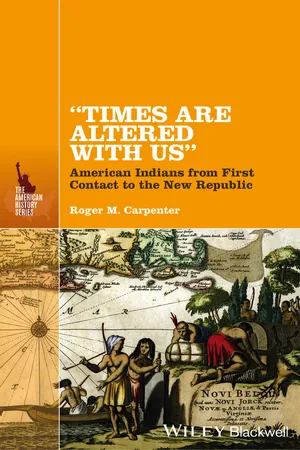
eBook - ePub
"Times Are Altered with Us"
American Indians from First Contact to the New Republic
- English
- ePUB (mobile friendly)
- Available on iOS & Android
eBook - ePub
"Times Are Altered with Us"
American Indians from First Contact to the New Republic
About this book
"Times Are Altered with Us": American Indians from Contact to the New Republic offers a concise and engaging introduction to the turbulent 300-year-period of the history of Native Americans and their interactions with Europeans—and then Americans—from 1492 to 1800.
- Considers the interactions of American Indians at many points of "First Contact" across North America, from the Gulf of Mexico to the Pacific and Atlantic Coasts
- Explores the early years of contact, trade, reciprocity, and colonization, from initial engagement of different Indian and European peoples—Spanish, French, Dutch, English, and Russian—up to the start of tenuous and stormy relations with the new American government
- Charts the rapid decline in American Indian populations due to factors including epidemic Old World diseases, genocide and warfare by explorers and colonists, tribal warfare, and the detrimental effects of resource ruination and displacement from traditional lands
- Features a completely up-to-date synthesis of the literature of the field
- Incorporates useful student features, including maps, illustrations, and a comprehensive and evaluative Bibliographical Essay
- Written in an engaging style by an expert in Native American history and designed for use in both the U.S. history survey as well as dedicated courses in Native American studies
Tools to learn more effectively

Saving Books

Keyword Search

Annotating Text

Listen to it instead
Information
1
1492 and Before
Before Europeans
In 1492, Europeans believed that they had “discovered” a “new world” when Italian explorer Cristóbal Colón (later anglicized into Christopher Columbus), sailing under the Spanish flag, returned from his first voyage. Native Americans would have dismissed both notions, first by noting that they had long known of the two continents that would eventually be known as the Americas and, therefore, they did not need to be discovered. They would have also refuted the idea that their lands constituted “a new world.” They and their ancestors had lived here for several millennia; if anything, Colón merely managed to connect two old worlds. Native Americans claimed that they had always been here, and like peoples all over the world, had their own explanations as to how the world began and as to where their ancestors came from. On the eve of contact with Europeans, over 500 different Native American communities, bands, and tribes, who spoke approximately 350 different languages, called North America home. With such a diversity of languages and communities, it should not be surprising that native peoples also had varying sets of beliefs concerning their origins. The creation stories of Native Americans often reflected the environments in which they lived.
A common theme among native peoples of both the Northeastern and Southeastern Woodlands is the notion that at one time the earth consisted of nothing but water. The Iroquoian peoples of the Northeast, for example, believe they are descended from Aataentsic, a woman who fell from the sky into this world, which at the time consisted of nothing but one vast ocean. One day in the sky world, a tree fell down. Aataentsic looked through the hole, astonished to see a world composed entirely of water, miles below her own. As she gazed through the hole, she accidentally slipped and fell through it. Despite frantically clawing at the sides of the hole for something to hang on to, she plunged downward through space, toward the world made of water. Seeing her fall from the sky, the aquatic animals inhabiting the water world – the beaver, otter, and muskrat – decided they must do something to save her. They asked the geese for help, who caught Aataentsic and placed her on the back of an enormous turtle. Aataentsic began to weep, and the aquatic animals asked her what was wrong. She explained that she could not survive without land. The aquatic animals dived to the bottom of the ocean, found a bit of mud, and gave it to Aataentsic, who placed it on the back of the turtle and watched as it expanded and became Turtle Island, or as we call it, North America. Pregnant when she fell into this world, Aataentsic soon gave birth to a daughter, who years later bore male twins. Continually at odds with one another, the twins often fought each other in the womb. When it came time to be born, one of the twins entered the world in the usual way, encouraging his brother to follow him. But the other twin ignored his sibling’s advice and introduced death into the world when he entered the world via his mother’s armpit. The twin who had been born in the usual way set about the business of improving the world, creating edible plants and rivers that ran both ways, so that people would find travel easier. Lacking his brother’s ability to create, the twin who killed his mother attempted to spoil his brother’s work, adding thorns and briars to plants and changing the rivers so that they ran only one way. In short, one twin made everything that is good in the world, while his brother did all he could to make the world unpleasant. In one of the final conflicts between the two siblings, the malevolent twin locked all of the animals in an underground cave. Humankind, lacking a source of meat, suffered because of this. Discovering what his brother had done, the benevolent twin freed the animals, setting up an epic battle between the two. The good twin beat his evil brother, striking him repeatedly with a set of buck’s antlers. The blood the evil twin shed as he fled from his brother transformed into flint, which Iroquois peoples used to make tools and weapons.
The Cherokee likewise believed that the earth at one time consisted wholly of water. In the beginning, all of the world’s animals lived in a stone vault in the sky. As the animals reproduced, the vault became crowded. The animals sent a water beetle to search for another place to live. The beetle found this world, but could only skip along its watery surface. Diving underwater, the beetle found some mud and placed it on the surface, where it magically began to grow and became land. Eager to leave the stone sky vault, the animals waited impatiently as their sodden and muddy new world dried. Each day, the animals sent one of the birds to fly over the earth to examine closely whether or not it had dried enough so that they could live on its surface. One day the animals sent the vulture to scout the drying earth, but he flew too low and his large wings inadvertently carved into its smooth damp surface, creating the hills and valleys of the Cherokee country of northern Georgia, the western Carolinas, and Tennessee.
Peoples that lived in other regions, such as the Pacific Northwest, had creation stories that reflected their environment as well. A common creation story of the Pacific Northwest begins with a beach pea (an aquatic plant) that, much like other beach peas, washed up on shore. But unlike other beach peas, this one contained a man, who snapped into consciousness. In this first moment of awareness, he realized he was in a place that was dark, clammy, and cramped. Stretching his arms and legs, the man burst out of the beach pea and stood on the beach, blinking as his eyes adjusted to the sunlight. As he looked around, he saw only earth, sky, and ocean. After a while, the man saw something flying in the sky. The object drew closer, circled the man, and landed several feet from him. The object turned out to be the Raven, who stood gazing at the man for some time. The Raven finally spoke and asked the man “what are you?” The man replied that he did not know. The Raven then asked the man where he came from and the man gestured toward the shattered remains of the beach pea. The Raven expressed surprise, indicating that he created all the man saw, including the beach pea, but he did not expect the man to burst out of it. Raven asked the man how he felt and the man gestured toward his stomach, indicating he felt hungry. The Raven showed the man how to get food and created animals for him to hunt. In time, he realized the man felt lonely, and made him a mate.
Remarkably common throughout Native North America, the flooded world motif reflected a blend of traditional creation stories and the post-contact influence of Christian missionaries. Whereas the western religious tradition relies on an all-powerful being who creates all that exists, deities – or perhaps near deities – in the Native American spiritual convention are powerful, but usually not all-powerful – nor are all wise. In the Cheyenne creation story, a near-omnipotent being creates light, sky, air, water, and the creatures that live in water and sky. But he cannot create land until he secures help from birds who dive under water and find a little bit of mud which he uses to make earth. Native deities and powerful spiritual beings can also be fallible, and can sometimes be the subject of mirth in stories that emphasize their all too human failures and foibles. For example, Nanabush, the Great Hare of the Anishinabeg people, helped create the world, and could vanquish powerful enemies. Yet he also managed to be entertaining (or offensive depending on your perspective), such as when he amused himself after learning how to propel himself through the air with his own flatulence.
European explorers and missionaries often noted that the native peoples of the Americas lacked literacy, and concluded that this somehow deprived them of the ability to record the past, and that they therefore must lack history. But all peoples, logically speaking, have a past and preserve some knowledge of it in some fashion. Europeans did not seem to realize that while native peoples did not record events in writing, they developed their own ways of remembering their past. The peoples of the Great Plains recorded important events in winter counts, which consisted of pictographs painted on animal hides. Often begun by one person and continued by another, some of these winter counts recorded more than a century’s worth of events. Peoples of the Northeastern Woodlands made belts or used strings of sewan (wampum) made from whelk shells that served as mnemonic devices. In the hands of individuals who knew what the strings and designs woven into the belts meant, the past could be preserved. Other native peoples used petroglyphs, carving their history into rock. Even today, in parts of the Southwest, the Great Plains, and western Canada, petroglyphs can still be seen (if not always wholly understood). But the most important element that enabled native peoples to preserve their past came through the development of strong oral traditions. In this manner, native peoples recorded histories, legends, and stories, repeating them and allowing them to be passed down to younger generations. While many of these histories are still told, or were later preserved in writing by missionaries and scholars, many of these stories – and the histories that accompanied them – disappeared forever when Cristóbal Colón unwittingly initiated a 400-year campaign in October of 1492 that would see Europeans and their descendants invade the Americas.
Invasions of America
Americans often think of Cristóbal Colón as the “discoverer” of the Americas. The obvious problem with this formulation is that the Americas had already been discovered; both continents already hosted large populations of native peoples. But even the notion that Colón was the first European to set foot in the Americas is mistaken. Five centuries earlier, in approximately the year 1000, the Norse, reputedly led by Leif Ericson, explored Baffin Island and Labrador, and established a small colony at the northern tip of Newfoundland. According to Norse oral tradition, the colonists frequently traded and fought with the natives, whom they referred to as Skraelings (“ugly wretches”). Harassed and under sporadic attack by the natives, and far from their other colonies in Greenland, the Norse abandoned the “new-found land” after only a decade. For centuries thereafter, other Europeans and many Americans regarded the story of Vinland, as the Norse termed it, as a myth. That changed in the 1960s, when Canadian archaeologists unearthed the remains of a Norse settlement at L’Anse Aux Meadows in Newfoundland.
We do not know what Cristóbal Colón knew, or did not know, about prior Norse exploration to the west, when on the evening of October 12, 1492, he sighted a dim light on the horizon as his small fleet of three ships made their way west. The next day, Colón recorded the first contact between Europeans and the native peoples of what would become known as the Americas. Portraying the Taino people he met as children of nature, Colón described them as “simple-minded and handsomely-formed,” and decided they knew nothing about war when one Indian – seeing steel implements for the first time – inadvertently cut himself when he handled a Spaniard’s sword blade. Colón did not correct himself, even after noting that several Taino men evidently knew something about violence, since they bore the “marks of wounds on their bodies.” Implying that he could somehow understand the Taino language, Colón emphasized what he regarded as their submissiveness, noting they were “very docile” and “should be good servants.” Having a messianic bent – Colón’s first name meant “Christ Bearer” – he also thought the Indians “would easily be made Christians, as it appeared to me that they had no religion.” While only initial impressions, Colón’s notions about the New World’s natives would dominate European thinking through the next 300 years and beyond, a period during which explorers, missionaries, and colonists embarked on the unsettling and resettling of the American continents. Subsequent European explorers made observations similar to Colón’s.
Historian Daniel K. Richter conceptualized the native view of the invasion of their continent by Europeans as one in which they “faced east.” Richter’s formulation works as a reversal of the dominant narrative of American history that depicts Europeans and Americans as relentlessly pushing west and wresting control of the continent from native peoples – that is, when native peoples are even included as part of the narrative. As late as the mid-twentieth century, histories of the settlement of the Americas treated native peoples almost as bystanders in the process of European colonization. But the notion that the European invasion of the Americas came from the east misses a key point; the intrusion actually came from all sides. Algonquin peoples living along the Atlantic coast did indeed face east as Europeans landed on their shores, but the native peoples of the Florida peninsula and the Gulf Coast saw the European invasion surge at them not only from the east, but from the west and south as well. The native peoples in the Southwest saw Spaniards invade their homelands from the south while in the sixteenth century, California’s native peoples faced west, and watched abortive Spanish and English invasions emerge from, then recede back into the surf of the Pacific. Two centuries later, the Spanish staged a successful overland invasion of the region from the south and would remain. The peoples of the Pacific Northwest – to some degree more fortunate since they were among the last to have contacts with Europeans – saw the invasion come at them from both the north and the south. Russian fur traders crossed the Bering Strait in the eighteenth century, gained a toehold in Alaska, and then moved south. Spanish traders, fearing Russian influence, moved northward from Alta California to counter them, only to later be displaced by the British.

Figure 1.1 A highly romanticized depiction of Cristóbal Colón’s landing on Hispaniola. Native people greet him with what appear to be gold and gems. Spanish sailors erect a cross in the background, carrying out the first of numerous “ceremonies of possession” that Europeans would perform over the next two centuries. This illustration also highlights one of the key differences that Colón noted in his writings. He and his fellow Spaniards are fully clothed, while the Indians are almost naked. “El Almirante Christoval Colon descubre la Isla Española” by Pieter Balthazar Bouttats.
Library of Congress Rare Book and Special Collections Division LC-USZ62-8390.
Rewriting “History”
European narratives often characterize contact with the Americas as a “discovery.” Native peoples, however, knew better. They had lived here for centuries. Exactly how long ago their ancestors arrived in the Americas is a matter of some dispute. Since native peoples lacked writing, Europeans “helpfully” fabricated histories for them. Fascinated with this previously unknown continent and its peoples, Europeans concocted all sorts of fanciful theories as to the origins of Native Americans. One theory held that the ancestors of Native Americans escaped the lost continent of Atlantis. Some English colonists (and some nineteenth-century Americans as well) claimed they could hear traces of the Welsh language in native peoples’ speech and argued that they must be the descendants of a lost western expedition led by a Welsh prince named Modoc in the twelfth century. One colonist went so far as to claim that he could speak Welsh and be perfectly understood by Indians. The most popular – and perhaps persistent – theory regarding the origins of native peoples drew on biblical texts, and argued that they must be descended from the 10 lost tribes of Israel. Scholars and missionaries claimed that many Amerindian languages contained a variety of Hebrew words. William Penn, the founder of the Pennsylvania col...
Table of contents
- Cover
- The American History Series
- Title page
- Copyright page
- List of Illustrations
- List of Maps
- Introduction
- 1 1492 and Before
- 2 Encountering the Spanish
- 3 Encounters with the French
- 4 English and Native People in the Southeast
- 5 Native Americans in New England
- 6 The Five Nations, the Dutch, and the Iroquois Wars
- 7 Seeking a Middle Ground
- 8 The Imperial Wars
- 9 Pontiac's Rebellion
- 10 The Great Plains and the Far West
- 11 Native Americans and the American Revolution
- 12 Coping with the New Republic
- Bibliographical Essay
- Index
- End User License Agreement
Frequently asked questions
Yes, you can cancel anytime from the Subscription tab in your account settings on the Perlego website. Your subscription will stay active until the end of your current billing period. Learn how to cancel your subscription
No, books cannot be downloaded as external files, such as PDFs, for use outside of Perlego. However, you can download books within the Perlego app for offline reading on mobile or tablet. Learn how to download books offline
Perlego offers two plans: Essential and Complete
- Essential is ideal for learners and professionals who enjoy exploring a wide range of subjects. Access the Essential Library with 800,000+ trusted titles and best-sellers across business, personal growth, and the humanities. Includes unlimited reading time and Standard Read Aloud voice.
- Complete: Perfect for advanced learners and researchers needing full, unrestricted access. Unlock 1.4M+ books across hundreds of subjects, including academic and specialized titles. The Complete Plan also includes advanced features like Premium Read Aloud and Research Assistant.
We are an online textbook subscription service, where you can get access to an entire online library for less than the price of a single book per month. With over 1 million books across 990+ topics, we’ve got you covered! Learn about our mission
Look out for the read-aloud symbol on your next book to see if you can listen to it. The read-aloud tool reads text aloud for you, highlighting the text as it is being read. You can pause it, speed it up and slow it down. Learn more about Read Aloud
Yes! You can use the Perlego app on both iOS and Android devices to read anytime, anywhere — even offline. Perfect for commutes or when you’re on the go.
Please note we cannot support devices running on iOS 13 and Android 7 or earlier. Learn more about using the app
Please note we cannot support devices running on iOS 13 and Android 7 or earlier. Learn more about using the app
Yes, you can access "Times Are Altered with Us" by Roger M. Carpenter in PDF and/or ePUB format, as well as other popular books in History & North American History. We have over one million books available in our catalogue for you to explore.