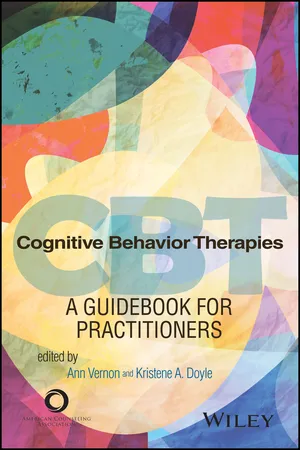
This comprehensive book showcases different approaches to cognitive behavior therapy (CBT) and focuses on the implementation of these various theories in real-world practice. Following an overview of cognitive therapy, practitioners and scholars discuss behavior therapy, cognitive therapy, rational emotive behavior therapy, multimodal therapy, acceptance and commitment therapy, dialectical behavior therapy, and mindfulness. Each theory highlighted includes a profile of the theorist(s), an overview of the theory, a discussion of the therapeutic process, an array of targeted interventions, a verbatim case transcript, an analysis of the limitations of the theory, and reflective sidebars to facilitate learning. The final chapter presents a single case study discussed from the perspective of each particular theory.
*Requests for digital versions from ACA can be found on www.wiley.com
*To purchase print copies, please visit the ACA website
*Reproduction requests for material from books published by ACA should be directed to [email protected]
Raymond DiGiuseppe, Rachel Venezia, and Roseanne Gotterbarn
Cognitive behavior therapy (CBT) represents a form of psychotherapy that solves current problems, disturbed emotions, and dysfunctional behavior by acknowledging the role of human learning as well as the effects of the environment, cognitions, and language in disturbance. It has become the overriding, generic term used to describe a wide range of approaches to counseling and psychotherapy that represent three distinct yet overlapping therapeutic approaches: behavior therapy (BT), cognitive therapies, and mindfulness and acceptance therapies. These approaches are similar but conceptualize the mediation of dysfunctional behavior differently.
CBT originated in BT and remains committed to many of its values and traditions. The main organization that represents the professional and scientific advancement of these therapies was originally known as the Association for the Advancement of Behavior Therapy; in 2004 this group added the term Cognitive to its name, thus becoming the Association for Behavioral and Cognitive Therapies.
This chapter provides an overview of CBT and orients you to general concepts that are described more specifically in the chapters of this book. Although there are many varieties of CBT, this book focuses on BT, cognitive therapy (CT), rational emotive behavior therapy (REBT), multimodal therapy (MMT), acceptance and commitment therapy (ACT), dialectical behavior therapy (DBT), and mindfulness. The editors selected these models because they each have good empirical support, are widely accepted, and appear to be growing in popularity.
Variation in CBT
Despite its popularity, CBT does not represent a monolithic paradigm. Some theorists have used the metaphor of three waves to understand the differences among the forms of CBT. The first wave of CBT started with the behavioral tradition, based on the work of B. F. Skinner and Ivan Pavlov and the clinical areas of applied behavior analysis (Martin & Pear, 2015) and pragmatic behavior therapy (Fishman, Rotgers, & Franks, 1988). Learning principles formed the basis of this initial approach, and interventions included relaxation training, exposure, operant interventions, and the rehearsal of new adaptive responses to problems.
The second wave emerged because of some dissatisfaction with the behavioral model. Behavior therapists recognized that human thoughts and language played a more central role in disturbed behavior than the behavioral model recognized. As the cognitive revolution occurred in BT, the number of approaches increased very quickly. This group of therapies included Albert Ellis' s REBT, Aaron Beck' s CT, Don Meichenbaum' s (1993) self-instructional training, and problem-solving skills training (Nezu, Maguth Nezu, & D' Zurilla, 2013).
The third wave included techniques based on mindfulness and a new approach to language and cognition called relational frame theory, which represents a new approach to Skinner' s learning theory applied to language. Relational frame theory differs from previous schools of thought insofar as it does not recommend trying to change the content of a belief or thought but instead attempts to break the connections between thoughts and rigid behavior actions. It relies on teaching acceptance of negative thoughts and training flexible behavioral reactions in response to their occurrence.
The metaphor of the three waves might not be the best way to conceptualize these differences in CBT. Waves come in an order, and new waves overtake previous waves, which recede back to the ocean unnoticed. The three waves of CBT did not occur in three different points in time; each has ancient roots in philosophy and psychology. Also, the first two waves have not run out of energy and fallen back into the undertow of science or clinical practice; they still exist and are going strong. A better metaphor would be three branches on an evolutionary bush, such as three groups of apes: gorillas, chimpanzees, and bonobos. Each model has common ancestors in psychology and philosophy and continues to evolve on its own. None of the models has driven the others into extinction.
Even in these three major groups there continues to be diversification and expansion. As early as 1993, Kuehlwein identified 10 schools of CBT. Since that time, more variants of CBT have appeared. Table 1.1 represents an inexhaustive list of types of CBT theories that we uncovered in a recent search.
Table 1.1 Models of CBT and Their Founders
Form of Counseling
Founder and Reference
Acceptance and commitment therapy
Hayes et al. (2011)
Applied behavior analysis
Martin & Pear (2015)
Behavior therapy
Wolpe (1969)
Cognitive therapy
A. T. Beck (1976)
Cognitive analytic therapy
Ryle (2005)
Constructivist cognitive psychotherapy
Neimeyer (2009)
Dialectical behavior therapy
Linehan (1993)
Fixed role therapy
Kelly (1955)
Functional analytic psychotherapy
Kohlenberg & Tsai (1991)
Meta-cognitive therapy
Wells (2008)
Mindfulness cognitive therapy
Sigel, et al. (2013)
Mindfulness-based interventions
Kabat-Zinn (2013)
Multimodal therapy
A. A. Lazarus (1981)
Parent training
Forgatch & Patterson (2010)
Pragmatic behavior therapy
Fishman et al. (1988)
Problem-solving therapy
Nezu et al. (2013)
Rational emotive behavior therapy
Ellis (1962)
Rumination-focused CBT
Watkins et al. (2007)
Schema-focused cognitive therapy
Young et al. (2003)
Self-instructional training
Meichenbaum (1977)
Trauma-focused CBT (TF-CBT)
Cohen (2006)
Trial-based cognitive therapy
de Oliveira (2016)
Wellness therapy
Fava (2016)
Note. CBT = Cognitive behavior therapy.
As noted, this book describes only a few variants of CBT but includes representatives from all three branches or waves. The chapter on BT represents the first branch and includes the basic skills of CBT. The chapters on REBT (Ellis, 1962), CT (A. T. Beck, 1970, 1976), and MMT (A. A. Lazarus, 1981) represent the second branch. The chapters on ACT (Hayes, Villatte, Levin, & Hildebrandt, 2011), DBT (Linehan, 1993), and mindfulness (Kabat-Zinn, 2013) represent the third branch.
Although these models share more similarities than differences, they emphasize different learning, cognitive, and psychological processes as mediating the relationship between environmental stressors and emotional and behavioral disturbances. Furthermore, although they use many different interventions, most of the interventions in each of these models are compatible with the other models. Hofmann, Asmundson, and Beck (2013) described CBT as a theoretically consistent model that focuses on a wide range of clinical problems, each of which might require a different emphasis and intervention. Thus, CBT practitioners might use multiple procedures to accomplish change yet remain theoretically consistent, describing their clients in terms of CBT theoretical constructs that are presented in this book.
Observing a number of professionals delivering CBT sessions might be confusing to the novice because one is likely to see the counselors doing many different things without a consistent pattern. O' Donohue and Fisher (2009) described 74 different CBT interventions. Here is a list of some of the techniques used in CBT:
Assertiveness training
Assessing the emotions, thoughts, and behaviors that occurred when the client tried to implement a homework assignment
Assessing the presence of dysfunctional behaviors or emotions
Behavioral activation—increasing mastery and pleasuring experiences
Bibliotherapy
Challenging the client' s irrational beliefs
Challenging the client' s negative automatic thoughts
Changing the client' s underlying schemas
Decentering
Defusion
Diagnostic interviewing
Distress tolerance
Exploring the adaptability of the client' s belief system
Exploring the adaptability of the client' s emotions and behaviors
Flooding
Graduate exposure
Habit reversal training
Harm reduction
Imaginal exposure
Mindfulness exercises
Modeling and role-playing new skills
Negotiating homework
Offering alternative rational beliefs or schemas to replace the client' s irrational beliefs or dysfunctional schemas
Operant strategies
Opposite action
Parent training
Performing a comprehensive multimodal assessment of behaviors, affect, sensations, imagery, cognitions, interpersonal relationships, drugs, or biological influences
Performing an ABC analysis of thoughts: activating event, beliefs, and emotional consequences
Performing an ABC functional analysis of behavior: antecedents, behaviors, and consequences
Relapse prevention
Relaxation procedures
Response chaining
Response prevention and exposure
Reviewing homework
Self-control procedures
Self-instructional training
Shaping
Social problem solving
Helping the client generate alternative solutions to problems
Helping the client evaluate the consequences and effectiveness of alternative solutions
Social skills training
Stimulus control procedures
Teaching the B → C connection
Teaching the difference between irrational and rational beliefs
Token economies
Validating the client' s emotions
Values and goals clarification
It is important to note that although CBT is eclectic in techniques, it is consistent in its theory. And although many therapists consider themselves eclectic, eclecticism can be a confusing and difficult path to follow. A. A. Lazarus (1967; A. A. Lazarus & Beutler, 1993) pointed out that therapists who practice as theoretically eclectic must inevitably use contradictory ideas, which begs the question of how one chooses or justifies using one theory with one case and a different theoretical approach with another case. However, CBT practitioners can and do use many different interventions while remaining theoretically consistent. A. A. Lazarus (1967) coined the term technical eclecticism to describe clinical practice that remains theoretically consistent yet uses a variety of methods that target the theoretical mechanism identified by one' s orientation.
Assumptions and Core Principles of CBT
Given all of these variations on CBT, you might wonder what they have in common. In this section, we review the common assumptions, principles, and histories that unite CB...
Table of contents
Cover
Title Page
Copyright
Dedication
Preface
About the Editors
About the Authors
Chapter 1: What Is Cognitive Behavior Therapy?
Chapter 2: Behavior Therapy
Chapter 3: Cognitive Therapy
Chapter 4: Rational Emotive Behavior Therapy
Chapter 5: Multimodal Therapy
Chapter 6: Acceptance and Commitment Therapy
Chapter 7: Dialectical Behavior Therapy
Chapter 8: Mindfulness
Chapter 9: The Case of Marcos from each Theoretical Prespective
Index
Technical Support
End User License Agreement
Trusted by 375,005 students
Access to over 1.5 million titles for a fair monthly price.
Study more efficiently using our study tools.
Frequently asked questions
Yes, you can cancel anytime from the Subscription tab in your account settings on the Perlego website. Your subscription will stay active until the end of your current billing period. Learn how to cancel your subscription
No, books cannot be downloaded as external files, such as PDFs, for use outside of Perlego. However, you can download books within the Perlego app for offline reading on mobile or tablet. Learn how to download books offline
Perlego offers two plans: Essential and Complete
Essential is ideal for learners and professionals who enjoy exploring a wide range of subjects. Access the Essential Library with 800,000+ trusted titles and best-sellers across business, personal growth, and the humanities. Includes unlimited reading time and Standard Read Aloud voice.
Complete: Perfect for advanced learners and researchers needing full, unrestricted access. Unlock 1.5M+ books across hundreds of subjects, including academic and specialized titles. The Complete Plan also includes advanced features like Premium Read Aloud and Research Assistant.
Both plans are available with monthly, semester, or annual billing cycles.
We are an online textbook subscription service, where you can get access to an entire online library for less than the price of a single book per month. With over 1.5 million books across 990+ topics, we’ve got you covered! Learn about our mission
Look out for the read-aloud symbol on your next book to see if you can listen to it. The read-aloud tool reads text aloud for you, highlighting the text as it is being read. You can pause it, speed it up and slow it down. Learn more about Read Aloud
Yes! You can use the Perlego app on both iOS and Android devices to read anytime, anywhere — even offline. Perfect for commutes or when you’re on the go. Please note we cannot support devices running on iOS 13 and Android 7 or earlier. Learn more about using the app
Yes, you can access Cognitive Behavior Therapies by Ann Vernon,Kristene Anne Doyle in PDF and/or ePUB format, as well as other popular books in Education & Professional Development. We have over 1.5 million books available in our catalogue for you to explore.