This book analyses the development of Collective Intelligence by a better knowledge of the diversity of the temperaments and behavioural and relational processes. The purpose is to help the reader become a better Collective Intelligence Leader, who will be able to capitalize on the specificities and the differences of the individuals present in its collective, and transform these differences into complementarities, which are a source of wealth.

- English
- ePUB (mobile friendly)
- Available on iOS & Android
eBook - ePub
Collective Intelligence Development in Business
About this book
Information
1
Relevance and Foundations of Collective Intelligence
We believe that improving the level of Collective Intelligence in companies is an untapped resource that is vital, substantial and sustainable. We think that understanding what produces Collective Intelligence and Collective Unintelligence is essential. To explain this, it is useful:
- – to point out the relevance of the development of Collective Intelligence in the current economic context and its requirements;
- – to understand the foundations of Collective Intelligence, which, in this context, allow businesses to adapt most effectively, frequently and without becoming destabilized.
As you will see, this reflection will naturally lead us to place People – and so also the knowledge we might have – at the center of the issue of Collective Intelligence.
1.1. Adapting to a world in complete transformation
The question of understanding the productive mechanisms of Collective Intelligence is crucial for anyone who wants to take part in and adapt to the accelerated transformation of both production and global economic behavior. Through whatever lens we consider our era – historical, sociological, economic, technological, cultural, geostrategic or even climatological – there is a unanimous acknowledgment that an unprecedented transformation is underway.
More specifically, what transformations does this entail?
First of all, the USA–Europe–Japan trio no longer dominates. While a large part of Europe clings desperately to their old certainties, Japan and the USA are seeing their economic and technological domination increasingly challenged by countries considered as “emerging” by Western countries, not without some condescension. Condescension? Yes, because even if their political systems are different from Western democracies, especially those of China and Russia, you need to only take a casual stroll through these countries to see that their development, although still too heterogeneous and unequal, is spectacularly obvious. To confirm this, there is a basic indicator: the purchasing power of the middle classes, which, as it happens, is growing considerably. For example, as of now, the Brazilian middle class represents about 50% of the total population of the country (more than 100 million people) and has incomes ranging from $520 to $2,000 per month [OEC 10b]. China offers a second example, as Jean-Yves Carfantan [CAR 09] explains, showing that China’s middle class is divided into two levels: an “upper” level, which includes 105 million consumers, with incomes from $4,800 to $12,500 per year, and a “lower” level, which includes about 190 million new consumers, with incomes ranging from $3,000 to $4,800 per year. According to his study, it appears that the Chinese middle class has changed its lifestyle choices in relation to:
- – mobility (more car purchases);
- – housing (decoration, home improvement, new technologies);
- – cooking (household appliances);
- – food (more protein).
The global middle class has seen an unprecedented growth, as much in terms of global volume as in consumption per person. Similarly, consumer choices change as the country develops.
What are the consequences of these economic “eruptions” for our subject? Very simply, a challenge for traditionally Western economic leadership in favor of a new geo-economic “match”, including countries like Brazil, Russia, India, China, South Africa, Indonesia, Australia, South Korea, Thailand, Turkey, Mexico, Chile, Niger, etc. Consequently, the global economic “pie” is being divided into a greater number of parts, whose dimensions are extremely volatile; competition is increasing as it is diversifying. In Europe, a substantial part – notably the “greatest minds” – remain stuck in their political excuses and their frantic quest for comfort and ease, which translates into a growing need for a thorough overhaul of our models of wealth creation by a high-quality, multifunctional and collective reflection. This change seems monumental for southern Europe, as policies and populations are sinking into either characteristic denial or major suffering under the pressures of a sudden obsession with “no deficit” among the leading European classes, provoking economic recession, social paralysis or rebellion. We can give examples of “affronts” from all over the world, from the victory of Syriza in Greece to the rise in extreme right factions in Europe, which are different manifestations of a common disease – nothing in any case that would be good for the economy, or that reflects a high Collective Intelligence. On the contrary, these behaviors are more like the survival behaviors described later in this book which are instinctive and often not very constructive, rather than a controlled collective pragmatism. In short, faced with the recognized appearance of new economic powers (recall that, in 1999, the G8 became the G20), it is time to consider our collective capacity to return to an optimistic dynamic which supports private and public projects that are independent from any election and creates rewarding jobs, capable of meeting the level of optimism, culture of pragmatism and proactiveness of modern powers.
More precisely, on the topic of optimism, we will cite François Lafargue, doctor of geopolitics and political science and a specialist in emerging powers: “One of the common, essential points of emerging powers is a confidence about the future. A confidence that nourishes optimism and supports growth…”. In early 2011, a survey by Pew Research Center revealed that 87% of the Chinese population are confident about the future, as are 50% of Brazilians – although only 30% of Americans and 26% of the French population feel the same way. In the words of Professor Axelle Degans [DEG 11], “Hope has switched sides!”. Finally, we will cite Fondapol’s survey of “global youth”, which highlights that French youth are one of the most anxious about globalization. From all this, it is relevant to understand that the world is reeling, with a West that is seized with the vertigo, unfortunately justified, of a loss of social position: “The emerging middle class will represent 30% of the global population in ten years and will be the prime market on the planet”, estimates a report by the Boston Consulting Group.
So, is confidence the key to the success of these countries? Yes, we think so, because confidence is an undeniable parameter for success. But what confidence are we talking about? Is it the confidence of the power of one’s country-continent, with all that entails in terms of mass effect for domestic markets and energy resources? Is it confidence as a kind of cyclical shift: “you dominated once, now it’s our turn?” It is not just that… This optimism originates from a confidence in a collective capacity to face the challenges of tomorrow, thanks to an awareness of its geographical or geological assets, but also and above all, thanks to a form of energy, a spirit that is not anchored in the solutions of the past, a capacity to collectively defend its interests. More than this, it is a confidence in an ability to rely on youth and to offer them education and training adapted to the world in the 21st Century. Citing the OECD [OEC 10a], “if the current trends continue, China and India will count 40% of all young graduates with tertiary degrees in the G20 countries and the OECD by 2020, contrary to only slightly more than 25% for the United States and the countries of the European Union”.
Yet, the equation is simple: more graduates in emerging countries = more innovations.
The increase in tertiary graduates in emerging countries is not without influence on the world economy, especially in its innovative sectors. Simply recall the evolution of the Japanese automobile from the 1970s. Initially, we smiled at them, then we were annoyed by these cars, almost copies of European models, a bit dated, with old-fashioned interior layouts and suspensions that were especially unsuitable for our road networks, whose unique assets included a low price, a proven reliability, and ... a serial car radio! Alas, Europeans, and especially Americans, did not smile long, and the annoyance was quickly replaced by concern, so exemplary was the rise to power, as spectacular as pragmatic, of this industry, particularly in relation to… innovation. For the Japanese automobile, the copy was just one step in its development; after that, in the car industry as in other domains, Japan has not ceased to amaze the world with its innovating potential.
In other words, if a country is capable of putting to work a part of its population with degrees and quality technical knowledge, then this country gives itself the possibility of developing an industry that does not make knock-offs or buy expensive patents, but an industry that produces and sells (at a high price!) new patents at the source of major business trends. So, in light of the increase in the number of tertiary graduates emerging, innovation has changed place, and with it, profitable products, giving rise to an increasingly well-off middle class. The circle is complete.
So, confidence would be at the heart of success. However, as we have seen, this hardly means an ill-constructed, pretentious confidence. It is a kind of confidence in a collective capacity to innovate. Innovation is now the condition sine qua non of success, today more than ever. To confirm this, you need only observe the increase in the ability to develop new technologies around the world. For example, to reach a market of 50 million people, it took 38 years for radio, 13 years for television, 4 years for Internet, 3 years for Apple with its iPod, 2 years for Facebook and 1 year for Google.
Yes, today successes have a short shelf life, and the capacity to innovate is crucial.
In this sense, Heraclitus was particularly wise when he wrote, “Change is the only constant”. Yet, some of our readers who have been confronted by the need to develop a service, department, or work method or relocate their company, know how difficult it can be to effect a change. Later in this book, we will discuss techniques for executing changes, but the extreme difficulty of implementing changes, particularly here in France, is worthy of reflection. The world is developing so quickly nowadays that if we want our companies to survive, there is no other option but to become an actor and supporter of change for the benefit of our business, making the most of the skills present in the company team.
How can we “make the most” of this? Once again, we will detail the procedures to engage people in change in an effective and lasting manner, but to understand the thrust of our argument, think about how Collective Intelligence is structurally useful, or in other words, how Collective Intelligence – analyzed, dissected, understood, controlled – is at the root of collective successes, especially in complex or extremely competitive spheres. Now that the word “structure” has been used, it is time to focus on the “pillars” of a company in development, or what we consider to be the structural bases of Collective Intelligence. What are these foundations?
1.2. The pillars of a company in development, the foundations of Collective Intelligence
Consider the schema given in Figure 1.1.
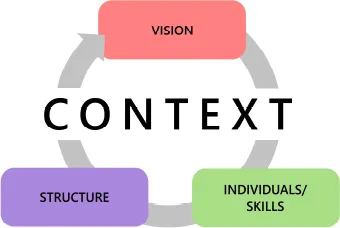
Figure 1.1. The three pillars of a Company in Development (inspired by the work of Ikujito Nonaka [NON 95])
This schema lays out the basics of Collective Intelligence in Business. What does it tell us?
Simply, that a company, regardless of its size, relies on three interdependent foundations:
- – The Vision. This is the direction of the Company, which justifies the existence of all structures and skills within it. The Vision gives meaning to action, in terms of objectives and resources.
- – The Structure. This is unique to each company and is often easily associated with a certain type of structure (pyramid, matrix, etc.). This is the combination, the arrangement of the whole, that gives structure to the actions carrying out the Vision.
- – The Individuals and their skills. Diverse and varied, they must adapt, u...
Table of contents
- Cover
- Table of Contents
- Title
- Copyright
- Introduction
- 1 Relevance and Foundations of Collective Intelligence
- 2 People: The Heart of the Collective Intelligence Development Process
- 3 Developing Collective Intelligence: Understanding People and Diversity
- 4 What is Leadership? A Note on Works about Leadership and a Tentative Definition of Leadership
- 5 Postures and Roles of a Leader to Develop Collective Intelligence
- 6 The Skills of a Leader in the Service of Collective Intelligence
- Conclusion
- Bibliography
- Index
- End User License Agreement
Trusted by 375,005 students
Access to over 1.5 million titles for a fair monthly price.
Study more efficiently using our study tools.
Frequently asked questions
Yes, you can cancel anytime from the Subscription tab in your account settings on the Perlego website. Your subscription will stay active until the end of your current billing period. Learn how to cancel your subscription
No, books cannot be downloaded as external files, such as PDFs, for use outside of Perlego. However, you can download books within the Perlego app for offline reading on mobile or tablet. Learn how to download books offline
Perlego offers two plans: Essential and Complete
- Essential is ideal for learners and professionals who enjoy exploring a wide range of subjects. Access the Essential Library with 800,000+ trusted titles and best-sellers across business, personal growth, and the humanities. Includes unlimited reading time and Standard Read Aloud voice.
- Complete: Perfect for advanced learners and researchers needing full, unrestricted access. Unlock 1.5M+ books across hundreds of subjects, including academic and specialized titles. The Complete Plan also includes advanced features like Premium Read Aloud and Research Assistant.
We are an online textbook subscription service, where you can get access to an entire online library for less than the price of a single book per month. With over 1.5 million books across 990+ topics, we’ve got you covered! Learn about our mission
Look out for the read-aloud symbol on your next book to see if you can listen to it. The read-aloud tool reads text aloud for you, highlighting the text as it is being read. You can pause it, speed it up and slow it down. Learn more about Read Aloud
Yes! You can use the Perlego app on both iOS and Android devices to read anytime, anywhere — even offline. Perfect for commutes or when you’re on the go.
Please note we cannot support devices running on iOS 13 and Android 7 or earlier. Learn more about using the app
Please note we cannot support devices running on iOS 13 and Android 7 or earlier. Learn more about using the app
Yes, you can access Collective Intelligence Development in Business by Patricia Bouvard,Hervé Suzanne in PDF and/or ePUB format, as well as other popular books in Computer Science & Information Technology. We have over 1.5 million books available in our catalogue for you to explore.