Circadian Medicine
eBook - ePub

Circadian Medicine

  1. English
  2. ePUB (mobile friendly)
  3. Available on iOS & Android
eBook - ePub

Circadian Medicine

About this book

Circadian rhythms, the biological oscillations based around our 24-hour clock, have a profound effect on human physiology and healthy cellular function. Circadian Rhythms: Health and Disease is a wide-ranging foundational text that provides students and researchers with valuable information on the molecular and genetic underpinnings of circadian rhythms and looks at the impacts of disruption in our biological clocks in health and disease.

Circadian Rhythms opens with chapters that lay the fundamental groundwork on circadian rhythm biology. Section II looks at the impact of circadian rhythms on major organ systems. Section III then turns its focus to the central nervous system. The book then closes with a look at the role of biological rhythms in aging and neurodegeneration.

Written in an accessible and informative style, Circadian Rhythms: Health and Disease, will be an invaluable resource and entry point into this fascinating interdisciplinary field that brings together aspects of neuroscience, cell and molecular biology, and physiology.
Frequently asked questions

Yes, you can cancel anytime from the Subscription tab in your account settings on the Perlego website. Your subscription will stay active until the end of your current billing period. Learn how to cancel your subscription.
No, books cannot be downloaded as external files, such as PDFs, for use outside of Perlego. However, you can download books within the Perlego app for offline reading on mobile or tablet. Learn more here.
Perlego offers two plans: Essential and Complete
  • Essential is ideal for learners and professionals who enjoy exploring a wide range of subjects. Access the Essential Library with 800,000+ trusted titles and best-sellers across business, personal growth, and the humanities. Includes unlimited reading time and Standard Read Aloud voice.
  • Complete: Perfect for advanced learners and researchers needing full, unrestricted access. Unlock 1.4M+ books across hundreds of subjects, including academic and specialized titles. The Complete Plan also includes advanced features like Premium Read Aloud and Research Assistant.
Both plans are available with monthly, semester, or annual billing cycles.
We are an online textbook subscription service, where you can get access to an entire online library for less than the price of a single book per month. With over 1 million books across 1000+ topics, we’ve got you covered! Learn more here.
Look out for the read-aloud symbol on your next book to see if you can listen to it. The read-aloud tool reads text aloud for you, highlighting the text as it is being read. You can pause it, speed it up and slow it down. Learn more here.
Yes! You can use the Perlego app on both iOS or Android devices to read anytime, anywhere — even offline. Perfect for commutes or when you’re on the go.
Please note we cannot support devices running on iOS 13 and Android 7 or earlier. Learn more about using the app.
Yes, you can access Circadian Medicine by Christopher S. Colwell in PDF and/or ePUB format, as well as other popular books in Biological Sciences & Neuroscience. We have over one million books available in our catalogue for you to explore.

Information

III
Clocks in the Central Nervous System

15
Circadian Clock, Reward and Addictive Behavior

Urs Albrecht
Dept of Biology, Unit of Biochemistry, University of Fribourg, Fribourg, Switzerland

15.1 Introduction

The aim of this chapter is to highlight relationships between the circadian clock and reward that may influence addictive behavior. To begin, some of the key terms used in this chapter are defined.
The circadian clock is a biochemical mechanism that oscillates with a period of about 24 hours and can be coordinated with the day–night cycle. It consists of three major components: (i) a central oscillator with a period of 24 hours that is made up of several clock genes that regulate themselves in an autoregulatory manner allowing them to keep time (Chapters 1 and 2); (ii) a series of input pathways to the central oscillator to allow entrainment of the clock; and (iii) a series of output pathways tied to distinct phases of the oscillator allowing regulation of overt rhythms in biochemistry, physiology and behavior. If biochemical and physiological rhythms are described under the natural light–dark cycle of the environment (in contrast to constant conditions) these rhythms are defined as diurnal and not circadian.
Reward is a stimulus (positive or negative) that increases the intensity and occurrence of an associated behavior when presented more than once. This process is called reinforcement. Primary rewards are those necessary for survival, such as food, water, and sex. Secondary rewards derive their value from the primary rewards and include pleasant touch, music, and money (of which the latter two are probably for humans only). Rewards can be positive or negative. Positive rewards, such as drugs of abuse (e.g., alcohol, cocaine, nicotine), influence the reward system by improving subjective well-being and encourage repetitive drug use that eventually leads to addiction. In contrast, negative rewards, such as hunger or pain, induce searching behavior or avoidance of particular circumstances.
Addiction is the continued use or exposure to mood altering substances or cues despite adverse dependency consequences. This leads to chronic change of the reward system, motivation, memory and related circuitries in the brain, which is reflected in an individual by pursuing reward and/or relief by substance use and other behaviors.

15.2 Evidence for a time of day basis of addictive behavior

Many of the observations described in this section compare day to night and are best considered diurnal rhythms. There is evidence that time of day and addictive behaviors are linked. Drug addicts display disrupted sleep–wake and activity cycles as well as abnormal eating patterns, body temperature and hormone rhythms, and abnormal blood pressure (Wasielewski and Holloway, 2001; Jones et al., 2003). These disruptions persist long after drug use and may contribute to relapse (Jones et al., 2003) and it seems that drugs can affect diurnal rhythms. Similarly, it appears that the sensitivity to drugs of abuse is dependent on the time of day. Individuals experiencing a drug overdose are mostly admitted to emergency rooms between 6 and 7 p.m. (Raymond et al., 1992), and cocaine sensitization displays a diurnal rhythm in rodents (Baird and Gauvin, 2000; Abarca et al., 2002; Akhisaroglu et al., 2004). These observations suggest a diurnal component in the body’s response to drugs (also described in Chapter 17). A recent study in adult Finnish twins supports this view, because late type individuals (those with a slower clock) are more likely to become nicotine dependent than early type individuals (Broms et al., 2011). Furthermore, people with genetic sleep disorders are more prone to addiction (Shibley et al., 2008) and a rat strain with abnormal circadian rhythms shows increased ethanol preference (Rosenwasser et al., 2005a).

15.3 Drugs, circadian clock genes and addictive behavior

There are various types of rewarding drugs; these can be subdivided into three main classes (Lüscher, 2007 ): (i) drugs that bind to transporters of biogenic amines; (ii) drugs that bind to ionotropic receptors and ion channels; and (iii) drugs that activate G protein-coupled receptors. Drugs that belong to the family of biogenic amines are cocaine and methamphetamine. Drugs that bind to ionotropic receptors and ion channels are alcohol and nicotine. Drugs that activate G protein-coupled receptors include opioids and cannabinoids. How these drugs affect the circadian clock and how the clock may be involved in the processing of the signals triggered by these drugs is discussed in the following sections.

15.3.1 Cocaine

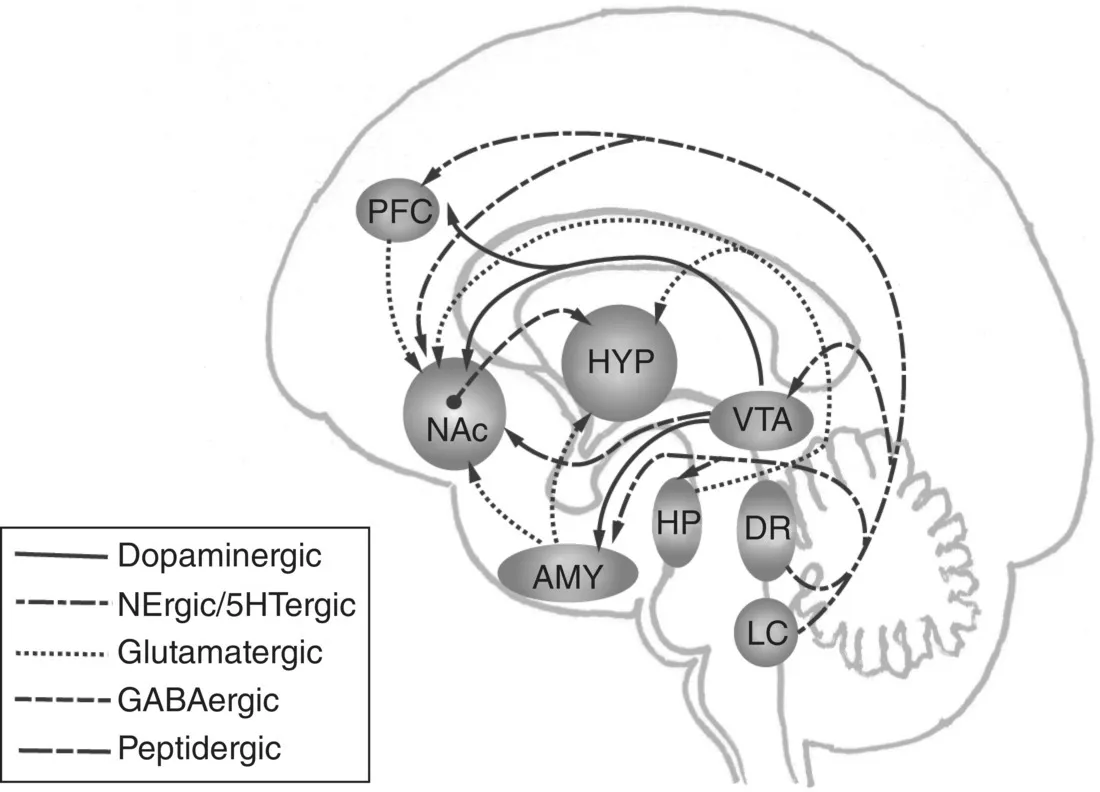
Evidence for involvement of the circadian clock in the response to drugs of abuse came from studies performed in Drosophila (Andretic et al., 1999). This study showed that flies mutant in various clock genes, including Period (Per), were lacking sensitization to repeated cocaine exposure and tyrosine decarboxylase was not induced as normally seen after cocaine exposure. This indicated that clock genes in the fly may directly or indirectly regulate tyrosine decarboxylase. In mice, similar observations were made. Cocaine modulates pathways for photic and nonphotic entrainment of the mammalian SCN circadian clock (Glass et al., 2012). Mice lacking the Per1 or the Per2 gene displayed abnormal locomotor sensitization and conditioned place preference in response to cocaine (Abarca et al., 2002). Expression of these genes was induced by cocaine in the dorsal striatum and the nucleus accumbens (NAc) (Yuferov et al., 2003), brain regions important for cocaine mediated behavioral effects (Fig. 15.1). Interestingly, cocaine differentially affected clock gene expression in various brain regions depending on the treatment schedule (acute or chronic (Uz et al., 2005). Cocaine and other drugs of abuse such as methamphetamine (see below) regulate the reward system via modulation of dopaminergic neurotransmission in the mesolimbic dopaminergic reward circuit, which includes the ventral tegmental area (VTA) and NAc of the striatum (Nestler and Carlezon 2006) (Fig. 15.1).
c15-fig-0001
Fig. 15.1 Neural circuitry of addiction and mood. Several brain regions are implicated in the regulation of addiction. Besides the hippocampus (HP) and the prefrontal cortex (PFC), several subcortical structures are involved in reward, fear, and motivation. These include the nucleus accumbens (NAc), amygdala (AMY), and hypothalamus (HYP). The figure shows only a subset of the many known interconnections between these various brain regions. The ventral tegmental area (VTA) provides dopaminergic input to the NAc, AMY, and PFC.
DR, Dorsal raphe nuclei; GABA, gamma-aminobutyric acid; LC, locus coeruleus; NE, norepinephrine; 5HT, serotonin.
Interactions between the circadian clock and dopamine have been reported. In the retina, dopamine neurons regulate adaptation to light (Witkovsky, 2004) and mice lacking the dopamine D2 receptor display impaired light masking (Doi et al., 2006). Signaling via the dopamine D2 receptor potentiates circadian transcriptional regulation in the retina (Yujnovsky et al., 2006). Interestingly, retinal dopamine mediates multiple dimensions of light-adapted vision (Jackson et al., 2012), which may indirectly affect the circadian system. This is supported by imaging analysis in Drosophil...

Table of contents

  1. Cover
  2. Title page
  3. Table of Contents
  4. List of Contributors
  5. Preface
  6. I: Fundamental Concepts
  7. II: Circadian Regulation of Major Physiological Systems
  8. III: Clocks in the Central Nervous System
  9. Index
  10. End User License Agreement