Current developments in the renewable energy field, and the trend toward self-production and self-consumption of energy, has led to increased interest in the means of storing electrical energy; a key element of sustainable development.
This book provides an in-depth view of the environmentally responsible energy solutions currently available for use in the building sector. It highlights the importance of storing electrical energy, demonstrates the many services that the storage of electrical energy can bring, and discusses the important socio-economic factors related to the emergence of smart buildings and smart grids. Finally, it presents the methodological tools needed to build a system of storage-based energy management, illustrated by concrete, pedagogic examples.
1 Storing Electrical Energy in Habitat: Toward “Smart Buildings” and “Smart Cities”
1.1. Toward smarter electrical grids
1.1.1.The move to decentralize electrical grids
The traditional organization of an electrical grid is based on centralized management, at the level of the transport grid to which conventional nuclear, thermal or hydraulic production systems are connected. Originally, the distribution grid only supplied consumers, and only carried power flows from high voltage points, through connections to the transport grid, toward lower voltage points. The possibilities for adjustment at the distribution level are limited, and ancillary services (voltage and frequency control) are provided by production units connected to the transport grid [ROB 12c, ROB 15].
The development of decentralized production, generally low power, unplanned and not monitored by a central entity, has brought about significant changes. Producers are often connected to a distribution grid and dispersed across a territory, contrasting with the classic model of high-power production on a few, clearly defined sites. The effects of integrating this production, which generally comes from wind and solar sources, are becoming increasingly noticeable and bring in new constraints. The variable nature of wind and photovoltaic sources, which is difficult to predict, adds a further level of complexity to grid management issues.
The liberalization of the electricity market within the European Union, beginning in the early 21st Century, has resulted in a clear separation between the management of energy production, which is subject to competition, and the management of transport and distribution grids: evidently, the infrastructure involved cannot be duplicated. In France, the CRE (commission de régulation de l’électricité, Electricity Regulation Commission) [CRE] is charged with ensuring that the new competition mechanisms are respected, that competition does not have a negative effect for consumers and that there is no danger to an infrastructure crucial to both the economy and security of the country. Liberalization has led to a need for new approaches to managing the electricity system, alongside new market mechanisms integrating the characteristics of new decentralized sources. Given that the electricity grids themselves cannot be rebuilt, development is needed at three specific levels:
– at the source level, using the possibilities offered by power electronics to develop new control and supervision strategies and provide ancillary services, notably through the implementation of energy storage; to develop multi-source systems (integrating intermittent renewable production, classic, predictable sources and storage) featuring integrated and optimized energy management [ROB 15];
– at the grid level, rolling out smart grids and developing new grid architectures, such as micro-grids, in order to increase the efficiency, security and availability of electricity grids, and increasing energy storage capacity, either at a central point or dispersed across these grids [ROB 15];
– at the consumer level, in industrial processes, tertiary buildings and homes, through electric and rechargeable hybrid vehicles, and in guided transport systems (trains, subway systems and trams) [ROB 16], with the aim of modulating energy demands to correspond to consumption, renewable production availability and the constraints inherent in electric grids.
Interactions between these different aspects need to be coordinated to some extent, and this raises questions regarding the optimal and most acceptable level of decentralization; a system for communication between components is also required. These issues are not purely technological in nature, including economic and sociological aspects, and requiring new developments on the judicial stage.
1.1.2.Smart grids
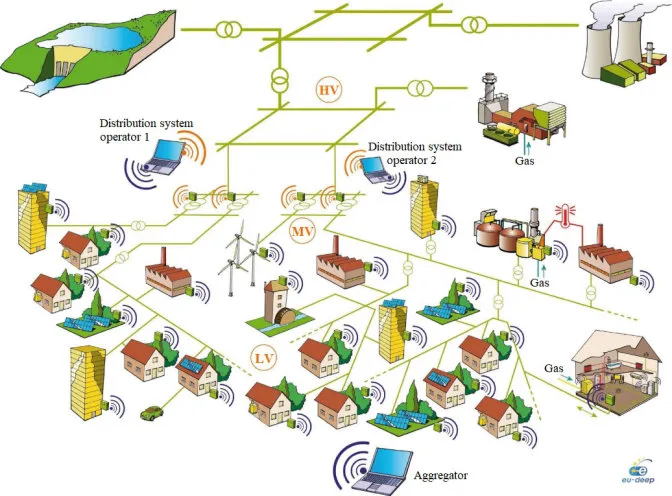
It is thus essential that we install and use new communication technologies as part of advanced management mechanisms. The level of intelligence in a grid depends on two factors. The first corresponds to the installation of a telecommunications network, mechanisms and equipment for remote control and automated network management within transport and distribution grids. The second involves advanced management of production (centralized and/or decentralized) and of loads, notably via the development of new products and services by producers and distributors, including network managers which increase the level of freedom available in piloting a grid. Final consumers may also benefit from special services and pricing offers, allowing the adoption of ambitious approaches to mastering instant demands for electricity and the integration of renewable energy sources (Figure 1.1).
Figure 1.1.Example of a future smart grid, including the distribution of regulation capacities across multiple sites via the Internet. HV = high voltage grid, MV = medium voltage grid, LV = low voltage grid (EU-Deep project). For a color version of the figures in this chapter see www.iste.co.uk/robyns/buildings.zip
There are important issues to consider in relation to the infrastructure and reliability of communication grids, the “top layer” of infrastructure management software, the normalization of communication processes, and the security and confidentiality of data. Rapid and efficient management of extremely large quantities of data is essential for an electric system of this type to function effectively. For example, grid topology may need to be altered in response to an accident, or customer erasure may be decided upon in accordance with their contract conditions, in response to an unexpected change in local consumption. The rollout of large numbers of captors and measurement instruments (such as the Linky connected meters in France) means that the volume of information produced and used to manage the electric system is constantly increasing. A modular, evolutive and extendable grid architecture is therefore necessary.
In France, in 2016, buildings absorbed 45% of total final energy consumption (across all energy types). It is thus crucial to increase their energy efficiency and to develop their capacity to produce and store energy, integrating mechanisms for efficient energy management in connection with the existing distribution grid.
1.2. Storage requirements in buildings
A priori, buildings which are directly powered by the grid have no need to store electrical energy, with the exception of certain critical buildings which have their own backup supply for safety and security reasons, maintaining services such as lighting in public buildings, ensuring equipment continues to function in hospitals or guaranteeing that certain business systems continue to operate to avoid economic losses (e.g. data servers or sites devoted to specific sensitive industries). Renewable energy, which may be produced locally using solar panels, for example, creates different requirements. The inherent variability of production, uncertainty in predictions and the priority given to local consumption, reducing transportation losses, create a greater need for local electrical storage. Unlike onboard systems, storage solutions in buildings are not subject to weight constraints as they are not carried by the system; however, volume remains a significant consideration. Another point to consider is that the grid used should correspond to the application, for example in terms of DC voltage and current.
The increase in the use of electrical energy in buildings is due to the flexibility it offers, as we...
Table of contents
Cover
Table of Contents
Foreword
Introduction
1 Storing Electrical Energy in Habitat: Toward “Smart Buildings” and “Smart Cities”
2 Energy Storage in a Commercial Building
3 Energy Storage in a Tertiary Building, Combining Photovoltaic Panels and LED Lighting
4 Hybrid Storage Associated with Photovoltaic Technology for Buildings in Non-interconnected Zones
5 Economic and Sociological Implications of Smart Grids
6 Energy Mutualization for Tertiary Buildings, Residential Buildings and Producers
7 Centralized Management of a Local Energy Community to Maximize Self-consumption of PV Production
8 Reversible Charging from Electric Vehicles to Grids and Buildings
References
Index
End User License Agreement
Trusted by 375,005 students
Access to over 1.5 million titles for a fair monthly price.
Study more efficiently using our study tools.
Frequently asked questions
Yes, you can cancel anytime from the Subscription tab in your account settings on the Perlego website. Your subscription will stay active until the end of your current billing period. Learn how to cancel your subscription
No, books cannot be downloaded as external files, such as PDFs, for use outside of Perlego. However, you can download books within the Perlego app for offline reading on mobile or tablet. Learn how to download books offline
Perlego offers two plans: Essential and Complete
Essential is ideal for learners and professionals who enjoy exploring a wide range of subjects. Access the Essential Library with 800,000+ trusted titles and best-sellers across business, personal growth, and the humanities. Includes unlimited reading time and Standard Read Aloud voice.
Complete: Perfect for advanced learners and researchers needing full, unrestricted access. Unlock 1.5M+ books across hundreds of subjects, including academic and specialized titles. The Complete Plan also includes advanced features like Premium Read Aloud and Research Assistant.
Both plans are available with monthly, semester, or annual billing cycles.
We are an online textbook subscription service, where you can get access to an entire online library for less than the price of a single book per month. With over 1.5 million books across 990+ topics, we’ve got you covered! Learn about our mission
Look out for the read-aloud symbol on your next book to see if you can listen to it. The read-aloud tool reads text aloud for you, highlighting the text as it is being read. You can pause it, speed it up and slow it down. Learn more about Read Aloud
Yes! You can use the Perlego app on both iOS and Android devices to read anytime, anywhere — even offline. Perfect for commutes or when you’re on the go. Please note we cannot support devices running on iOS 13 and Android 7 or earlier. Learn more about using the app
Yes, you can access Electrical Energy Storage for Buildings in Smart Grids by Benoît Robyns,Arnaud Davigny,Hervé Barry,Sabine Kazmierczak,Christophe Saudemont,Dhaker Abbes,Bruno François in PDF and/or ePUB format, as well as other popular books in Physical Sciences & Energy. We have over 1.5 million books available in our catalogue for you to explore.