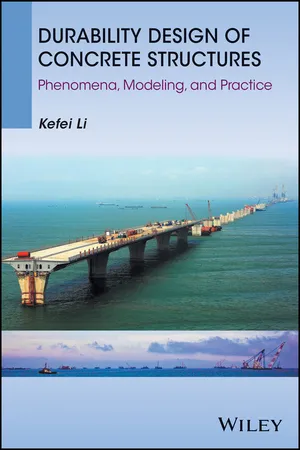
Durability Design of Concrete Structures
eBook - ePub

Durability Design of Concrete Structures

Phenomena, Modeling, and Practice

  1. English
  2. ePUB (mobile friendly)
  3. Available on iOS & Android
eBook - ePub

Durability Design of Concrete Structures

Phenomena, Modeling, and Practice

About this book

Comprehensive coverage of durability of concrete at both material and structural levels, with design related issues

  • Links two active fields in materials science and structural engineering: the durability processes of concrete materials and design methods of concrete structures
  • Facilitates communication between the two communities, helping to implement life-cycle concepts into future design methods of concrete structures
  • Presents state-of-the-art information on the deterioration mechanism and performance evolution of structural concrete under environmental actions and the design methods for durability of concrete structures
  • Provides efficient support and practical tools for life-cycle oriented structural design which has been widely recognized as a new generation of design philosophy for engineering structures
  • The author has long experience working with the topic and the materials presented have been part of the author's current teaching course of Durability and Assessment of Engineering Structures for graduate students at Tsinghua University
  • The design methods and approaches for durability of concrete structures are developed from newly finished high level research projects and have been employed as recommended provisions in design code including Chinese Code and Eurocode 2

Trusted byĀ 375,005 students

Access to over 1.5 million titles for a fair monthly price.

Study more efficiently using our study tools.

Information

Publisher
Wiley
Year
2016
Print ISBN
9781118910092
Edition
1
eBook ISBN
9781118910122

Part One
Deterioration of Concrete Materials

1
Carbonation and Induced Steel Corrosion

This chapter treats the first important durability process of concrete materials and structures: the carbonation and the induced corrosion of steel bars in concrete. The carbonation of concrete originates from the reaction between the alkaline pore solution of concrete and the carbon dioxide (CO2) gas migrating into the pores. The carbonation does not compromise the material properties but decreases the alkalinity of the pore solution, which has an adverse effect on the electrochemical stability of steel bars in concrete. The risk of steel corrosion can be substantially enhanced in a carbonated concrete. This chapter begins with the phenomena of concrete carbonation and its effect on the long‐term durability of concrete materials and structures. Then the detailed mechanisms are presented, according to the state of the art of knowledge, for concrete carbonation and the induced steel corrosion, together with a comprehensive analysis on the main influential factors for these processes. On the basis of the available knowledge, the modeling aspect is brought forth through mechanism‐based and empirical models for engineering use. Since the valid scope and the uncertainty are two fundamental aspects for model application, the critical analysis is given to the models presented and their application. Some basis for durability design against the carbonation and the induced corrosion is given at the end.

1.1 Phenomena and Observations

As concrete is exposed to the atmosphere, the CO2 present in the atmosphere can migrate into the material through the pore structure and react with the cement hydrates such as portlandite (Ca(OH)2 or CH) and the calcium silicate hydrates (C‐S‐H). These reactions are termed the ā€œcarbonationā€ of concrete materials. The direct consequence of carbonation is the consumption of CH, eventually C‐S‐H, and the decrease in pH value of the pore solution. Under a less alkaline environment, the electrochemical stability of the embedded steel bars in concrete can be destroyed, the steel can be depassivated and the electrochemical process of corrosion can occur. As the corrosion develops to a significant extent, the reaction products from corrosion accumulate at the concrete–steel interface and can fracture the concrete cover. Since all concrete structures are built and used in the envelope of the atmosphere, carbonation is a basic and fundamental process for the long‐term durability of concrete elements. Note that the detrimental aspect of carbonation resides mainly in the corrosion risk for the embedded steel bars and the carbonation itself is not found detrimental to concrete materials. Relevant studies show that the products of the carbonation reaction can notably reduce the porosity of hardened concrete, and the carbonation can also be used as a pretreatment technique for the recycled coarse aggregates to reduce the water sorptivity (Thiery et al., 2013).
Concrete carbonation has been well investigated with regard to both the reaction mechanism and the alteration of properties of material and structural elements. The mechanism of carbonation is to be detailed later, while the most severe deterioration of concrete elements by carbonation is usually due to the less compacted concrete, insufficient protection of steel bars from the concrete cover, and the favorable moisture conditions for steel corrosion. For residential buildings, most reinforced concrete (RC) elements, like slabs and walls, usually bear surface lining or protection la...

Table of contents

  1. Cover
  2. Title Page
  3. Table of Contents
  4. Preface
  5. Acknowledgments
  6. Part One: Deterioration of Concrete Materials
  7. Part Two: From Materials to Structures
  8. Part Three: Durability Design of Concrete Structures
  9. References
  10. Index
  11. End User License Agreement

Frequently asked questions

Yes, you can cancel anytime from the Subscription tab in your account settings on the Perlego website. Your subscription will stay active until the end of your current billing period. Learn how to cancel your subscription
No, books cannot be downloaded as external files, such as PDFs, for use outside of Perlego. However, you can download books within the Perlego app for offline reading on mobile or tablet. Learn how to download books offline
Perlego offers two plans: Essential and Complete
  • Essential is ideal for learners and professionals who enjoy exploring a wide range of subjects. Access the Essential Library with 800,000+ trusted titles and best-sellers across business, personal growth, and the humanities. Includes unlimited reading time and Standard Read Aloud voice.
  • Complete: Perfect for advanced learners and researchers needing full, unrestricted access. Unlock 1.5M+ books across hundreds of subjects, including academic and specialized titles. The Complete Plan also includes advanced features like Premium Read Aloud and Research Assistant.
Both plans are available with monthly, semester, or annual billing cycles.
We are an online textbook subscription service, where you can get access to an entire online library for less than the price of a single book per month. With over 1.5 million books across 990+ topics, we’ve got you covered! Learn about our mission
Look out for the read-aloud symbol on your next book to see if you can listen to it. The read-aloud tool reads text aloud for you, highlighting the text as it is being read. You can pause it, speed it up and slow it down. Learn more about Read Aloud
Yes! You can use the Perlego app on both iOS and Android devices to read anytime, anywhere — even offline. Perfect for commutes or when you’re on the go.
Please note we cannot support devices running on iOS 13 and Android 7 or earlier. Learn more about using the app
Yes, you can access Durability Design of Concrete Structures by Kefei Li in PDF and/or ePUB format, as well as other popular books in Technology & Engineering & Civil Engineering. We have over 1.5 million books available in our catalogue for you to explore.