- Easy-to-use, updated resource with brief synopses for everyday clinical reference
- Includes self-testing clinicopathologic exercises to help readers further their skills and gain confidence in their knowledge
- Focuses on decision making, from communicating diagnoses to developing and discussing treatment plans
- Presents clinically oriented information on the most important aspects of common oral and maxillofacial diseases
- Features detailed color illustrations, treatment algorithms, differential diagnosis, and case examples with discussion
- English
- ePUB (mobile friendly)
- Available on iOS & Android
eBook - ePub
The ADA Practical Guide to Soft Tissue Oral Disease
About this book
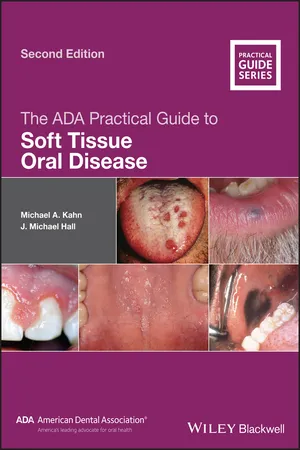
The ADA Practical Guide to Soft Tissue Oral Disease, Second Edition is a fully updated new edition of this popular guide to oral and maxillofacial diseases likely to be encountered in general or specialist dental practices.
Information
Section II
Diagnosis and Management
3
Common Oral Soft Tissue Lesions
White Lesions
- White‐coated tongue (Fig. 3.1)
- Site – Tongue dorsum.
- Morphology – Thin film or plaque from sloughing keratin.
- Color – White.
- Signs and symptoms – Can be scraped off with difficulty. Some diffuse lesions cannot be scraped off.
- Treatment – Brush tongue daily to minimize accumulation of bacterial debris and keratinized slough.
- CandidiasisAcute pseudomembranous type (also called thrush) (Fig. 3.2)
- Site – Buccal mucosa, palate, and dorsal tongue are most common.
- Morphology – Plaques composed of tangled masses of hyphae, yeasts, desquamated epithelial cells, and debris.
- Color – Creamy white.
- Signs and symptoms – Resembles cottage cheese or curdled milk; can be scraped or rubbed off with dry gauze, leaving an underlying pink or red mucosa. There may be no symptoms or a mild burning sensation or an unpleasant “salty” or “bitter” taste. Thrush can be initiated by impairment of the immune system or by broad‐spectrum antibiotics, which eliminate competing bacteria.
- Treatment – Prescription of antifungal agents: cream, ointment, liquid, and tablets.
Chronic hyperplastic type (candidal leukoplakia) (Fig. 3.3)- Site – Usually anterior buccal mucosa; tongue.
- Morphology – Plaque.
- Color – White.
- Signs and symptoms – Cannot be scraped off and so cannot be clinically distinguished from leukoplakia. Candidal leukoplakia often can have a red component intermingled (i.e. speckled leukoplakia).
- Treatment – Antifungal agents (cream, ointment, liquid, tablets). If the lesion fails to resolve (essentially confirming the diagnosis), then a biopsy is mandatory.
- Morsicatio (nibbling habit) (Fig. 3.4a,b,c)
- Site – Most often buccal mucosa (morsicatio buccarum) centered along occlusal plane, also labial mucosa (morsicatio labiorum), and lateral tongue (morsicatio linguarum).
- Morphology – Roughened, ragged, thickened surface plaque; may also see ulceration and erosion intermixed.
- Color – White.
- Signs and symptoms – A conscious or subconscious chronic nibbling habit or, rarely, suction; asymptomatic. The superficial portion (i.e. tissue tags) can be scraped or peeled off but the remainder cannot. Lesions are usually bilateral, with or without other site involvement.
- Treatment – None required.
- Thermal burn (Fig. 3.5a,b)
- Site – Palate or posterior buccal mucosa.
- Morphology – Red macule (erythema) with ulcer, often with remnant of the epithelium at the periphery.
- Color – White.
- Signs and symptoms – Usually results from history of accidental ingestion of hot foods or beverages. Superficial white change can be scraped off or is wipeable due to surface coagulative necrosis.
- Treatment – Resolves without treatment.
- Chemical burn (aspirin burn) (Fig. 3.6a,b)
- Site – All oral mucosal sites.
- Morphology
- Mhort exposure time – Superficial wrinkled plaque.
- Longer exposure time – Surface epithelium becomes separated from underlying tissue, easily desquamates into erosion.
- Color
- Short exposure time – White.
- Longer exposure time – White surface removed, leaving necrotic red, bleeding connective tissue.
- Signs and symptoms – History of accidental oral mucosal contact with caustic agents such as aspirin, hydrogen peroxide, silver nitrate, phenol, and endodontic materials. Overuse of mouthwashes with high alcohol content can also cause a superficial ...
Table of contents
- Cover
- Title Page
- Table of Contents
- Preface to the Second Edition
- Preface to the First Edition
- Acknowledgments
- Section I: Detection and Documentation
- Section II: Diagnosis and Management
- Section III: Clinicopathologic Exercises
- Appendix A: Glossary of Descriptive Terminology
- Appendix B: Formulary of Over‐the‐Counter and Prescription Medications Based on Disease Classification
- Answers to End‐of‐Chapter Questions
- Index
- End User License Agreement
Trusted by 375,005 students
Access to over 1.5 million titles for a fair monthly price.
Study more efficiently using our study tools.
Frequently asked questions
Yes, you can cancel anytime from the Subscription tab in your account settings on the Perlego website. Your subscription will stay active until the end of your current billing period. Learn how to cancel your subscription
No, books cannot be downloaded as external files, such as PDFs, for use outside of Perlego. However, you can download books within the Perlego app for offline reading on mobile or tablet. Learn how to download books offline
Perlego offers two plans: Essential and Complete
- Essential is ideal for learners and professionals who enjoy exploring a wide range of subjects. Access the Essential Library with 800,000+ trusted titles and best-sellers across business, personal growth, and the humanities. Includes unlimited reading time and Standard Read Aloud voice.
- Complete: Perfect for advanced learners and researchers needing full, unrestricted access. Unlock 1.5M+ books across hundreds of subjects, including academic and specialized titles. The Complete Plan also includes advanced features like Premium Read Aloud and Research Assistant.
We are an online textbook subscription service, where you can get access to an entire online library for less than the price of a single book per month. With over 1.5 million books across 990+ topics, we’ve got you covered! Learn about our mission
Look out for the read-aloud symbol on your next book to see if you can listen to it. The read-aloud tool reads text aloud for you, highlighting the text as it is being read. You can pause it, speed it up and slow it down. Learn more about Read Aloud
Yes! You can use the Perlego app on both iOS and Android devices to read anytime, anywhere — even offline. Perfect for commutes or when you’re on the go.
Please note we cannot support devices running on iOS 13 and Android 7 or earlier. Learn more about using the app
Please note we cannot support devices running on iOS 13 and Android 7 or earlier. Learn more about using the app
Yes, you can access The ADA Practical Guide to Soft Tissue Oral Disease by Michael A. Kahn,J. Michael Hall in PDF and/or ePUB format, as well as other popular books in Médecine & Dentisterie. We have over 1.5 million books available in our catalogue for you to explore.