The first comprehensive guide to the design and implementation of security in 5G wireless networks and devices
Security models for 3G and 4G networks based on Universal SIM cards worked very well. But they are not fully applicable to the unique security requirements of 5G networks. 5G will face additional challenges due to increased user privacy concerns, new trust and service models and requirements to support IoT and mission-critical applications. While multiple books already exist on 5G, this is the first to focus exclusively on security for the emerging 5G ecosystem.
5G networks are not only expected to be faster, but provide a backbone for many new services, such as IoT and the Industrial Internet. Those services will provide connectivity for everything from autonomous cars and UAVs to remote health monitoring through body-attached sensors, smart logistics through item tracking to remote diagnostics and preventive maintenance of equipment. Most services will be integrated with Cloud computing and novel concepts, such as mobile edge computing, which will require smooth and transparent communications between user devices, data centers and operator networks.
Featuring contributions from an international team of experts at the forefront of 5G system design and security, this book:
Provides priceless insights into the current and future threats to mobile networks and mechanisms to protect it
Covers critical lifecycle functions and stages of 5G security and how to build an effective security architecture for 5G based mobile networks
Addresses mobile network security based on network-centricity, device-centricity, information-centricity and people-centricity views
Explores security considerations for all relative stakeholders of mobile networks, including mobile network operators, mobile network virtual operators, mobile users, wireless users, Internet-of things, and cybersecurity experts
Providing a comprehensive guide to state-of-the-art in 5G security theory and practice, A Comprehensive Guide to 5G Security is an important working resource for researchers, engineers and business professionals working on 5G development and deployment.
Wireless communication technologies are essential parts of our lives. From WiFi home networks to sophisticated machine‐to‐machine communication in the robotics industry, we live in a world of wireless connectivity and it is impossible to imagine a single day without using any wireless devices. The blessings of cellular technologies provided us with a great deal of mobility and thus made it possible to listen to the radio while travelling in a car or on the beach. The cellular devices are also convenient in that we no longer have to worry about the size of the cables to connect to the networks. We are now living in a world where conferences for business meetings, distance and online courses from universities, and medical help over long distances are considered as part and parcel of our daily lives. We have greater access to information than ever before and it is all possible due to the advancements and inventions in cellular communication.
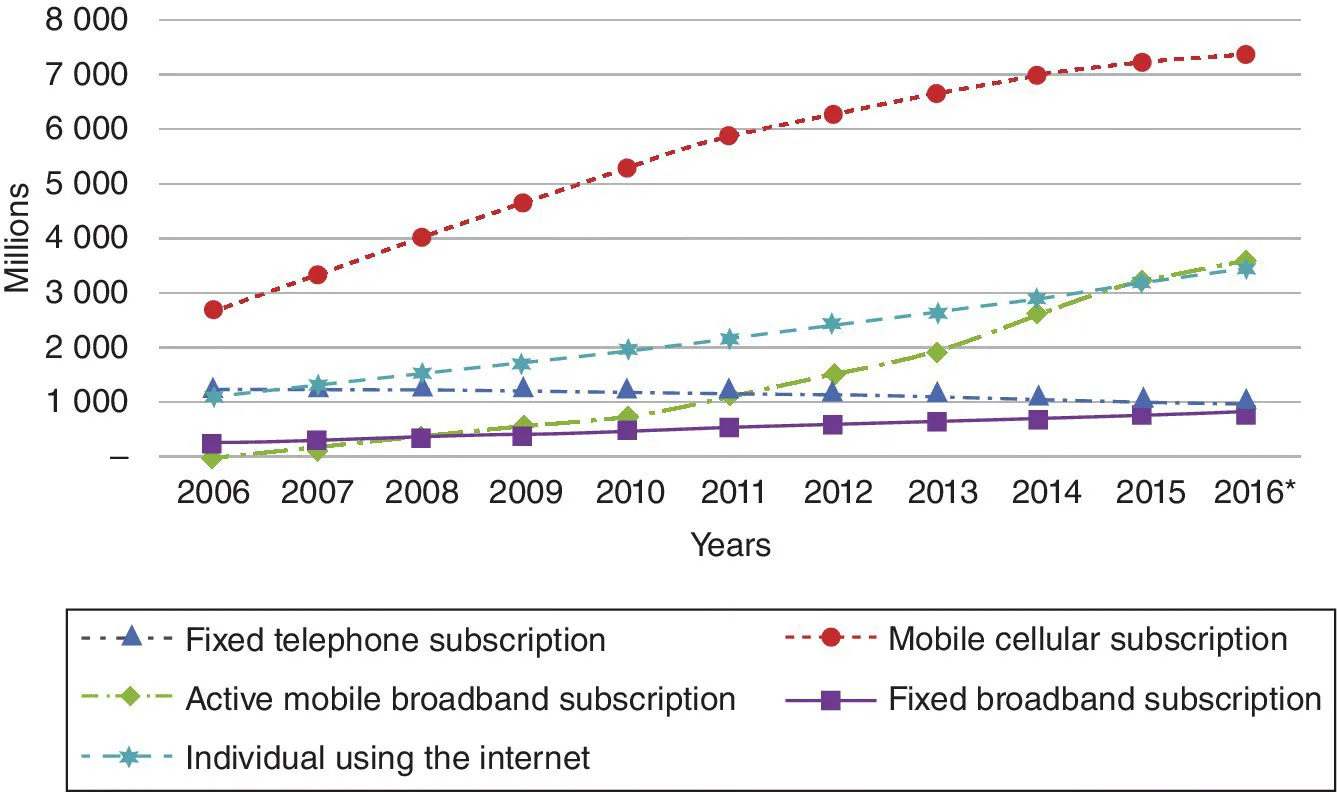
The number of cellular users increased dramatically over the last decade compared to the other technologies and are still increasing. We can see from Figure 1.1 that the fixed broadband or fixed wired subscription did not increase that much in a last decade, while the mobile cellular subscriptions are increasing day by day. With the advent of sophisticated technologies, such as tactile computing, autonomous vehicles, wireless charging, smart living, etc., we can only envision how the use of cellular technologies will grow in the future.
Figure 1.1 Growth of communication services encompassing the last decade.
This chapter is dedicated towards the evolution of cellular communication. In that respect, we start by discussing the initial developments and history of cellular systems. We subsequently go through the different generations of cellular systems and have a brief discussion about them. As the topic is broad, we try to confine ourselves to the basic information related to the radio interfaces and network architecture of different generations. We align the chapter with the focus of the book by discussing the evolution of security measurements during each generation.
1.2 Early Development
Wireless communication in its current practice is a very sophisticated technology, making long distance voice, data and multimedia communication possible between people, no matter which part of the world they reside in. The kind of evolution that wireless cellular technologies went through, in particular over the last three decades, and over the last two hundred years in general, makes for a fascinating journey. If we try to trace the initial efforts that became the foundation of the wireless communications of today, we have to go back as early as the ancient Greek, Roma and Chinese cultures, where electrical and magnetic properties of materials were experimented on. The early experiments on electrical and magnetic properties were not intended for wireless communication, since that sort of vision was not present as a motivation for these experiments.
We see that even in the 19th century, when the connection between electricity and magnetism was first developed, the intuition and imagination of what it could achieve was naturally missing amongst the researchers. It is good to say that it was mostly the random experiments that eventually led to the kind of communication systems we have now, and that is something which makes this journey more interesting. Even though, as mentioned above, the experiments towards trying to find electrical and magnetic properties in various ancient cultures, and considered as one of the foremost steps in this journey, it is also important to keep in mind that the last two hundred years present a more coherent and consistent picture that is paved with ground‐breaking discoveries.
So, in our analysis the last two hundred years are of primary importance. We have to try to coherently present the connection of all those discoveries as to how one discovery led to another, and what became the motivation to carry out further discoveries. Until this decade, the story is not as linear and direct as it might appear when looking back to its destination. But as far as wireless communications are concerned, it would be unfair and unimaginative to consider this point in time as the final destination, because as far as wireless communication is concerned, the sky is the limit, or even beyond [9].
Starting with the last two hundred years, say the year 1820, the Danish physicist Hans Christian Ørsted, during one of his lectures noticed that when the current from a battery was switched on and off, a compass needle showed the deflection. This observation led him to discover that an electric field creates a magnetic field; more particularly, an electric current produces a circular magnetic field as it flows through a wire.
The connection between electricity and magnetism was of immense importance that rapidly led to further developments. However, it is sometimes claimed that it was Gian Domenico Romagnosi who discovered this connection around two decades before, but the importance of this discovery cannot be considered insignificant. From the years 1823 to 1826, Dominique François Jean Arago, a French mathematician and physicist, discovered something called rotary magnetism, which was termed Arago’s rotation. In simple words, he showed that a wire can become a magnet when current flows through it, and that most bodies could be magnetized. These discoveries were further explained by Michael Faraday later. André‐Marie Ampère, another French physicist and mathematician, discovered electrodynamics. Ampère showed that two parallel wires carrying electric currents attract or repel each other, depending on whether the currents flow in the same or opposite directions. Ampere’s initial plan was to gain more understanding between electricity and magnetism, and this had led him to these discoveries.
Michael Faraday’s contributions are very significant in this journey, and he deserves all the credit that we can give him. After Ørsted had discovered the phenomenon of electromagnetism, it motivated many scientists to study this further, the efforts which helped Ampere in his discoveries. Similar motivation led Michael Faraday to carry out experiments, whereby he successfully managed to build two devices to produce electromagnetic rotation. Not only did he discover electromagnetic induction, but also predicted that electromagnetic forces extended the empty space around the conductor. In simple words, he predicted the existence of electromagnetic waves, which proved to be a true prediction later.
Samuel Finley Breese Morse, an American painter, invented the single‐wired telegraph system. He was also a co‐developer of the Morse code. This discovery also became possible because of the discovery of electromagnetism. The telegraph was important because it was a first attempt to use electromagnetism in an effort to communicate. The list of discoveries continued in the rest of the 19th century, and the German physiologist and physicist Hermann Ludwig Ferdinand von Helmholtz, worked on the phenomenon of electrical oscillation in 1847, which in itself was not a major contribution, but led to the major contribution by Heinrich Rudolf Hertz, one of his students, who later demonstrated electromagnetic radiations. In 1853, William Thomson also contributed in the form of calculating the period, damping and intensity, as the function of the capacity, self‐inductance and resistance of an oscillatory circuit. Another proof of Helmholtz’s work came from a discovery by Feddersen, who verified the resonant frequency o...
Table of contents
Cover
Title Page
Table of Contents
The Editors
About the Contributors
Foreword
Preface
Acknowledgements
Part I: 5G Security Overview
Part II: 5G Network Security
Part III: 5G Device and User Security
Part IV: 5G Cloud and Virtual Network Security
Index
End User License Agreement
Trusted by 375,005 students
Access to over 1.5 million titles for a fair monthly price.
Study more efficiently using our study tools.
Frequently asked questions
Yes, you can cancel anytime from the Subscription tab in your account settings on the Perlego website. Your subscription will stay active until the end of your current billing period. Learn how to cancel your subscription
No, books cannot be downloaded as external files, such as PDFs, for use outside of Perlego. However, you can download books within the Perlego app for offline reading on mobile or tablet. Learn how to download books offline
Perlego offers two plans: Essential and Complete
Essential is ideal for learners and professionals who enjoy exploring a wide range of subjects. Access the Essential Library with 800,000+ trusted titles and best-sellers across business, personal growth, and the humanities. Includes unlimited reading time and Standard Read Aloud voice.
Complete: Perfect for advanced learners and researchers needing full, unrestricted access. Unlock 1.5M+ books across hundreds of subjects, including academic and specialized titles. The Complete Plan also includes advanced features like Premium Read Aloud and Research Assistant.
Both plans are available with monthly, semester, or annual billing cycles.
We are an online textbook subscription service, where you can get access to an entire online library for less than the price of a single book per month. With over 1.5 million books across 990+ topics, we’ve got you covered! Learn about our mission
Look out for the read-aloud symbol on your next book to see if you can listen to it. The read-aloud tool reads text aloud for you, highlighting the text as it is being read. You can pause it, speed it up and slow it down. Learn more about Read Aloud
Yes! You can use the Perlego app on both iOS and Android devices to read anytime, anywhere — even offline. Perfect for commutes or when you’re on the go. Please note we cannot support devices running on iOS 13 and Android 7 or earlier. Learn more about using the app
Yes, you can access A Comprehensive Guide to 5G Security by Madhusanka Liyanage, Ijaz Ahmad, Ahmed Bux Abro, Andrei Gurtov, Mika Ylianttila, Madhusanka Liyanage,Ijaz Ahmad,Ahmed Bux Abro,Andrei Gurtov,Mika Ylianttila in PDF and/or ePUB format, as well as other popular books in Technology & Engineering & Electrical Engineering & Telecommunications. We have over 1.5 million books available in our catalogue for you to explore.