Solar cooling systems can be a cost-effective and environmentally attractive air-conditioning solution. The design of such systems, however, is complex. Research carried out under the aegis of the International Energy Agency's Solar Heating and Cooling Program has shown that there is a range of seemingly subtle design decisions that can impact significantly on the performance of solar cooling systems.
In order to reduce the risk of errors in the design process, this guide provides detailed and very specific engineering design information. It focuses on case study examples of installed plants that have been monitored and evaluated over the last decade. For three successful plants the design process is described in detail and the rationale for each key design decision is explained. Numerical constraints are suggested for the sizing / selection parameters of key equipment items.
Moreover, the application conditions under which the system selection is appropriate are discussed. By following The Guide for any of the three specific solar cooling systems, the designer can expect to reliably achieve a robust, energy-saving solution.
This book is intended as a companion to the IEA Solar Cooling Handbook which provides a general overview of the various technologies as well as comprehensive advice to enable engineers to design their own solar cooling system from first principles.
eBook - ePub
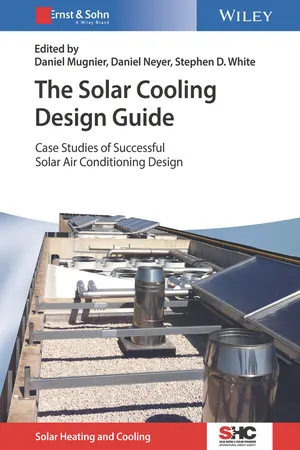
The Solar Cooling Design Guide
Case Studies of Successful Solar Air Conditioning Design
- English
- ePUB (mobile friendly)
- Available on iOS & Android
eBook - ePub
The Solar Cooling Design Guide
Case Studies of Successful Solar Air Conditioning Design
About this book
Information
1
Introduction
Stephen White, Daniel Mugnier, Daniel Neyer, and Jacqueline Neyer
There has been a tremendous increase in the market for air-conditioning worldwide, especially in developing countries. Global sales of room air-conditioners has increased dramatically, from about 44 million units per annum worldwide in 2002 to more than 100 million units per annum in 2013 [1]. In order to limit the negative impact on energy consumption, greenhouse gas emissions and electricity network infrastructure, solar air-conditioning is proposed as a new environmentally sound alternative to conventional fossil-fuel-based air-conditioning.
Solar air-conditioning is intuitively a good combination, because the demand for air-conditioning correlates quite well with the availability of the sun. The hotter and sunnier the day, the more air-conditioning is required. Key benefits include:
- – It saves electricity and thus conventional primary energy sources and greenhouse gas emissions.
- – It reduces peak electricity demand. This could help to reduce the size and cost of electricity network infrastructure if applied on a broad scale.
Interest in solar air-conditioning has grown steadily over the last ten years. A recent survey has estimated the number of worldwide installations at nearly 1200 systems in 2014 (Figure 1.1).
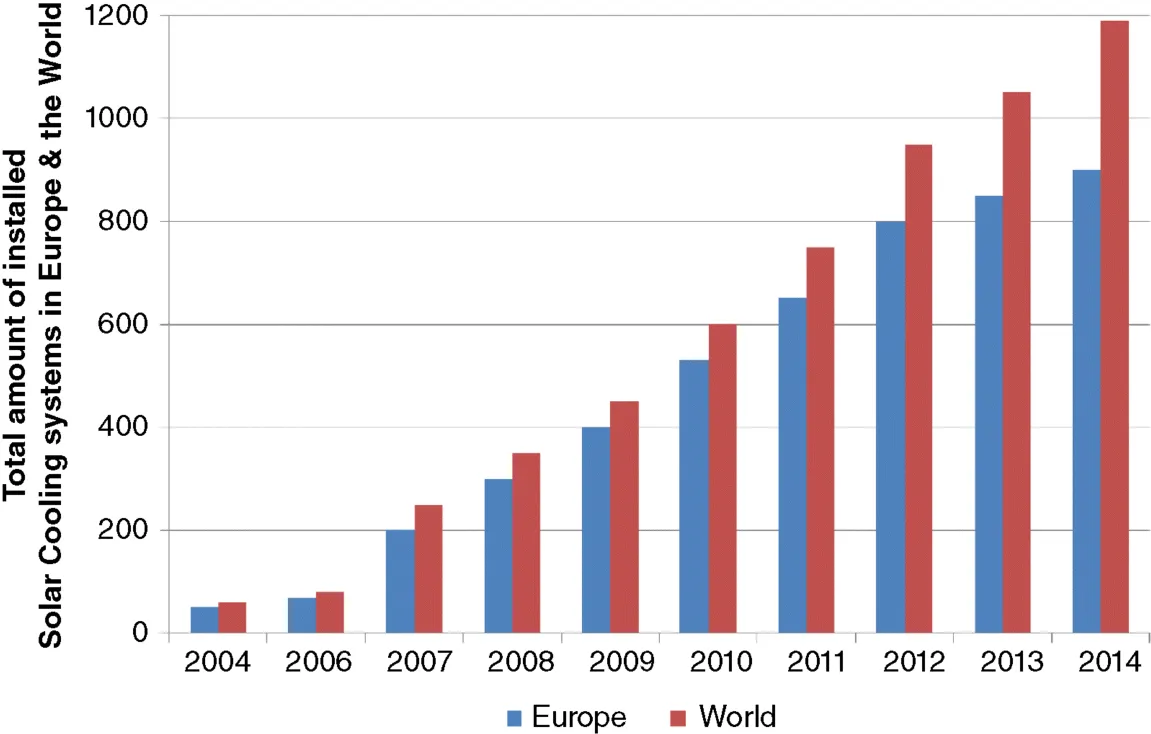
Fig. 1.1 Estimation of the global number of solar cooling systems [2]
Solar air-conditioning can be achieved by either driving a vapor compression air-conditioner with electricity produced by solar photovoltaic cells, or by driving a thermal chiller with solar thermal heat. The vast majority of existing solar air-conditioning systems (Figure 1.1) are driven by solar thermal heat. While the idea of cooling from heat seems counterintuitive, solar thermal air-conditioning has many benefits and synergies, which are listed below.
- – Solar thermal cooling technologies use environmentally sound materials that have no or very little ozone depletion potential (ODP) and global warming potential (GWP).
- – Integrated systems can be designed to satisfy the need for multiple thermal products in a building cost-effectively, for example, domestic hot water, space heating (solar combi-systems) as well as solar cooling.
- – Solar thermal collectors are generally more efficient (>40%) than photovoltaic (electricity) panels (<20%). This is particularly significant for integrated systems, where heating (and domestic hot water) is a significant portion of the total building thermal demand. But it is less significant for solar cooling-only applications where low photovoltaic (PV) efficiency is compensated by the higher efficiency of electricity-driven chillers compared with thermal chillers.
- – Thermally driven cooling can be used to reduce the risk of high temperature stagnation situations in solar thermal collector systems designed predominantly for heating applications.
- – Thermally driven cooling systems, compared with electrical chillers, are low-noise and vibration-free.
- – Thermally driven cooling systems can use other waste heat sources to supplement the solar heat source.
1.1 About the IEA SHC Task 48
IEA SHC Task 48 “Quality Assurance and Support Measures for Solar Cooling” was a project conducted by a group of researchers and practitioners from nine countries (Australia, Austria, Canada, China, France, Germany, Italy, Singapore and USA). Its aims were to find solutions to enable industry to deliver solar thermal driven heating and cooling systems that are (a) efficient, (b) reliable and (c) cost-competitive. These three major targets were to be achieved through activities grouped into four subtasks (Figure 1.2):
- Development of tools and procedures that characterize the performance of the main components of solar air-conditioning (SAC) systems (Subtask A).
- Creating practical and unified procedures for specifying the best technical configurations for complete integrated SAC systems (Subtask B).
- Development of standards and procedures to identify and validate the quality of SAC systems under three scenarios (Subtask C):
- Measured performance of large systems, post-construction.
- Design quality of large systems, prior to construction.
- Deemed performance of small “plug-and-play” solar cooling products, at point of sale.
- Production and dissemination of information to promote solar thermal-driven cooling and heating systems (Subtask D).
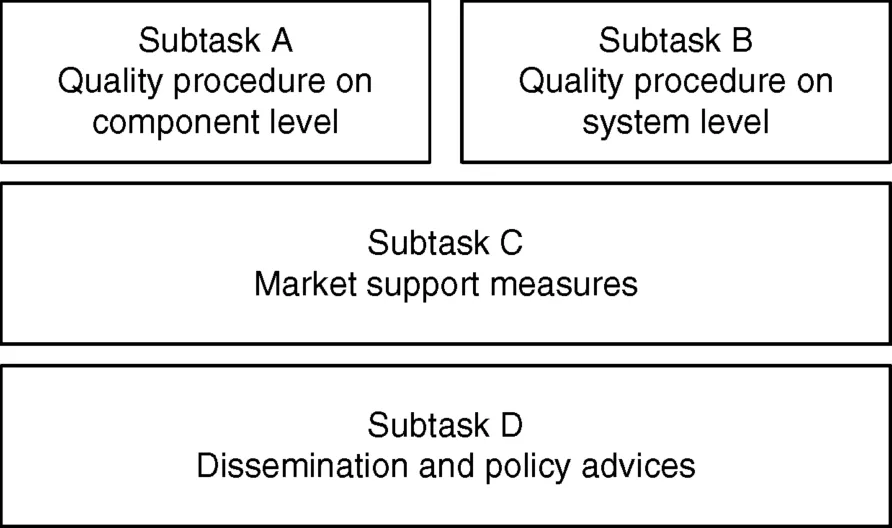
Fig. 1.2 Schematic of the main activities in IEA SHC Task 48
The scope of the Task includes the technologies for production of cold water or conditioned air by means of solar thermal heat. It starts with the solar radiation reaching the collector and ends with the chilled water and/or conditioned air transferred to the application. While the cold distribution system in the building, and the interaction of the building with the technical equipment, is not the main topic of the Task, this interaction is discussed in specific cases, where necessary.
The IEA SHC Task 48 was completed in summer 2015. Full details and outcomes can be found at www.task48.iea-shc.org.
1.2 Ambition and Philosophy of the Book
The Solar Cooling Design Guide (the Guide) is intended as a companion to the IEA Solar Cooling Handbook [3]. The content and function of the two companion books are as follows
- – The IEA Solar Cooling Handbook (the Handbook) provides a comprehensive but general overview of the various technologies and equipment components that convert solar heat into useful cold. It aims to provide comprehensive information and advice on all aspects of solar cooling, in order to enable engineers to design their own solar cooling system from first principles. In this way, it focuses on the broader principles involved, and it leaves full design flexibility for engineers to respond to the wide range of possible applications that may be encountered. While it contains examples, it does not provide prescriptive designs for specific applications.
- – This Guide aims to provide more detailed and specific engineering design information than in the Handbook. By focusing on a limited number of specific case study examples, the Guide aims to provide additional useful information relevant to specific embodiments of solar cooling, which are not necessarily general to all forms of solar cooling. In this way it aims to provide a limited number of more prescriptive design solutions, which reduces the number of decisions required by the engineer, and more clearly codifies the art of solar cooling design in the light of specific application experience.
The Handbook aims to give comprehensive foundational design understanding across the breadth of alternative solar cooling solutions, while ...
Table of contents
- Cover
- Related Titles
- Title Page
- Copyright
- Important Disclaimer
- About the Editors
- List of Contributors
- The IEA Solar Heating and Cooling Programme
- Notes from the Editors
- Foreword
- Chapter 1: Introduction
- Chapter 2: General Considerations
- Chapter 3: Case Study of a Solar Cooling System with a Small NH3/H2O Absorption Chiller
- Chapter 4: Case Study of a Solar Cooling System Combining an Absorption Chiller with Domestic Hot Water Production
- Chapter 5: Design Guide for Solar Cooling with Double-Effect Absorption Chillers
- Index
- End User License Agreement
Trusted by 375,005 students
Access to over 1.5 million titles for a fair monthly price.
Study more efficiently using our study tools.
Frequently asked questions
Yes, you can cancel anytime from the Subscription tab in your account settings on the Perlego website. Your subscription will stay active until the end of your current billing period. Learn how to cancel your subscription
No, books cannot be downloaded as external files, such as PDFs, for use outside of Perlego. However, you can download books within the Perlego app for offline reading on mobile or tablet. Learn how to download books offline
We are an online textbook subscription service, where you can get access to an entire online library for less than the price of a single book per month. With over 1.5 million books across 990+ topics, we’ve got you covered! Learn about our mission
Look out for the read-aloud symbol on your next book to see if you can listen to it. The read-aloud tool reads text aloud for you, highlighting the text as it is being read. You can pause it, speed it up and slow it down. Learn more about Read Aloud
Yes! You can use the Perlego app on both iOS and Android devices to read anytime, anywhere — even offline. Perfect for commutes or when you’re on the go.
Please note we cannot support devices running on iOS 13 and Android 7 or earlier. Learn more about using the app
Please note we cannot support devices running on iOS 13 and Android 7 or earlier. Learn more about using the app
Yes, you can access The Solar Cooling Design Guide by Daniel Mugnier, Daniel Neyer, Stephen D. White, Daniel Mugnier,Daniel Neyer,Stephen D. White in PDF and/or ePUB format, as well as other popular books in Sciences physiques & Énergie. We have over 1.5 million books available in our catalogue for you to explore.