Comprehensive coverage of understanding, prevention, and risk management of extreme drought events, with examples of approaches followed in water-stressed regions
This book describes the progress made in our understanding of severe drought and explains how we can deal with—and even avoid—complete devastation brought on by such punishing events. It brings forward advanced knowledge on drought hazard analysis and management, particularly from EU-funded research projects, to assist in the development of the corresponding drought management plans. In addition, this book addresses issues of social vulnerability to drought and science-policy interfaces, which are important elements of drought management.
Divided into three sections, this book covers the diagnosis of physical processes, historic drought and the trends in historic drought, and perspectives of future drought. It takes an academic approach to risk evaluation, including characterization of drought episodes, development of indicators of risk in hydrological and agricultural systems, and analysis of the role of socio-economic instruments for risk mitigation. It also discusses the interactions that have resulted in the complex institutional framework, and highlights the importance of stakeholder involvement and awareness building for successful drought management. In addition, Drought: Science and Policy features a collection of case studies that include the description of effective measures taken in the past.
Addresses the growing issue of drought preparedness planning, monitoring, and mitigation
Teaches methodologies and lessons focused on specific, drought-prone regions so the applications have more significance
Provides examples of approaches followed in water-stressed regions (river basin and national scale) with drought analyses at the pan-European scale
Drought: Science and Policy will be an invaluable reference for researchers and practitioners in the field as well as Masters students taking relevant courses in drought management and natural disaster management.
Part One Understanding Drought as a Natural Hazard
1.1 Diagnosis of Drought‐Generating Processes
Henny A.J. Van Lanen1 Anne F. Van Loon2 and Lena M. Tallaksen3
1Wageningen University, Wageningen, The Netherlands
2University of Birmingham, Birmingham, United Kingdom
3University of Oslo, Oslo, Norway
1.1.1 Introduction
It is well known that precipitation deficits initiate drought development. In cold climates (snow and glaciers), temperature anomalies (both high and low) too may contribute to drought generation. An in‐depth understanding, that is, drought diagnosis, of how climate drives precipitation and temperature anomalies, and subsequently how these anomalies propagate into soil moisture, groundwater, and streamflow deficits (catchment control), is a prerequisite for reducing the immense socioeconomic and environment impacts of droughts (e.g. Stahl et al., 2016). Comprehensive overviews on drought are provided by Wilhite (2000); Tallaksen and Van Lanen (2004); Mishra and Singh (2010); Sheffield and Wood (2011); and Van Loon (2015). This chapter builds upon these overviews and complements them by synthesising knowledge from recently finished EU projects.
The chapter starts with an introduction about key hydroclimatological processes controlling drought generation – that is, how precipitation and temperature drive drought, and which stores and fluxes are affected. Different drought types are explained, and the main drought indices that are used in this chapter are briefly described (Section 1.1.2). Section 1.1.3 gives an overview of the main atmospheric and oceanic drivers for meteorological drought (deficit in precipitation, temperature anomalies), supplemented with a detailed description of the drivers of the 2015 summer drought in Europe, and a discussion of the influence of climate change on the meteorological drought in Europe. Section 1.1.4 continues with a more comprehensive description of the influence of meteorological drought on soil water, followed by the influence on groundwater and streamflow (Section 1.1.5). Both sections focus on key processes controlling the development of droughts in the hydrological system – that is, soil moisture, streamflow, and groundwater drought – followed by the role of human influence in modifying the drought signal. Section 1.1.6 addresses how these different droughts propagate in the hydrological system – that is, how precipitation deficits and temperature anomalies affect snow accumulation and smelt, propagating into soil water, groundwater, and streamflow (drought propagation). A recently developed hydrological drought typology explains how climate and catchment controls determine drought propagation (Section 1.1.6). The focus in this chapter is on natural processes; however, at the end of each section, human interferences and their feedbacks are briefly touched upon (Sections 1.1.3–1.1.6). Finally, the concluding remarks are given in Section 1.1.7.
1.1.2 Background
The climate in the centre and north of Europe is influenced by the westerlies of the mid‐latitudes during the whole year, bringing moisture from the Atlantic Ocean. The Mediterranean region lies in a transitional climate zone, influenced by the Subtropical High‐Pressure Belt during summer and the mid‐latitude westerlies during winter. Hence, two main climate regions can be distinguished: a temperate climate with a dry summer season in the Mediterranean; and a temperate climate and a cold climate without any dry season in the centre and north of Europe, respectively. Within these regions, climate is modified by numerous other permanent or temporally variable global, regional, or local factors, such as soil moisture, oceanic currents, and topography. Blocking situations disturb the common eastwards movement of the mid‐latitude pressure systems, that is, the westerlies. During a blocking phase, an extended, persistent, high‐pressure system develops in the eastern Atlantic Ocean at the mid‐latitudes that does not move eastwards or moves only very slowly (Stahl and Hisdal, 2004). As a consequence, the moisture‐bringing pressure systems divert moisture to Northern Africa and Northern Fennoscandia, causing an extended dry period (precipitation deficits) in mainland Europe (Section 1.1.3). During a dry and warm summer, feedbacks between the land surface and the atmosphere may amplify the drought signal. As the soil dries out, less energy is used for evapotranspiration (latent heat flux), and the partitioning of incident solar energy changes as more energy is used for heating the air (sensible heat flux). Heat waves thus frequently accompany major droughts, as reported for Europe by Ionita et al. (2017).
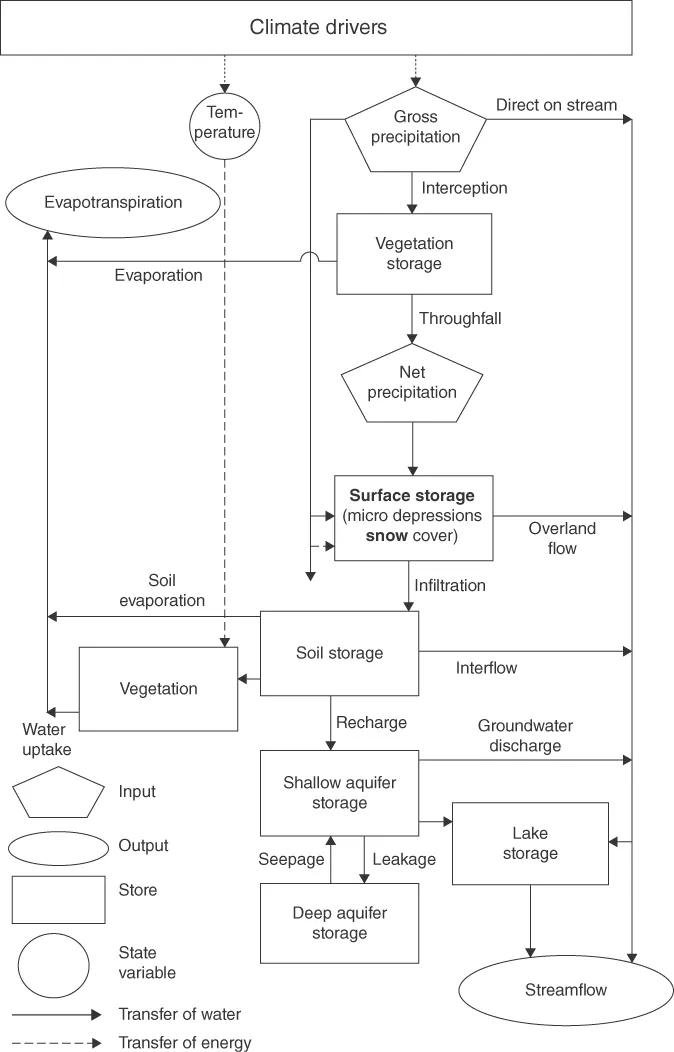
The lower‐than‐normal precipitation, usually combined with higher temperature and associated larger potential evapotranspiration (PET), leads to a decreased net precipitation (gross precipitation minus evaporated interception water), and hence infiltration into the topsoil of the vegetated surfaces (Figure 1.1.1). In places without vegetation, the lower gross precipitation directly results in lower infiltration. Evaporation of intercepted water, especially in forests, and overland flow on sloping land is also lower.
Figure 1.1.1 Water stores and fluxes affected by drought.
Source: Derived from Van Lanen et al. (2004a).
The reduced soil infiltration, together with the often‐higher atmospheric water demand (increased PET), causes a larger depletion of the soil moisture storage than normal. Consequently, lowered soil evaporation and lessened soil water uptake by vegetation results in reduced evapotranspiration in many cases. Another important effect of the more depleted soil moisture store is the lower recharge to the underlying aquifer. In catchments where interflow takes place (e.g. soils with contrasting hydraulic conductivities, slopes), the aquifer also receives less water. This leads to lower groundwater levels, and hence reduced groundwater discharge to streams and lakes. Deeper, regional aquifers also receive less water input (lower leakage), which may have long‐lasting impacts in a wide area. Lakes can mitigate the effects of a downstream drought, because their natural role is to store surface water during wet periods and to release it during a dry period (upstream–downstream differences in streamflow). The changes in hydrological processes, which also have different time delays (i.e. response times), are more elaborated in the following sections (Sections 1.1.4 and 1.1.5).
In cold climates, irrespective of precipitation amounts, below‐normal temperatures can result in earlier snow accumulation at the start of the cold season, which might lead to lower inflow to the streams. This also takes place when the cold season is longer than normal (delayed snow melt peak). In glaciated regions, cold temperature anomalies also lead to below‐normal streamflow. Higher‐than‐normal winter t...
Table of contents
Cover
Table of Contents
Series Preface
The Series Editor – Philippe Quevauviller
List of Contributors
Part One: Understanding Drought as a Natural Hazard
Part Two: Vulnerability, Risk, and Policy
Part Three: Drought Management Experiences and Links to Stakeholders
Index
End User License Agreement
Trusted by 375,005 students
Access to over 1.5 million titles for a fair monthly price.
Study more efficiently using our study tools.
Frequently asked questions
Yes, you can cancel anytime from the Subscription tab in your account settings on the Perlego website. Your subscription will stay active until the end of your current billing period. Learn how to cancel your subscription
No, books cannot be downloaded as external files, such as PDFs, for use outside of Perlego. However, you can download books within the Perlego app for offline reading on mobile or tablet. Learn how to download books offline
Perlego offers two plans: Essential and Complete
Essential is ideal for learners and professionals who enjoy exploring a wide range of subjects. Access the Essential Library with 800,000+ trusted titles and best-sellers across business, personal growth, and the humanities. Includes unlimited reading time and Standard Read Aloud voice.
Complete: Perfect for advanced learners and researchers needing full, unrestricted access. Unlock 1.5M+ books across hundreds of subjects, including academic and specialized titles. The Complete Plan also includes advanced features like Premium Read Aloud and Research Assistant.
Both plans are available with monthly, semester, or annual billing cycles.
We are an online textbook subscription service, where you can get access to an entire online library for less than the price of a single book per month. With over 1.5 million books across 990+ topics, we’ve got you covered! Learn about our mission
Look out for the read-aloud symbol on your next book to see if you can listen to it. The read-aloud tool reads text aloud for you, highlighting the text as it is being read. You can pause it, speed it up and slow it down. Learn more about Read Aloud
Yes! You can use the Perlego app on both iOS and Android devices to read anytime, anywhere — even offline. Perfect for commutes or when you’re on the go. Please note we cannot support devices running on iOS 13 and Android 7 or earlier. Learn more about using the app
Yes, you can access Drought by Ana Iglesias, Dionysis Assimacopoulos, Henny A.J. Van Lanen, Ana Iglesias,Dionysis Assimacopoulos,Henny A.J. Van Lanen in PDF and/or ePUB format, as well as other popular books in Physical Sciences & Geography. We have over 1.5 million books available in our catalogue for you to explore.