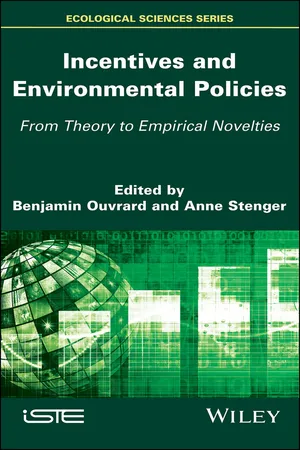
The economic protection of the quality of the environment took shape properly in the middle of the 20th Century when various economic instruments were proposed to policymakers. Today, protecting the environment is essential, as evidenced in the rise in temperatures, the melting of the icecaps, the disappearance of animal species, etc. Moreover, with recent advances in other disciplines (notably in psychology), economists are turning more and more towards non-monetary forms of incentive. However, questions concerning the effectiveness of these forms arise.
Incentives and Environmental Policies deals with the role of the economy in protecting the environment by revisiting traditional economic instruments and pursuing an advanced consideration of the role of new forms of incentive. It appears that, in order to strive towards the best possible environmental quality, policymakers will have to take into account the future of many combinations of socially acceptable incentives.
eBook - ePub
Incentives and Environmental Policies
From Theory to Empirical Novelties
- English
- ePUB (mobile friendly)
- Available on iOS & Android
eBook - ePub
Incentives and Environmental Policies
From Theory to Empirical Novelties
About this book
Information
1
The History of Incentives in Environmental Economics1
The role of economic incentives in public policy in general and in environmental economics in particular is closely linked to the use of the concept of externality. An externality harks back to the effect of an agent’s activity on the welfare (utility or profit) of another without monetary exchange. As a market failure2, it designates a form of cost-free or market-free individual interaction and produces a Paretian suboptimality, which is then the responsibility of public authorities to correct. The only forms of internalization considered economically efficient by economists rely on incentives in the form of prices (whether market-oriented or administered like a tax). The history of the use of economic incentives to reorient individual behaviors should therefore be understood in light of the history of the concept of externality.
The concept of externality came fully into its own in the 1960s, driven by the parallel development of the fledgling field of environmental economics. It was during this period that the modern definition of externality emerged, stabilized and became associated with the environmental problems that were arising with new sharpness, in the context of rising industrial pollution and the emergence of environmentalist movements. This concept of environmental externality prompted a search for new regulatory policies that were both more pragmatic than those prescribed by a welfare economics forever in search of ideal Pareto optimality, and more effective than the traditional regulatory policies of the era.
Historically, the first form of internalization was suggested by Arthur Pigou in his book The Economics of Welfare (1920), via what is now called a Pigovian tax. This was followed by a relatively long period, lasting until the 1950s, during which the concept of externality remained little studied, having not yet been assigned its modern meaning, and thus able to refer to various different phenomena (see section 1.1). However, though the definition of the concept during this long gestation period had not yet stabilized, Pigovian tradition featured heavily in the theoretical literature on public economics, until it was criticized by Ronald Coase (The Problem of Social Cost, 1960) in favor of an approach based on the exchange of property rights (see section 1.2). By the early 1960s, then, two major approaches making it theoretically possible to achieve an optimum level of externality were known, both of them based on economic incentive; yet, from an empirical point of view, externalities were still considered to be relatively marginal phenomena, often associated with proximity issues. It was only from the mid-1960s onward, simultaneously with the flourishing of environmental economics, that the concept found a new field of application in environmental issues (see section 1.3). The rise of the concept of environmental externalities would contribute to the renewed re-examination of the regulatory policies traditionally used at the time to regulate environmental problems (see section 1.4): these were considered to be economically ineffective and were now dismissed by economists in favor of new, second-best instruments such as license systems, which made it theoretically possible to achieve certain environmental objectives at a lower cost (see section 1.5.1). The effectiveness of these new incentivizing policies was supported in the early 1970s by least-cost theorems, and would cement the split between regulatory (command and control) instruments and incitative (market-based) ones (see section 1.5.2).
1.1. From Pigou to the origins of the concept of externality
A pupil of Alfred Marshall at Cambridge University, whose chair he took over in 1908, Arthur Pigou focused in his 1920 book on the welfare economics; more specifically, on the reallocation of resources to increase national revenue, which correlated in his opinion with social welfare. In the book, he examines the misallocation of these resources, identified as divergences between the collective cost and the private cost of an output, and links these divergences, these sources of inefficiency, to principles of government intervention. The divergences can have varying origins, including increasing returns in an industry (here Pigou draws on Marshall’s concept of external economies3) and the presence of external effects connected to an industrial activity. At this point, Pigou develops the first outline of what would become the concept of externality:
“A person A, while he is in the process of providing a certain service, for payment, to another person B, inadvertently affects other people, for better or worse, who do not provide similar services, in such a way that payment cannot be demanded from those benefiting from it, and nor can compensation be provided to those suffering from it”. (Pigou, 1920, p. 183)
The examples provided by Pigou concern deforestation, investment in scientific research, the construction of factories and air pollution. The government must intervene and, through taxes or subsidies (extraordinary encouragements or extraordinary restraints, (Pigou, 1920, p. 192)), make up for the divergence between private cost or benefit and social cost or benefit, thus increasing social welfare.
This was followed by a period of controversy around the concept of externality and its precise definition. The term “externality” did not appear until the 1950s; it was still deemed to be part of external economies at the time, in reference to Marshall’s concept, and to be closely linked to the idea of increasing returns. The Marshallian concept posed immediate problems of definition and aroused major controversy during the inter-war period. This controversy, known as the “empty boxes” debate, had the particular effect of maintaining a certain confusion around the true meaning of this concept; Schumpeter would say that it provided “a glaring example of the slowness and convolutedness of analytical progress”4. It was not until Viner’s contribution in 1931 that certain misunderstandings were finally resolved. Viner introduced a determining distinction between pecuniary external economies and technological external economies. Technological external economies harks back to the modern meaning: an external effect of one company’s activity on another with no mediation via prices. On the other hand, pecuniary external economies, which includes the Marshallian concept, has to do with effects transmitted by prices; for example, an increase in output involves a variation in the prices of the inputs necessary for this production. Thus, pecuniary external economies never stands in the way of Pareto optimality: “[They] go through market prices and reveal only the necessity of a general equilibrium analysis” (Laffont, 1977, p. 16). In this sense, they require no public intervention and will no longer be considered relevant.
These 1930s debates around the concept eventually fizzled out, and literature dedicated to the subject became rare. It was in the 1950s that the theory and use of the concept of externality saw a resurgence, including a number of works (Meade, 1952; Scitovsky, 1954; Bator, 1958; Buchanan and Stubblebine, 1962) lamenting the absence of a clear and strict definition of the concept, with each proposing their own typology. In reality, at the time, externalities could refer to a fairly wide range of phenomena (public goods, Veblen effects, unpaid factors, increasing returns, etc.), all of which share the characteristic of producing a market failure in a broad sense, that is, a Paretian suboptimality, and thus requiring government intervention. During these new debates, the concept separated itself gradually from the idea of returns to scale and quitted the production sphere to which it had often been confined, to cover activities of consumption. It was not until the late 1960s that the definition would stabilize and resume its modern meaning of a unpriced effect of one agent’s activity on others.
1.2. Coase theorem
It was in the context of this renewed interest in externalities that Coase published his famous article “The Problem of Social Cost” (1960); yet, his contribution was not made part of the debates around the definition of the concept. Coase did not even use the term “externality”, finding it too connotative from a normative point of view. Trained at the London School of Economics, he was highly pragmatic, and his interest was directly focused on forms of internalization. More precisely, he attacked the Pigovian tradition, which was widely dominant at the time in public economics and the welfare economics. While the definition of the concept of externality continued to fluctuate at that time, economists had a well-defined, and widely shared, idea of the way in which optimality must be restored in the face of this type of market failure: government intervention must occur via the imposition of Pigovian taxes (or subsidies), helping to equalize the marginal cost with the marginal benefit of the externality.
In his paper, Coase addresses three criticisms of this approach. The first is directed at what he calls blackboard economics, which is accused of overlooking the difficulties of concretely implementing such an optimal tax; this quest for optimality is “grossly inadequate for questions of economic policy because, whatever image of the ideal world we have in our heads, it is clear that we have not yet discovered how to achieve it from where we are” (1960, p. 43). The first criticism deals first of all, with the unrealistic nature of the Pigovian approach, which, to determine the optimal tax level, assumes full knowledge of the marginal damage or benefit. But the criticism runs deeper than this: even in a hypothetical world where we would have complete understanding of this information, Coase believes that there is no reason to systematically correct the behavior of the party at the origin of the externality, on in the name of what he calls the principle of reciprocity. For example, if the production activity of A is harmful to the production activity of B, we must not necessarily reduce the damage sustained by B, in the sense that this will then harm the activity of A. The real question is knowing which damage, that which has been sustained by B or that which A would sustain if its activity were limited, is greater. Externality, according to Coase, is a reciprocal problem, and the real challenge is to maximize the total production value, the joint production of A and B, and not necessarily to favor the victim. Thus, Coase calls into question what is called the polluter-payer principle today, and is implicitly at the heart of the Pigovian approach5.
For this reason, he proposes a solution based on the distribution of property rights of the externality – distribution which, ordained by a judge on a case-by-case basis, can work in favor of the polluter as well as the party affected by the pollution. According to Coase, it matters little who receives the rights; once the allocation is made, agents are free to negotiate a reallocation of these rights between themselves. Thus, if A is the beneficiary, it can sell its rights to B (B thus purchases the right to produce the externality, to pollute, for example); but if it is B who receives the rights, then A may have an interest in purchasing these rights from B in order to reduce its production of the externality. Coase believes that, once the rights are initially allocated, the agents will eventually manage, via a form of bilateral bargaining inspired by Edgeworth, to achieve optimal allocation through the trading of these rights (under the implicit but determining assumption that they will exhaust all mutually advantageous possibilities of exchange, that is, to attain the contract curve). This is the famous Coase theorem6, though the designation of it as such is completely absent from the 1960 article and the idea was not established and christened as the “Coase theorem” until 1966 by Stigler. Coase’s article relies mainly on a series of specific cases of bilateral externalities associated with proximity issues (a cattle rancher whose herd destroys part of the harvest belonging to the neighboring ...
Table of contents
- Cover
- Table of Contents
- Foreword
- Introduction
- 1 The History of Incentives in Environmental Economics
- 2 Environmental Incentives Over Time: From the First Forms of Regulation to the Recognition of Cognitive Biases
- 3 Environmental Regulation through Nudges
- 4 Incentives, Prosocial Motivations, and Pro-environmental Public Policies: A Reflection Illustrated by the Waste Management Policy in France
- 5 Toward an Endogenization of Incentives? The Role of Education
- Conclusion
- List of Authors
- Index
- End User License Agreement
Trusted by 375,005 students
Access to over 1.5 million titles for a fair monthly price.
Study more efficiently using our study tools.
Frequently asked questions
Yes, you can cancel anytime from the Subscription tab in your account settings on the Perlego website. Your subscription will stay active until the end of your current billing period. Learn how to cancel your subscription
No, books cannot be downloaded as external files, such as PDFs, for use outside of Perlego. However, you can download books within the Perlego app for offline reading on mobile or tablet. Learn how to download books offline
Perlego offers two plans: Essential and Complete
- Essential is ideal for learners and professionals who enjoy exploring a wide range of subjects. Access the Essential Library with 800,000+ trusted titles and best-sellers across business, personal growth, and the humanities. Includes unlimited reading time and Standard Read Aloud voice.
- Complete: Perfect for advanced learners and researchers needing full, unrestricted access. Unlock 1.5M+ books across hundreds of subjects, including academic and specialized titles. The Complete Plan also includes advanced features like Premium Read Aloud and Research Assistant.
We are an online textbook subscription service, where you can get access to an entire online library for less than the price of a single book per month. With over 1.5 million books across 990+ topics, we’ve got you covered! Learn about our mission
Look out for the read-aloud symbol on your next book to see if you can listen to it. The read-aloud tool reads text aloud for you, highlighting the text as it is being read. You can pause it, speed it up and slow it down. Learn more about Read Aloud
Yes! You can use the Perlego app on both iOS and Android devices to read anytime, anywhere — even offline. Perfect for commutes or when you’re on the go.
Please note we cannot support devices running on iOS 13 and Android 7 or earlier. Learn more about using the app
Please note we cannot support devices running on iOS 13 and Android 7 or earlier. Learn more about using the app
Yes, you can access Incentives and Environmental Policies by Benjamin Ouvrard, Anne Stenger, Benjamin Ouvrard,Anne Stenger in PDF and/or ePUB format, as well as other popular books in Biological Sciences & Environmental Science. We have over 1.5 million books available in our catalogue for you to explore.