Nanotechnology Commercialization
eBook - ePub

Nanotechnology Commercialization

Manufacturing Processes and Products

  1. English
  2. ePUB (mobile friendly)
  3. Available on iOS & Android
eBook - ePub

Nanotechnology Commercialization

Manufacturing Processes and Products

About this book

A fascinating and informative look at state-of-the-art nanotechnology research, worldwide, and its vast commercial potential

Nanotechnology Commercialization: Manufacturing Processes and Products presents a detailed look at the state of the art in nanotechnology and explores key issues that must still be addressed in order to successfully commercialize that vital technology. Written by a team of distinguished experts in the field, it covers a range of applications notably: military, space, and commercial transport applications, as well as applications for missiles, aircraft, aerospace, and commercial transport systems.

The drive to advance the frontiers of nanotechnology has become a major global initiative with profound economic, military, and environmental implications. Nanotechnology has tremendous commercial and economic implications with a projected $ 1.2 trillion-dollar global market. This book describes current research in the field and details its commercial potentialβ€”from work bench to market.

  • Examines the state of the art in nanotechnology and explores key issues surrounding its commercialization
  • Takes a real-world approach, with chapters written from a practical viewpoint, detailing the latest research and considering its potential commercial and defense applications
  • Presents the current research and proposed applications of nanotechnology in such a way as to stimulate further research and development of new applications
  • Written by an all-star team of experts, including pioneer patent-holders and award-winning researchers in nanotechnology

The major challenge currently faced by researchers in nanotechnology is successfully transitioning laboratory research into viable commercial products for the 21 st century. Written for professionals across an array of research and engineering disciplines, Nanotechnology Commercialization: Manufacturing Processes and Products does much to help them bridge the gap between lab and marketplace.
Frequently asked questions

Yes, you can cancel anytime from the Subscription tab in your account settings on the Perlego website. Your subscription will stay active until the end of your current billing period. Learn how to cancel your subscription.
No, books cannot be downloaded as external files, such as PDFs, for use outside of Perlego. However, you can download books within the Perlego app for offline reading on mobile or tablet. Learn more here.
Perlego offers two plans: Essential and Complete
  • Essential is ideal for learners and professionals who enjoy exploring a wide range of subjects. Access the Essential Library with 800,000+ trusted titles and best-sellers across business, personal growth, and the humanities. Includes unlimited reading time and Standard Read Aloud voice.
  • Complete: Perfect for advanced learners and researchers needing full, unrestricted access. Unlock 1.4M+ books across hundreds of subjects, including academic and specialized titles. The Complete Plan also includes advanced features like Premium Read Aloud and Research Assistant.
Both plans are available with monthly, semester, or annual billing cycles.
We are an online textbook subscription service, where you can get access to an entire online library for less than the price of a single book per month. With over 1 million books across 1000+ topics, we’ve got you covered! Learn more here.
Look out for the read-aloud symbol on your next book to see if you can listen to it. The read-aloud tool reads text aloud for you, highlighting the text as it is being read. You can pause it, speed it up and slow it down. Learn more here.
Yes! You can use the Perlego app on both iOS or Android devices to read anytime, anywhere β€” even offline. Perfect for commutes or when you’re on the go.
Please note we cannot support devices running on iOS 13 and Android 7 or earlier. Learn more about using the app.
Yes, you can access Nanotechnology Commercialization by Thomas O. Mensah,Ben Wang,Geoffrey Bothun,Jessica Winter,Virginia Davis in PDF and/or ePUB format, as well as other popular books in Technik & Maschinenbau & Chemie- & Biochemietechnik. We have over one million books available in our catalogue for you to explore.

Information

Chapter 1
Overview: Affirmation of Nanotechnology between 2000 and 2030

Mihail C. Roco1,2
1National Science Foundation, Arlington, VA, USA
2National Nanotechnology Initiative, U.S. National Science and Technology Council, Washington,, DC, USA

1.1 Introduction

In the nanoscale domain, nature transitions from the fixed physical behavior of a finite number of atoms to an almost infinite range of physical–chemical–biological behaviors of collections of atoms and molecules. The fundamental properties and functions of all natural and man-made materials are defined and can be modified efficiently at that scale. The unifying definition of nanotechnology, based on specific behavior at the nanoscale and the long-term nanotechnology research and education vision, was formulated in 1997–1999, and its implementation begun with National Nanotechnology Initiative (NNI) in 2000. We have estimated that it would take about three decades to advance from a scientific curiosity in 2000 to a science-based general purpose technology with broad societal benefits toward 2030 [1–3] (see www.wtec.org/nano2/).
A long-term strategic view is needed because nanotechnology is a foundational general purpose field. Three development stages of nanotechnology, corresponding to the level of complexity of typical outcomes, have been envisioned: passive and active nanostructures in the first stage of development (Nano 1), nanosystems and molecular nanosystems in the second stage (Nano 2), and converging technology platforms and distributed interconnected nanosystems in the last stage (Nano 3).
We use the definition of nanotechnology as set out in Nanotechnology Research Directions [2]. Nanotechnology is the ability to control and restructure matter at the atomic and molecular levels in the range of approximately 1–100 nm, and exploiting the distinct properties and phenomena at that scale as compared to those associated with single atoms or bulk behavior. The aim is to create materials, devices, and systems with fundamentally new properties and functions for novel applications by engineering their small structure. This is the ultimate frontier to economically change materials and systems properties, and the most efficient length scale for manufacturing and molecular medicine. The same principles and tools are applicable to different areas of relevance and may help establish a unifying platform for science, engineering, and technology at the nanoscale. The transition from the behavior of single atoms or molecules to collective behavior of atomic and molecular assemblies is encountered in nature, and nanotechnology exploits this natural threshold.
This chapter describes the timeline and affirmation of nanotechnology, its three stages, key challenges, and discusses nanotechnology return on investment.

1.2 Nanotechnology – A Foundational Megatrend in Science and Engineering

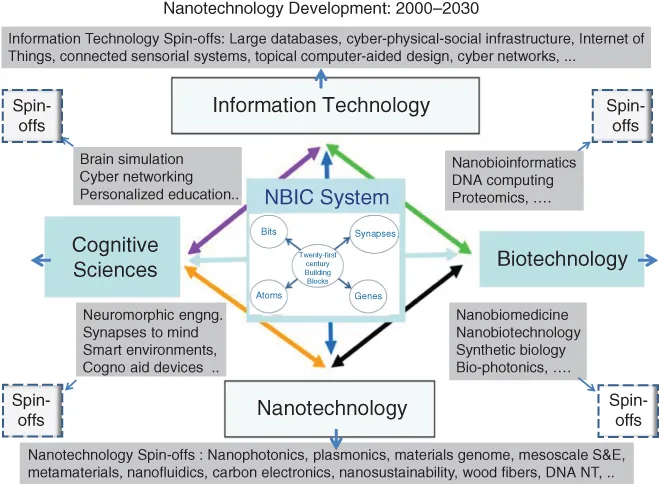
Nanotechnology is a foundational, general purpose technology for all sectors of the economy dealing with matter and biosystems, as information technology is a general purpose technology for communication and computation. Biotechnology and cognitive technologies are two other foundational technologies growing at the beginning of the twenty-first century (Figure 1.1). Table 1.1 shows several category levels of science and technology (S&T) platforms according to their level of generality and societal impact: foundational S&T, topical S&T, application domain, and product/service platform. While there are only five foundational S&T platforms most dynamic at this moment (Figure 1.1), the number of topical S&T platforms increases with the number of spin-offs, interplatform and further recombination growth. Each topical S&T platform has several application domains, which at their turn each have a series of products and related services. The importance of foundational platforms – and in particular its most exploratory component part at this moment, nanotechnology – is underlined by the cumulative investment amplification factor by developing the respective S&T platform that is a product of the foundational platform investment amplification factor, with the topical, application area and product amplification factors.
Illustration of Converging foundational technologies, and their interdisciplinary and spin-offs subfields.
Figure 1.1 Converging foundational technologies, and their interdisciplinary and spin-offs subfields.
Modified from Roco and Bainbridge [4].
Table 1.1 Proposed classification of science and technology platforms
Category I. Foundational S&T platform (system architecture) II. Topical S&T platform (hierarchical system from I) III. Application field platform (branched, inter- and recombination) IV. Product and service platform (spin-off, inter- and recombination)
S&T Platforms
  • Nanotechnology: (atom architecture)
  • Information S&T (bit architecture)
  • Modern bio S&T (gene architecture)
  • Cognitive S&T (synapsis architecture)
  • Artificial Intelligence S&T (system design)
Essential: Photonics
Semiconductors
Genomics
Biomedicine
Contributing: Synthetic biology
Neuromorphic eng
Proteomics
Nanofluidics
Metamaterials ….
Cell phone system
Transportation
Medicine
Energy conversion and storage
Agriculture
Space exploration ….
Car components
Medical devices
Nano coatings
LEDs
Nano lasers ….
Typical timescales 25–50 years 10–25 years 5–10 years 3–5 years
One-step investment amplification factor kf(undamental) kt(opical) ka(pplication) kp(product and service)
Cumulative investment amplification factor kf kt ka kp kt ka kp ka kp kp
Game changer for: Knowledge Technology approach Application field User consumption
Nanotechnology continues exponential growth by vertical science-to-technology transition, horizontal expansion to areas as agriculture/textiles/cement, and spin-off areas (∼20) as spintronics/metamaterials/…, progressively penetrating in key economic sectors. The number of World of Science publications on nano-exte...

Table of contents

  1. Cover
  2. Title Page
  3. Copyright
  4. Table of Contents
  5. List of Contributors
  6. Preface
  7. Editor in Chief
  8. Chapter 1: Overview: Affirmation of Nanotechnology between 2000 and 2030
  9. Chapter 2: Nanocarbon Materials in Catalysis
  10. Chapter 3: Controlling and Characterizing Anisotropic Nanomaterial Dispersion
  11. Chapter 4: High-Throughput Nanomanufacturing via Spray Processes
  12. Chapter 5: Overview of Nanotechnology in Military and Aerospace Applications
  13. Chapter 6: Novel Polymer Nanocomposite Ablative Technologies for Thermal Protection of Propulsion and Reentry Systems for Space Applications
  14. Chapter 7: Manufacture of Multiscale Composites
  15. Chapter 8: Bioinspired Systems
  16. Chapter 9: Prediction of Carbon Nanotube Buckypaper Mechanical Properties with Integrated Physics-Based and Statistical Models
  17. Chapter 10: Fabrication and Fatigue of Fiber-Reinforced Polymer Nanocomposites – A Tool for Quality Control
  18. Chapter 11: Nanoclays: A Review of Their Toxicological Profiles and Risk Assessment Implementation Strategies
  19. Chapter 12: Nanotechnology EHS: Manufacturing and Colloidal Aspects
  20. Index
  21. End User License Agreement