eBook - ePub
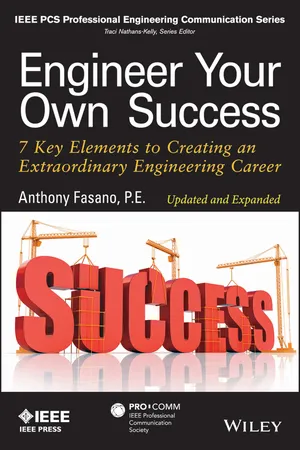
Engineer Your Own Success
7 Key Elements to Creating an Extraordinary Engineering Career
- English
- ePUB (mobile friendly)
- Available on iOS & Android
eBook - ePub
Engineer Your Own Success
7 Key Elements to Creating an Extraordinary Engineering Career
About this book
Focusing on basic skills and tips for career enhancement, Engineer Your Own Success is a guide to improving efficiency and performance in any engineering field. It imparts valuable organization tips, communication advice, networking tactics, and practical assistance for preparing for the PE exam—every necessary skill for success. Authored by a highly renowned career coach, this book is a battle plan for climbing the rungs of any engineering ladder.
Information
Part I
YOUR GUIDE TO ENGINEERING A SUCCESSFUL JOB SEARCH
1
Building a Winning Résumé
When it comes to getting a job or client, congruent value is aligning the employer's need with your value add.—Richie Norton, Resumes Are Dead and What to Do About It [1]
1.1 Building a Winning Résumé (Online and Offline)
People often talk about a “winning résumé.” Is there really a difference between a typical résumé and one that “wins” over the mind of the prospective employer?
My definition of a winning résumé is very simple: it helps you land the job that you are applying for. To be more specific, a winning résumé is a document that helps to secure an interview. This step alone is a huge challenge, especially in a down economy or in a competitive market.
A winning résumé does not look a certain way, nor is it a certain length; it is a résumé that showcases your qualifications and ultimately results in an interview. No matter how it looks or how long it is, if you send it in and do not get an interview, it is a losing résumé—end of story.
In the following pages, I will give you a blueprint for building a winning résumé for any job that you apply for. While I will offer some guidelines as to the appearance and length of the résumé, your overall focus on the target person or company who is doing the hiring is the most important aspect of this résumé preparation process.
“Find out what you like doing best and get someone to pay you for doing it.”
— Katherine Whitehorn[2]
1.2 There Is One Key Factor to a Great Résumé
As part of my job as an engineering career coach, I have had the opportunity to speak to many engineering hiring managers and industry recruiters, and I always ask them to explain to me exactly what they are looking for in a résumé. You may be surprised at what they have told me.
While the content of your résumé and your experience are critical to being hired by an engineering company, recruiters and hiring managers say that it is the visual presentation that will actually get you in the door for that all important first interview.
While the content of your résumé and your experience are critical to being hired by an engineering company, recruiters and hiring managers say that it is the visual presentation of your résumé that will actually get their attention.
There are hundreds of engineers applying for the same job these days. Recruiters and hiring managers don’t have the time to look through hundreds of résumés, so instead, they scan them first. They spend about 10 seconds per résumé, identifying which ones look good enough for them to come back to for a more detailed review at a later date.
The résumés that typically make it to the second round of reviews are those that are neat and easy to read and contain some key points about the individual. They simply stand out from the rest.
There is no right or wrong way to create a résumé; the key is to make it presentable and give the reviewer some points that will create interest. When creating your résumé, keep in mind that someone may look at it for a mere 10 seconds and decide whether or not you will be interviewed.
1.3 The Importance of Customizing Your Résumé
Before we get into the actual résumé preparation, I want to convey the importance of customizing your résumé for a specific desired job. Here’s a true story. During one of my Engineer Your Own Success seminars, an engineering executive in the audience shared some very powerful advice with the attendees. This executive worked for a large engineering company, and one of his responsibilities was to review résumés of prospective candidates and decide which ones his company should interview.
He told us that, in one instance, while looking through a pile of résumés, a candidate mentioned one of the projects that the executive’s company was working on at the time. Let’s say, e.g., the executive worked for XYZ Company. The applicant’s résumé said, “I am currently managing the John Smith Memorial Hospital project which is very similar in nature to XYZ’s Bill Taylor project in that it has a budget of $X,XXX,XXX and the clients goal is to ABC.” The executive told us that as soon as he saw his company’s name on the résumé, he decided to interview this candidate. Whether or not this candidate got the job is irrelevant because getting the interview can mean winning more than half the battle. The larger point is this: the applicant made a brilliant move by linking personal work projects to the current projects of the hiring company. Nothing impresses a company more than itself, so use that to your advantage.
Experienced recruiters have told me that one engineering position could have hundreds of applicants, so following this executive’s advice could mean the difference between being considered for the interview or getting passed over. To stand out, you need to customize each résumé to match the requirements of the company where you are applying. I believe you will find it is well worth the extra time.
To stand out, you need to customize each résumé to match the requirements and stated goals of the prospective employer.
This should be fairly simple to do if the position you are applying for has a complete job description. Simply use the same words from the job description on your résumé; those keywords, already in the job advertisement, tell you how to word your own application documents. Look for repeated wording like “leadership” or “technical competency” or “excellent communication skills.” Then, repeat those keywords or phrases, as applicable, in your own résumé and letter. If the job ad asks for someone with industry contacts, explain on your résumé or in your letter how you have a large network in the industry (if it’s true).
I have always told engineers that if you apply for 10 different jobs, you should have 10 different résumés. If you don’t, you are not putting yourself in the best position to land the jobs.
1.4 There Is a Formula to Building a Winning Résumé
Here are seven tips for creating a winning résumé or modifying an existing one:
- Include your contact information in the header section of the document. It should appear on all pages and should not cut into valuable résumé space. Ensure that your information is neatly listed and avoid offensive e-mail addresses (i.e., [email protected]). Hint: websites like Engineering.com allow you to get a free e-mail address with their URL (@engineering.com).
- Left justify the text. Doing so ensures that the text is neatly aligned. When you are counting on someone processing the information on your résumé in a short period of time, neatness counts. It must be neat and easy to read. Invisible tables can help you align segments of text.
- Ensure that the layout of the résumé is consistent. For example, if the date range for a job is in one place, be sure that it is in the same relative location for all positions you have held over the years. Using tables to create a consistent look is a good technique, but remember to make the gridlines invisible.
- For professionals, place your most relevant work experience at the top of the listings. Students and recent graduates should place the education section near the top of your résumé with experience (i.e., internships) immediately below. Please note that it is perfectly acceptable and sometimes encouraged to place non-engineering work experience on your résumé (see Section 1.6 for recommendations on effectively showing non-engineering experience).
- Use numbers where applicable. For example, if you are currently managing a project with a $35 million budget, working on a senior design project with five other students, or you are currently managing a team of 12 project engineers, include those numbers. Numbers give reviewers tangible items that can provide them with an idea of the magnitude of projects you have worked on or ...
Table of contents
- Cover
- Series page
- Title page
- Copyright page
- A Note From The Series Editor
- Acknowledgments
- Foreword
- Preface
- Introduction
- Part I: YOUR GUIDE TO ENGINEERING A SUCCESSFUL JOB SEARCH
- Part II: THE 7 KEY ELEMENTS TO AN EXTRAORDINARY ENGINEERING CAREER
- Appendix
- About the Author
- Index
- Press Series on Professional Engineering Communication
- End User License Agreement
Trusted by 375,005 students
Access to over 1.5 million titles for a fair monthly price.
Study more efficiently using our study tools.
Frequently asked questions
Yes, you can cancel anytime from the Subscription tab in your account settings on the Perlego website. Your subscription will stay active until the end of your current billing period. Learn how to cancel your subscription
No, books cannot be downloaded as external files, such as PDFs, for use outside of Perlego. However, you can download books within the Perlego app for offline reading on mobile or tablet. Learn how to download books offline
Perlego offers two plans: Essential and Complete
- Essential is ideal for learners and professionals who enjoy exploring a wide range of subjects. Access the Essential Library with 800,000+ trusted titles and best-sellers across business, personal growth, and the humanities. Includes unlimited reading time and Standard Read Aloud voice.
- Complete: Perfect for advanced learners and researchers needing full, unrestricted access. Unlock 1.5M+ books across hundreds of subjects, including academic and specialized titles. The Complete Plan also includes advanced features like Premium Read Aloud and Research Assistant.
We are an online textbook subscription service, where you can get access to an entire online library for less than the price of a single book per month. With over 1.5 million books across 990+ topics, we’ve got you covered! Learn about our mission
Look out for the read-aloud symbol on your next book to see if you can listen to it. The read-aloud tool reads text aloud for you, highlighting the text as it is being read. You can pause it, speed it up and slow it down. Learn more about Read Aloud
Yes! You can use the Perlego app on both iOS and Android devices to read anytime, anywhere — even offline. Perfect for commutes or when you’re on the go.
Please note we cannot support devices running on iOS 13 and Android 7 or earlier. Learn more about using the app
Please note we cannot support devices running on iOS 13 and Android 7 or earlier. Learn more about using the app
Yes, you can access Engineer Your Own Success by Anthony Fasano in PDF and/or ePUB format, as well as other popular books in Technology & Engineering & Engineering General. We have over 1.5 million books available in our catalogue for you to explore.