Pharmaceutical Calculations
eBook - ePub

Pharmaceutical Calculations

  1. English
  2. ePUB (mobile friendly)
  3. Available on iOS & Android
eBook - ePub

Pharmaceutical Calculations

About this book

Retaining the successful previous editions' programmed instructional format, this book improves and updates an authoritative textbook to keep pace with compounding trends and calculations – addressing real-world calculations pharmacists perform and allowing students to learn at their own pace through examples.

  • Connects well with the current emphasis on self-paced and active learning in pharmacy schools
  • Adds a new chapter dedicated to practical calculations used in contemporary compounding, new appendices, and solutions and answers for all problems
  • Maintains value for teaching pharmacy students the principles while also serving as a reference for review by students in preparation for licensure exams
  • Rearranges chapters and rewrites topics of the previous edition, making its content ideal to be used as the primary textbook in a typical dosage calculations course for any health care professional
  • Reviews of the prior edition: "...a well-structured approach to the topic..." (Drug Development and Industrial Pharmacy) and "...a perfectly organized manual that serves as a expert guide..." (Electric Review)

Frequently asked questions

Yes, you can cancel anytime from the Subscription tab in your account settings on the Perlego website. Your subscription will stay active until the end of your current billing period. Learn how to cancel your subscription.
At the moment all of our mobile-responsive ePub books are available to download via the app. Most of our PDFs are also available to download and we're working on making the final remaining ones downloadable now. Learn more here.
Perlego offers two plans: Essential and Complete
  • Essential is ideal for learners and professionals who enjoy exploring a wide range of subjects. Access the Essential Library with 800,000+ trusted titles and best-sellers across business, personal growth, and the humanities. Includes unlimited reading time and Standard Read Aloud voice.
  • Complete: Perfect for advanced learners and researchers needing full, unrestricted access. Unlock 1.4M+ books across hundreds of subjects, including academic and specialized titles. The Complete Plan also includes advanced features like Premium Read Aloud and Research Assistant.
Both plans are available with monthly, semester, or annual billing cycles.
We are an online textbook subscription service, where you can get access to an entire online library for less than the price of a single book per month. With over 1 million books across 1000+ topics, we’ve got you covered! Learn more here.
Look out for the read-aloud symbol on your next book to see if you can listen to it. The read-aloud tool reads text aloud for you, highlighting the text as it is being read. You can pause it, speed it up and slow it down. Learn more here.
Yes! You can use the Perlego app on both iOS or Android devices to read anytime, anywhere — even offline. Perfect for commutes or when you’re on the go.
Please note we cannot support devices running on iOS 13 and Android 7 or earlier. Learn more about using the app.
Yes, you can access Pharmaceutical Calculations by Maria Glaucia Teixeira,Joel L. Zatz in PDF and/or ePUB format, as well as other popular books in Medicine & Pharmacology. We have over one million books available in our catalogue for you to explore.

Information

Publisher
Wiley
Year
2017
Print ISBN
9781118978511
eBook ISBN
9781118978535
Edition
5
Subtopic
Pharmacology

Chapter 1
Review of Basic Mathematical Principles

Learning Objectives After completing this chapter the student should be able to:
  1. Recall the skills of basic mathematical operations required to work in the health field.
  2. Use estimation as a means of preventing errors.
  3. Perform mathematical operations containing units.
  4. Compare two quantities (ratio).
  5. Apply ratio, proportion, and dimensional analysis in problem solving.
Pharmacists, nurses, doctors, and most health-related professionals perform basic calculations as a daily practice. While working in a variety of settings, pharmacists, for example, need to calculate doses and determine the number of dosage units required to fill prescriptions accurately, must determine the quantities of pharmaceutical ingredients required to compound formulas, and perform calculations related to dose adjustments for disease state management, and so on. The correct drug, strength, and amount of each medication prescribed that is dispensed in pharmacies must be finally checked by the pharmacist, who is legally accountable for an incorrect dose or dispensing of a wrong drug. The fact that most pharmaceuticals are prefabricated and not prepared inside the pharmacy does not lessen the pharmacist's responsibility.
Modern drugs are effective, potent, and therefore potentially toxic if not taken correctly. An overdose may be fatal. Knowing “how to” calculate the amount of each drug and “how to” combine them is not sufficient. Of course, dispensing a subpotent dose is not satisfactory either. The drug(s) given will probably not elicit the desired therapeutic effect and will therefore be of no benefit to the patient. Clearly, the only satisfactory approach is one that is completely free of error. Absolute accuracy is any health professional's goal. Since our goal when performing calculations is the correct answer, it is logical to suppose that any rational approach to a problem that results in the correct answer is acceptable. While this is true, some approaches are more coherent and practical than others. In this text we strive to use a method that requires as few steps as possible and that with which you will feel comfortable. Usually, the simplest, most direct pathway to the solution allows less opportunity for error in computation than does one that is more complicated.
In this chapter, we will review some techniques basic to all types of calculations. To he...
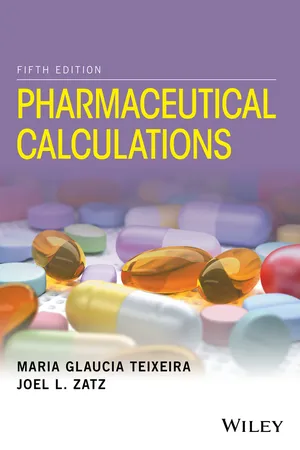
Table of contents

  1. Cover
  2. Title Page
  3. Copyright
  4. Dedication
  5. Preface
  6. Chapter 1: Review of Basic Mathematical Principles
  7. Chapter 2: Systems of Measurement
  8. Chapter 3: Prescriptions and Medication Orders
  9. Chapter 4: Weighing and Measuring in Pharmacy Practice
  10. Chapter 5: Dosage Calculations
  11. Chapter 6: Drug Concentration Expressions
  12. Chapter 7: Dilution and Concentration
  13. Chapter 8: Isotonicity
  14. Chapter 9: Dosage Calculations of Electrolytes
  15. Chapter 10: Calculations for Injectable Medications and Sterile Fluids
  16. Chapter 11: Enteral and Parenteral Nutrition
  17. Chapter 12: Miscellaneous Practical Calculations in Contemporary Compounding
  18. Appendices
  19. Literature Consulted
  20. Index
  21. End User License Agreement