Incorporate offense and defense for a more effective network security strategy
Network Attacks and Exploitation provides a clear, comprehensive roadmap for developing a complete offensive and defensive strategy to engage in or thwart hacking and computer espionage. Written by an expert in both government and corporate vulnerability and security operations, this guide helps you understand the principles of the space and look beyond the individual technologies of the moment to develop durable comprehensive solutions. Numerous real-world examples illustrate the offensive and defensive concepts at work, including Conficker, Stuxnet, the Target compromise, and more. You will find clear guidance toward strategy, tools, and implementation, with practical advice on blocking systematic computer espionage and the theft of information from governments, companies, and individuals.
Assaults and manipulation of computer networks are rampant around the world. One of the biggest challenges is fitting the ever-increasing amount of information into a whole plan or framework to develop the right strategies to thwart these attacks. This book clears the confusion by outlining the approaches that work, the tools that work, and resources needed to apply them.
Understand the fundamental concepts of computer network exploitation
Learn the nature and tools of systematic attacks
Examine offensive strategy and how attackers will seek to maintain their advantage
Understand defensive strategy, and how current approaches fail to change the strategic balance
Governments, criminals, companies, and individuals are all operating in a world without boundaries, where the laws, customs, and norms previously established over centuries are only beginning to take shape. Meanwhile computer espionage continues to grow in both frequency and impact. This book will help you mount a robust offense or a strategically sound defense against attacks and exploitation. For a clear roadmap to better network security, Network Attacks and Exploitation is your complete and practical guide.
A computer once beat me at chess, but it was no match for me at kickboxing.
—Emo Philips
Since Sun Tzu's The Art of War, historians and analysts have searched for guiding theories and principles of conflict. Their purpose was not always to create some academic treatise to be beheld or to provide an endless stream of pithy quotes for marketing presentations. Rather, in exploring the principles of conflict, the goal is to confer an advantage in training, planning, research and development, execution, and defense—in short, to increase the efficiency and effectiveness of a fighting force in all aspects.
Information systems are a new area of conflict; one in which the incursions are virtual and the violations of sovereignty are abstracted. Yet the stakes are tangible. There may be no land involved, but both sides seek to attack and protect a territory and property.
Information systems are integrated into all aspects of the global economy and modern nation-states. Of course, there is e-mail and the Web, but less visible are the inventory, ordering, and payment systems that drive business. You barely notice when the grocery store prints out coupons based on your shopping habits, while simultaneously noting the inventory loss for later restocking. All this data is shared over a network and stored in a data center in…well…you actually have no idea. Yet this unseen database can reveal not only your favorite item from aisle 10, but also whether you are married, have kids, own pets, like to drink, or are out of town right now.
Now the flavor of ice cream you prefer may not be much of a secret worth stealing, but there is a wealth of information that is. Interested in how to log in to a bank by spoofing someone's supposedly secure login token? Looking to know which of your neighbors are dissidents and are “inciting subversion of the state”? Curious about what an aspiring U.S. vice presidential candidate writes in e-mails? Do you find the source code to the computer systems on the F-35 Joint Strike Fighter appealing? My mint chocolate chip preference is the only untouched thing on this list; though that too is questionable.
Given the huge potential economic and military benefits of acquiring this information, it's no surprise that the act of stealing computer information has become a well-funded profession. And like any profession, it has developed its own set of terminology. So before getting too deep, let's start with the basics.
Computer Network Exploitation (CNE) is computer espionage, the stealing of information. It encompasses gaining access to computer systems and retrieving data. An old analogy is that of a cold war spy who picks the lock on a house, sneaks in, takes pictures of documents with his secret camera, and gets out without leaving a trace. A more modern analogy would be a drone that invades a hostile country's airspace to gather intelligence on troop strength.
Computer Network Attack (CNA) is akin to a traditional military attack or sabotage. It applies the four D's of “disrupt, deny, degrade, or destroy” to computer networks. Now, the cold war spy smashes a few artifacts as he leaves or maybe Fight Club-style, he introduces a gas leak so that the whole place explodes sometime later. Meanwhile, the drone rains hellfire missiles. CNA is the computer equivalent. It describes actions and effects that range from the subtle to the catastrophic.
Non-kinetic Computer Network Attack is a term this book uses to describe the subset of CNA conducted virtually, that is, any disruption, denial, degradation, or destruction initiated and performed via computers or computer networks. Although sending a missile into a data center is a rather effective form of CNA that fits well within the definition, physically initiated acts are outside the scope of this book.
Non-kinetic CNA therefore describes damage with virtual causes; though there very well may be physical effects. To continue with the analogy, instead of breaking anything, the spy remotely shuts off the heat during an extremely cold night causing the water pipes to burst. The cause was virtual, but the effect was not.
Computer Network Defense (CND) is protecting your networks from being exploited or attacked. It's the locks, doors, walls, and windows on the house and the police officer that walks by once a day on her beat, or the radar sweeps and antiaircraft missile systems that line the border.
Like CNA, there are both physical and virtual aspects to CND, but the term generally applies only to virtual security and is therefore used that way in this book.
Finally, Computer Network Operations (CNO) is the umbrella term that is composed of all the previous terms: Computer Network Exploitation (CNE), Computer Network Attack (CNA), and Computer Network Defense (CND).
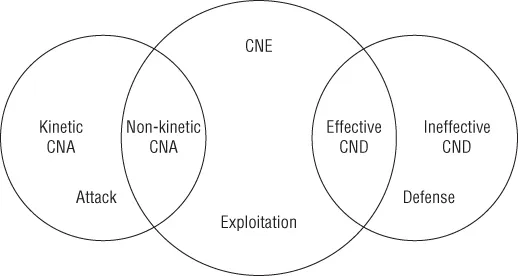
CNE is the key subject necessary for understanding all aspects of the topic. As shown in Figure 1.1, the effective parts of each discipline are rooted in CNE.
Figure 1.1 CNO disciplines
Effective non-kinetic CNA requires at least a measure of access to the target. Generally, the more access you have, the wider the range of options available. With minimal access, you might temporarily take a website offline. With extensive access, you can erase the data on tens of thousands of computers and take the company down for a week, as was done to the oil company Saudi Aramco, allegedly by Iran.
CND, or defense, does not rely directly on CNE (at least not while it remains illegal to counterattack), but trying to craft a successful network defense without understanding the offense is like trying to design a flak jacket without any knowledge of ballistics. Either way, the exercise is going to end with something full of holes.
CNE is central and therefore worth formally defining. The U.S. Department of Defense defines CNE as
Enabling operations and intelligence collection capabilities conducted through the use of computer networks to gather data from target or adversary automated information systems or networks.
—Joint Publication 3-13
The first thing to note is that CNE is directed. There is a “target or adversary.” This is a differentiating factor. Many a computer worm or virus, such as Michelangelo, Code Red, Melissa, or SQL Slammer, has gained access to computer systems. And yet, these infections were not CNE because there was no intended target and no intent to gather information.
An indiscriminate worm is more like the flu. There is no conscious choice of victim, and whether a particular person gets sick is a combination of natural defenses, preparation, and luck. CNE is more like biological warfare, leveraged with a particular target in mind.
This is not to say that a CNE operation is always precision targeted or that it will never compromise a collateral computer. Counterexamples exist. Stuxnet was a wormlike attack that infiltrated Iranian nuclear facilities and then went on to infect other companies. Worms, like those created to exploit the Linux Shellshock vulnerability, can be leveraged to deposit backdoors in preparation for later access. Every action need not be deterministic, but on balance, the bulk of a CNE operation is intended to be focused, targeted, and invisible.
The rest of the Department of Defense's definition provides a good basis for discussion but requires one significant point of emphasis. To understand the missing nuance, you must first understand computer operations.
Operations
A CNE operation is a series of coordinated actions directed toward a target computer or network in furtherance of a mission objective. The mission objective may be anything ranging from political intelligence, design plans, company strategies, or plain-old financial information.
Let's parse this definition because several words take on different meanings in a CNE context.
The word target has an intentional duality. Whether target systems, target networks, target data, or target employees, “target” simultaneously refers to both the goal and the obstacles to reaching it. Target includes both the data you want to acquire and the forces in place to protect it.
Though the word attacker is commonly used to describe the offensive actor, the corresponding defender is notably absent from this definition. A target might defend, but it might not. A target may not even know if and when it is attacked.
Now everyone knows what a computer is, right? It's a desktop, laptop, or smartphone. True. But it's also your television, alarm system, building air conditio...
Table of contents
Cover
Title Page
Copyright
Dedication
About the Author
About the Technical Editor
Credits
Acknowledgments
Chapter 1: Computer Network Exploitation
Chapter 2: The Attacker
Chapter 3: The Defender
Chapter 4: Asymmetries
Chapter 5: Attacker Frictions
Chapter 6: Defender Frictions
Chapter 7: Offensive Strategy
Chapter 8: Defensive Strategy
Chapter 9: Offensive Case Studies
Epilogue
Appendix: Attack Tools
References
Bibliography
End User License Agreement
Trusted by 375,005 students
Access to over 1.5 million titles for a fair monthly price.
Study more efficiently using our study tools.
Frequently asked questions
Yes, you can cancel anytime from the Subscription tab in your account settings on the Perlego website. Your subscription will stay active until the end of your current billing period. Learn how to cancel your subscription
No, books cannot be downloaded as external files, such as PDFs, for use outside of Perlego. However, you can download books within the Perlego app for offline reading on mobile or tablet. Learn how to download books offline
Perlego offers two plans: Essential and Complete
Essential is ideal for learners and professionals who enjoy exploring a wide range of subjects. Access the Essential Library with 800,000+ trusted titles and best-sellers across business, personal growth, and the humanities. Includes unlimited reading time and Standard Read Aloud voice.
Complete: Perfect for advanced learners and researchers needing full, unrestricted access. Unlock 1.5M+ books across hundreds of subjects, including academic and specialized titles. The Complete Plan also includes advanced features like Premium Read Aloud and Research Assistant.
Both plans are available with monthly, semester, or annual billing cycles.
We are an online textbook subscription service, where you can get access to an entire online library for less than the price of a single book per month. With over 1.5 million books across 990+ topics, we’ve got you covered! Learn about our mission
Look out for the read-aloud symbol on your next book to see if you can listen to it. The read-aloud tool reads text aloud for you, highlighting the text as it is being read. You can pause it, speed it up and slow it down. Learn more about Read Aloud
Yes! You can use the Perlego app on both iOS and Android devices to read anytime, anywhere — even offline. Perfect for commutes or when you’re on the go. Please note we cannot support devices running on iOS 13 and Android 7 or earlier. Learn more about using the app
Yes, you can access Network Attacks and Exploitation by Matthew Monte in PDF and/or ePUB format, as well as other popular books in Computer Science & Cyber Security. We have over 1.5 million books available in our catalogue for you to explore.