Paleoecology is a discipline that uses evidence from fossils to provide an understanding of ancient environments and the ecological history of life through geological time. This text covers the fundamental approaches that have provided the foundation for present paleoecological understanding, and outlines new research areas in paleoecology for managing future environmental and ecological change. Topics include the use of actualism in paleoecology, development of paleoecological models for paleoenvironmental reconstruction, taphonomy and exceptional fossil preservation, evolutionary paleoecology and ecological change through time, and conservation paleoecology. Data from studies of invertebrates, vertebrates, plants and microfossils, with added emphasis on bioturbation and microbial sedimentary structures, are discussed. Examples from marine and terrestrial environments are covered, with a particular focus on periods of great ecological change, such as the Precambrian-Cambrian transition and intervals of mass extinction.
Readership: This book is designed for advanced undergraduates and beginning graduate students in the earth and biological sciences, as well as researchers and applied scientists in a range of related disciplines.
Frequently asked questions
Yes, you can cancel anytime from the Subscription tab in your account settings on the Perlego website. Your subscription will stay active until the end of your current billing period. Learn how to cancel your subscription.
At the moment all of our mobile-responsive ePub books are available to download via the app. Most of our PDFs are also available to download and we're working on making the final remaining ones downloadable now. Learn more here.
Perlego offers two plans: Essential and Complete
Essential is ideal for learners and professionals who enjoy exploring a wide range of subjects. Access the Essential Library with 800,000+ trusted titles and best-sellers across business, personal growth, and the humanities. Includes unlimited reading time and Standard Read Aloud voice.
Complete: Perfect for advanced learners and researchers needing full, unrestricted access. Unlock 1.4M+ books across hundreds of subjects, including academic and specialized titles. The Complete Plan also includes advanced features like Premium Read Aloud and Research Assistant.
Both plans are available with monthly, semester, or annual billing cycles.
We are an online textbook subscription service, where you can get access to an entire online library for less than the price of a single book per month. With over 1 million books across 1000+ topics, weāve got you covered! Learn more here.
Look out for the read-aloud symbol on your next book to see if you can listen to it. The read-aloud tool reads text aloud for you, highlighting the text as it is being read. You can pause it, speed it up and slow it down. Learn more here.
Yes! You can use the Perlego app on both iOS or Android devices to read anytime, anywhere ā even offline. Perfect for commutes or when youāre on the go. Please note we cannot support devices running on iOS 13 and Android 7 or earlier. Learn more about using the app.
Yes, you can access Paleoecology by David J. Bottjer in PDF and/or ePUB format, as well as other popular books in Physical Sciences & Geology & Earth Sciences. We have over one million books available in our catalogue for you to explore.
Paleoecology is the study of ancient ecology in its broadest sense. It has been enormously successful in placing the history of life within an ecological context. As part of that understanding, it has served as a vital tool for understanding the occurrence of many natural resources. In all its sophisticated approaches, paleoecology has taught us much about the past history of life and Earth's environments. With this record of demonstrating the response of Earth's biota to past environmental change, paleoecology now stands poised as a vital source of information on how Earth's ecosystems will respond to the current episode of global environmental change.
History of study
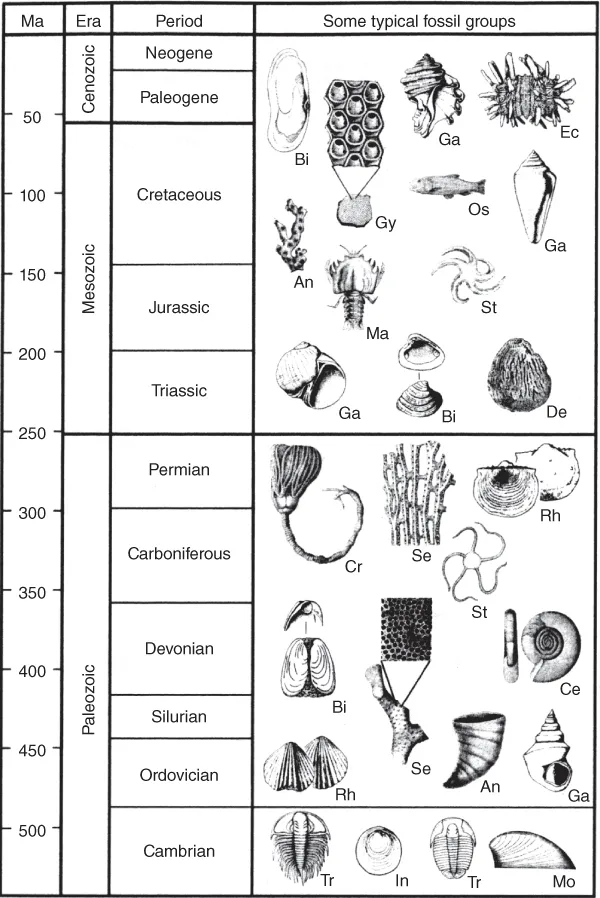
The notion that certain objects that one finds in sedimentary rocks were once living organisms is one that humanity struggled with for a long time. Leonardo da Vinci is generally credited with being the first to write down observations on the biological reality of fossils through examination of marine fossils from the Apennine Mountains of Italy. In reality, Leonardo also made some of the first paleoecological interpretations through understanding these fossils as the remains of once living organisms that had not been transported some great distance and hence were not deposited as part of a great flood. The great utility of fossils to geologists was highlighted in the 19th century by the development of the geological timescale, and of course, after publication of āOn the Origin of Speciesā by Darwin, evidence from the fossil record was some of the strongest available then for evolution. For the past 200 years, stratigraphic and paleontologic work has defined the occurrence of the major fossil groups that make up the record, and this general outline can be seen in Fig. 1.1, which shows Paleozoic, Mesozoic, and Cenozoic characteristic marine (ocean) skeletonized fossils.
Figure 1.1 The Phanerozoic timescale with distribution of characteristic skeletonized marine fossils. Occurrence of fossils through the stratigraphic record has largely been determined through mapping efforts around the globe to characterize the surface geology of the continents. These fossil distributions have been continuously refined through the use of fossils to build the relative timescale and definition of Eras, Periods, and other time intervals. Key to classes: An, Anthozoa; Bi, Bivalvia; Ce, Cephalopoda; Cr, Crinoidea; De, Demospongiae; Ec, Echinoidea; Ga, Gastropoda; Gy, Gymnolaemata; In, āInarticulataā (Linguliformea and Craniformea); Ma, Malacostraca; Mo, Monoplacophora; Os, Osteichthyes; Rh, āArticulataā (Rhynchonelliformea); Se, Stenolaemata; St, Stelleroidea; Tr, Trilobita. From McKinney (2007). Reproduced with permission from Columbia University Press.
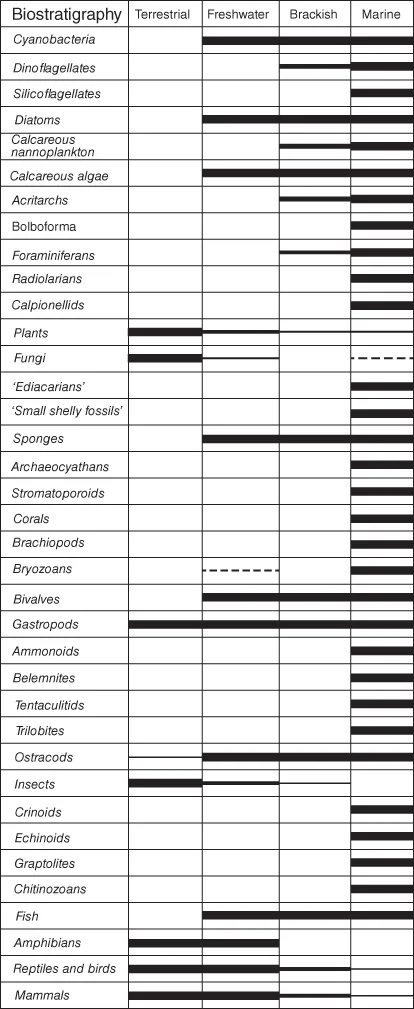
Paleoecology as originally practiced is the use of biological information found in sedimentary rocks to help determine ancient paleoenvironments. Phanerozoic sedimentary rocks are found to have in situ marine fossils that we know were deposited in ancient oceans. Devonian and younger sedimentary strata that have remains of plants can be interpreted as deposited in terrestrial environments. For example, Fig. 1.2 shows the distribution within environments of various different fossil groups that have a substantial fossil record. One can see that these data are very valuable for understanding the past and past environments. So this information makes it easy to determine depositional environments of Phanerozoic sedimentary rocks, particularly in combination with physical sedimentary structures and geochemical indicators. Much work on paleoecology has been spurred by the petroleum industry and the need to understand ancient environments from drill cores and cuttings as well as outcrops. This need has led to much activity on microfossils, which can yield many specimens from a small piece of rock. And, through microfossils, information can be gained not only on ancient environments but also for ancient age determinations.
Figure 1.2 Environmental distribution of selected groups of fossils. This information largely comes from studies on the distribution of these organisms in modern environments, but also includes data on facies associations and functional morphology, particularly for the extinct groups. From Jones (2006). Reproduced with permission from Cambridge University Press.
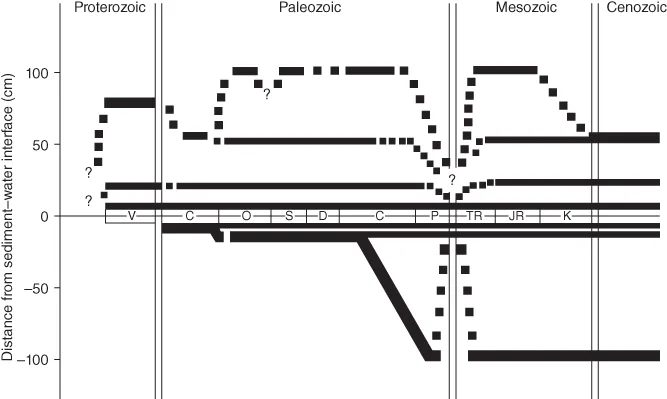
In the 1960s and 1970s, the study of fossil communities, or paleocommunities, blossomed. To many, the results from this research activity seemed to show that animals in the past lived the way they do today. But, as this information has accumulated, it became clear that ecology changes through time, due to both evolution as well as environmental change. The synthesis of this realization has come to be known as evolutionary paleoecology. Evolutionary paleoecology has become a group of research programs that focus on the environmental and ecological context for long-term macroevolutionary change as seen from the fossil record. For example, Fig. 1.3 displays the tiering history for benthic suspension-feeding organisms in shallow marine environments below wave base since their early evolution in the Ediacaran, synthesized in work done with William Ausich. Tiering is the distribution of organisms above and below the seafloor, and this diagram shows how the distribution has changed through time and therefore how organisms have evolved their ability to inhabit three-dimensional space. This diagram is the latest of several showing tiering, and its development in the early 1980s was part of the early history of evolutionary paleoecology.
Figure 1.3 Tiering history among marine soft-substrata suspension-feeding communities from the late Precambrian through the Phanerozoic. Zero on the vertical axis indicates the sedimentāwater interface; the heaviest lines indicate maximum levels of epifaunal or infaunal tiering; other lines are tier subdivisions. Solid lines represent data, and dotted lines are inferred levels. These characteristic tiering levels were determined for infaunal tiers by examination of the trace fossil record, particularly the characteristic depth of penetration below the seafloor of individual trace fossils. Data on shallow infaunal tiers also came from functional morphology studies of skeletonized body fossils. Paleocommunity and functional morphology studies of epifaunal body fossils comprise the data for epifaunal tiering trends. Tiering data from the late Precambrian is from studies of the Ediacara biota. This tiering history has been updated as more data have become available. From Ausich and Bottjer (2001). Reproduced with permission from John Wiley & Sons.
Paleoecology and the future
Earth's ancient ecology is a fascinating subject for study, but there is more to be gained from this study as a benefit to present society. We are entering a time of widespread environmental change, in large part due to disruption of the carbon cycle (Fig. 1.4) through burning of lithospheric coal and petroleum and subsequent transfer of carbon in the form of carbon dioxide from the lithosphere into the atmosphere. This increase in greenhouse gasses in the atmosphere is causing rapid increased warming of the atmosphere and the ocean (Fig. 1.5). Increased warming of the ocean can lead to reduced ocean circulation which causes decreased oxygen content in ocean ...
Table of contents
Cover
Title Page
Copyright
Table of Contents
Preface
Chapter 1: Overview
Chapter 2: Deep time and actualism in paleoecological reconstruction
Chapter 3: Ecology, paleoecology, and evolutionary paleoecology
Chapter 4: Taphonomy
Chapter 5: Bioturbation and trace fossils
Chapter 6: Microbial structures
Chapter 7: Across the great divide: Precambrian to Phanerozoic paleoecology