Liquidity risk is in the spotlight of both regulators and management teams across the banking industry. The European banking regulator has introduced and implemented a stronger liquidity regulatory framework and local regulators have made liquidity a top priority on their supervisory agenda. Banks have accordingly followed suit. Liquidity risk is now a topic widely discussed in boardrooms as banks strive to set up a strong and efficient liquidity risk management framework which, while maintaining sufficient resources, does not jeopardize the necessary profitability and return targets.
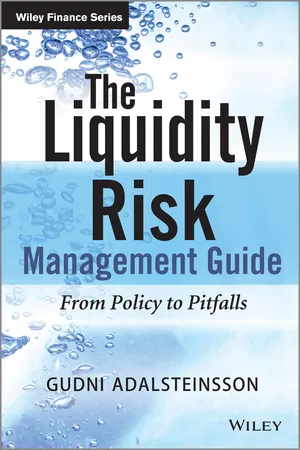
The Liquidity Risk Management Guide: From Policy to Pitfalls is practical guide for banks and risk professionals to proactively manage liquidity risk in a systemic way. The book sets out its own comprehensive framework, which includes all the various and critical components of liquidity risk management. The recommendations are based on experiences from the recent financial crises, best practices and compliance with current and future regulatory requirements, with special emphasis on Basel III.
Using the new 6 Step Framework, the book provides step-by-step guidance for the reader to build their liquidity management framework into a new overarching structure, which brings all the different parts of liquidity risk into one approach. Special attention is given to the challenges that banks currently face when adopting and implementing the Basel III liquidity requirements and guidance is given on how the new metrics can be integrated into the existing framework, providing the most value to the banks instead of being a regulatory reporting matter.
Much has been written about what went wrong in banking prior to and during the financial crises. These are, however, in many cases two distinct elements, which both contributed to the unprecedented financial crises.
From the start of the new millennium banks and capital markets enjoyed almost extraordinary times of prosperity where almost every factor both external and internal helped to fuel the growth. Macroeconomic conditions were generally good in the Western world and globalization became more than a buzz word with the influx of Asia and the Eastern bloc. Banks and in fact many other industries were reaping the benefits of deregulation, which had taken place simultaneously in various corners of the world. Apart from a short breather around the dotcom bubble the markets were moving forward at a great pace.
Credit spreads dropped, which helped to fuel the real economy and mid-sized corporates were financing themselves at yields only available to quality sovereigns a few years earlier. The other side of the coin was the search for sufficient yields on investments, which became more and more challenging as time passed with the ever increasing inflows of cash. Technological advances both within actual systems and the field of financial engineering meant that banks met investor demand for ‘unchanged’ yields with increasingly complex derivatives products. There is no reward without risk and in spite of the strong ratings that most of these products were granted, a higher reward was gained by additional risk. Leverage became a key ingredient in the returns offered. The ‘plain vanilla’ fixed income instruments were replaced by structured products and the emphasis of investment banks shifted accordingly. The team in which I had started in one of the investment banks shifted within a couple of years from being the distribution platform for new bond issuance from various companies to structuring and marketing different kinds of collateralized obligations and structured investments to the same investor base.
All pictures have cracks if looked at closely enough and the one painted above was no exception. The increased leverage in the overall system made it vulnerable to any market adjustments or even changes in assumptions on credit quality. The story of how effectively one product in one country (subprime housing loans in the United States) triggered global turmoil has been well covered.
This is the first part that went wrong. The second part was the inadequacy of banks and banking systems to withstand the external shocks, which led to the full-blown financial crises. The wave that hit the systems was of unprecedented magnitude but the walls and blocks in place to prevent the risk were in many cases inadequate. The biggest shortcomings were the lack of adequate liquidity systems, which is the area this book focuses on.
Much changed in the aftermath of the crises. The first response of regulators and supervisors was to apply measurements to prevent the same mistakes being repeated with the aim of restoring the banking system and promoting a more stable economy. Some of the risk measurements that have been put into law and are now being implemented, such as the Basel III framework, are a direct response to the specific factors that went astray. This holds especially true for the new inaugural liquidity ratios, the liquidity coverage ratio (LCR), which will come into effect in 2015, and the net stable funding ratio (NSFR), which is destined to be met with more resistance and may well take a new decade before it becomes a standard. When the criterion for meeting the two ratios is assessed it becomes clear that their purpose is to prevent history from repeating itself, that is avoiding longer-dated assets being financed with short-term liabilities. Once the standards are being met, it will be difficult if not impossible to imagine the scenario from 2007 happening again, which is something all stakeholders will welcome. However, will it avoid other liquidity problems happening? The short answer is no. No single measurement can capture and control all aspects of liquidity risk, however useful it may be.
It is important to realize that there will be liquidity problems again in the future. The only certainty is that as long as liquidity risk is embedded in the banking systems, there is always a possibility that the risk will go out of control. The problem is we do not know what will go wrong, where or which type of risk it might be; the only thing we know is that it will happen again. This is not a ‘the end is near’ apocalypse forecast and neither is it implying that the magnitude of future problems will be equal to the last one. It is only a fair reminder that liquidity risk is not dead. On the contrary, liquidity problems are more common than most of us realize. As an example, during the savings and loan crises in the United States in the 1980s and 1990s some 1,200 savings and loan associations failed, costing the US taxpayer about $150bn.1 This shows that liquidity risk is not just something that has been happening over the last ten years.
If you do not expect the unexpected, you will not find it; for it is hard to be sought out and difficult.
Not knowing where the risk comes from or when it will happen, what is there to do? To make things even worse the liquidity risk cannot easily be identified. It is not listed on any exchange. Nor can it be found on any financial institution's balance sheet. Nonetheless, we have established above that liquidity is a critical factor to the well-being and viability of every financial institution.
The approach in this book can be captured in the above ‘expect the unexpected’ phrase, which is believed to originate from the Greek philosopher Heraclitus of Ephesus.2 Though not likely to have been discerning himself about liquidity risk management, Heraclitus did however make a point, which is still valid some 2,500 years later. Rather than trying to avoid the last mistakes from happening, which are well known, it is a better approach to prepare for the unexpected. That can be done by developing a system that can identify various unknown threats from different sources and mitigate them.
In the absence of having a sound methodology some regulators adopted the ‘shot gun approach’ during the last crises. Not knowing where to aim the best solution was to open fire on anything that moved and hoping the future threats would be amongst the victims. No deaths were reported but many banks have struggled to come to terms with the cost of the burden of maintaining large liquidity buffers, which in some instances do not reflect the risk profile of the firm. For the lack of a better solution, this might be called a pragmatic approach.
However, in the long run the solution is not simply to ask banks to increase their liquidity buffer. Just as investors' most common reaction to increased risk is a ‘flight to quality’ the regulatory and management approach response to risk failures is sometimes to do more of the same, sometimes much more. This goes on until participants feel the threat has passed or is forgotten. Then these risk measures fall out of favour and are considered as an unnecessary burden for a healthy business. The situation is similar to one we all know while driving. After being through something we felt was a close call we slow down and become more cautious. Nevertheless, it is not long until the experience has worn off and we are back to our usual speed as if nothing had happened. This happens in risk management as well. We are even seeing the same supervisors easing their liquidity requirement again but without a risk justification, effectively admitting to being too conservative the first time around. This does not send the right message to businesses, which need to accept that the liquidity requirements set by the regulators are adequate and for their own good. A lack of support to the regime is not good for anyone. Therefore, the solution is not simply to lock everything down that will be abandoned sooner or later, knowingly or unknowingly, but to introduce tangible improvements.
1.1 THE IMPORTANCE OF AN OVERARCHING LIQUIDITY RISK MANAGEMENT FRAMEWORK
1995
Mexican crises
1998
Russia default
2001
Argentina sovereign default and banking crises
2008
Global financial crises
2012
Greece banking and sovereign crises
Above is a list of a few selected liquidity crises that have taken place over the past two decades. In reviewing them it is difficult to find one single common thread apart from the fact that financial institutions and sovereigns had problems servicing their liabilities when they fell due and payable, which is the very definition of liquidity risk. The history does, however, help in a more general manner as it provides a good understanding of the correlation between liquidity sources and their interplay. An example could be the asset-backed commercial paper (ABCP) (the CP issued by special purpose vehicles with collateralized obligations as its sole assets). ABCP might not cause problems again, but the wider experience of asset contagion is something that has been added to the toolbox of every risk specialist.
In the aftermath of the financial crises, liquidity risk management became the centre of attention. The emphasis on improved liquidity risk management did not only come from the individual bank level and their stakeholders. It was even to a larger extent an ultimatum from central banks and governments on behalf of the taxpayers, to demand that banks should recognize the large implications to the economy should they fail to control liquidity risk properly.
However, there are additional reasons for liquidity risk becoming critical to modern banking. The following fundamental but interlinked reasons can be named: a change in the traditional banking intermediation model and amplified competition. Historically, banks relied on stable and low-cost core deposits (demand, savings and time deposits) as the primary source of funding to generate a portfolio of (rather illiquid) loans held to maturity. This is a fundamental risk, as banks are in general structurally illiquid. However, as long as there was an easy access to stable core deposits banks would in normal circumstances be fine. More recently the availability of alternative investments and savings products offered by a wider variety of financial institutions has resulted in a decline in traditional deposit markets from which banks had funded themselves. Secondly, the technological advancement of customer benefits, where depositors can instantly chose between multiple banks, has changed the competitive landscape of traditional banking and decreased what can be generally called ‘core deposits’. Both of these factors call for an improved liquidity management framework, which can be aligned to changing external conditions.
The question then is how well banks are doing in having an adequate liquidity framework in place. Surveys indicate that apart from holding more liquidity than before, liquidity risk frameworks and governance are still not as well developed as other parts of their risk structure and can still be seen as the weakest link.
1.2 THE ‘6 STEP FRAMEWORK’
The book proposes a new risk management framework to deal with fundamentals of liquidity risk, in any shape or form in which they may arise. Rather than trying to aim at the symptoms of liquidity risk, which are always changing, the focus is set on the fundamental causes, which do not change over time or are different between banks or banking systems.
The book is not a magic pill against all diseases but emphasizes the elements all banks have in common, which can be seen as the core to risk management. By applying a top-down approach when orchestrating the framework the bank will build up a system that is suited to its individual needs and characteristics, rather than trying to mix together various solutions to individual problems. Only by applying the top-down method can the bank be sure that all t...
Table of contents
Cover
Series
Titlepage
Copyright
Dedication
Preface
1 Introduction
2 Primer in Banking
3 The ALM Function – The Framework on Top of Liquidity Management
4 Liquidity – Background and Key Concepts
5 The Appropriate Liquidity Framework – Introduction to the ‘6 Step Framework’
6 Step I: Sources of Liquidity Risk
7 Step II: Risk Appetite
8 Step III: Governance and High-Level Policy
9 Step IV: The Quantitative Framework
10 Step V: Stress Testing and the Contingency Funding Plan
11 Step VI: Reporting and Management Information
12 Basel III: The New Global Framework
Bibliography
Index
End User License Agreement
Trusted by 375,005 students
Access to over 1.5 million titles for a fair monthly price.
Study more efficiently using our study tools.
Frequently asked questions
Yes, you can cancel anytime from the Subscription tab in your account settings on the Perlego website. Your subscription will stay active until the end of your current billing period. Learn how to cancel your subscription
No, books cannot be downloaded as external files, such as PDFs, for use outside of Perlego. However, you can download books within the Perlego app for offline reading on mobile or tablet. Learn how to download books offline
Perlego offers two plans: Essential and Complete
Essential is ideal for learners and professionals who enjoy exploring a wide range of subjects. Access the Essential Library with 800,000+ trusted titles and best-sellers across business, personal growth, and the humanities. Includes unlimited reading time and Standard Read Aloud voice.
Complete: Perfect for advanced learners and researchers needing full, unrestricted access. Unlock 1.5M+ books across hundreds of subjects, including academic and specialized titles. The Complete Plan also includes advanced features like Premium Read Aloud and Research Assistant.
Both plans are available with monthly, semester, or annual billing cycles.
We are an online textbook subscription service, where you can get access to an entire online library for less than the price of a single book per month. With over 1.5 million books across 990+ topics, we’ve got you covered! Learn about our mission
Look out for the read-aloud symbol on your next book to see if you can listen to it. The read-aloud tool reads text aloud for you, highlighting the text as it is being read. You can pause it, speed it up and slow it down. Learn more about Read Aloud
Yes! You can use the Perlego app on both iOS and Android devices to read anytime, anywhere — even offline. Perfect for commutes or when you’re on the go. Please note we cannot support devices running on iOS 13 and Android 7 or earlier. Learn more about using the app
Yes, you can access The Liquidity Risk Management Guide by Gudni Adalsteinsson in PDF and/or ePUB format, as well as other popular books in Business & Finance. We have over 1.5 million books available in our catalogue for you to explore.