Statistics from A to Z
eBook - ePub

Statistics from A to Z

Confusing Concepts Clarified

  1. English
  2. ePUB (mobile friendly)
  3. Available on iOS & Android
eBook - ePub

Statistics from A to Z

Confusing Concepts Clarified

About this book

Statistics is confusing, even for smart, technically competent people. And many students and professionals find that existing books and web resources don't give them an intuitive understanding of confusing statistical concepts. That is why this book is needed. Some of the unique qualities of this book are:

• Easy to Understand: Uses unique "graphics that teach" such as concept flow diagrams, compare-and-contrast tables, and even cartoons to enhance "rememberability."

• Easy to Use: Alphabetically arranged, like a mini-encyclopedia, for easy lookup on the job, while studying, or during an open-book exam.

• Wider Scope: Covers Statistics I and Statistics II and Six Sigma Black Belt, adding such topics as control charts and statistical process control, process capability analysis, and design of experiments. As a result, this book will be useful for business professionals and industrial engineers in addition to students and professionals in the social and physical sciences.

In addition, each of the 60+ concepts is covered in one or more articles. The 75 articles in the book are usually 5–7 pages long, ensuring that things are presented in "bite-sized chunks." The first page of each article typically lists five "Keys to Understanding" which tell the reader everything they need to know on one page. This book also contains an article on "Which Statistical Tool to Use to Solve Some Common Problems", additional "Which to Use When" articles on Control Charts, Distributions, and Charts/Graphs/Plots, as well as articles explaining how different concepts work together (e.g., how Alpha, p, Critical Value, and Test Statistic interrelate).

ANDREW A. JAWLIK received his B.S. in Mathematics and his M.S. in Mathematics and Computer Science from the University of Michigan. He held jobs with IBM in marketing, sales, finance, and information technology, as well as a position as Process Executive. In these jobs, he learned how to communicate difficult technical concepts in easy - to - understand terms. He completed Lean Six Sigma Black Belt coursework at the IASSC - accredited Pyzdek Institute. In order to understand the confusing statistics involved, he wrote explanations in his own words and graphics. Using this material, he passed the certification exam with a perfect score. Those statistical explanations then became the starting point for this book.

Frequently asked questions

Yes, you can cancel anytime from the Subscription tab in your account settings on the Perlego website. Your subscription will stay active until the end of your current billing period. Learn how to cancel your subscription.
At the moment all of our mobile-responsive ePub books are available to download via the app. Most of our PDFs are also available to download and we're working on making the final remaining ones downloadable now. Learn more here.
Perlego offers two plans: Essential and Complete
  • Essential is ideal for learners and professionals who enjoy exploring a wide range of subjects. Access the Essential Library with 800,000+ trusted titles and best-sellers across business, personal growth, and the humanities. Includes unlimited reading time and Standard Read Aloud voice.
  • Complete: Perfect for advanced learners and researchers needing full, unrestricted access. Unlock 1.4M+ books across hundreds of subjects, including academic and specialized titles. The Complete Plan also includes advanced features like Premium Read Aloud and Research Assistant.
Both plans are available with monthly, semester, or annual billing cycles.
We are an online textbook subscription service, where you can get access to an entire online library for less than the price of a single book per month. With over 1 million books across 1000+ topics, we’ve got you covered! Learn more here.
Look out for the read-aloud symbol on your next book to see if you can listen to it. The read-aloud tool reads text aloud for you, highlighting the text as it is being read. You can pause it, speed it up and slow it down. Learn more here.
Yes! You can use the Perlego app on both iOS or Android devices to read anytime, anywhere — even offline. Perfect for commutes or when you’re on the go.
Please note we cannot support devices running on iOS 13 and Android 7 or earlier. Learn more about using the app.
Yes, you can access Statistics from A to Z by Andrew A. Jawlik in PDF and/or ePUB format, as well as other popular books in Mathematics & Probability & Statistics. We have over one million books available in our catalogue for you to explore.

Information

Publisher
Wiley
Year
2016
Print ISBN
9781119272038
eBook ISBN
9781119272007

ALPHA,

Summary of Keys to Understanding

  1. In Inferential Statistics, p is the Probability of an Alpha (“False Positive”) Error.
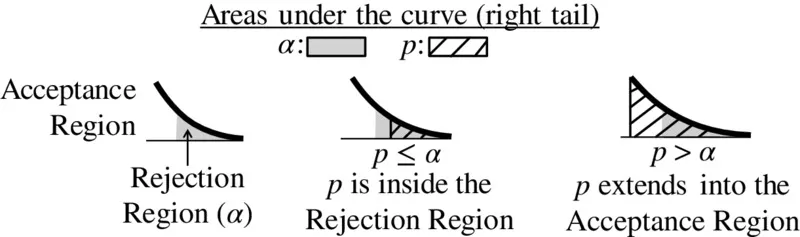
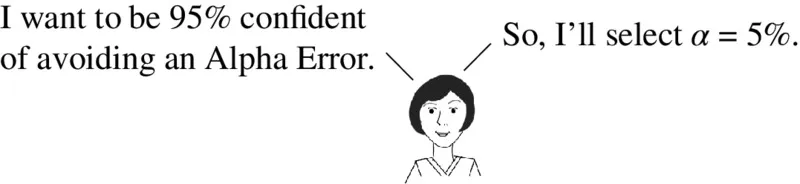
  1. Alpha is the highest value of p that we are willing to tolerate and still say that a difference, change, or effect observed in the Sample is “Statistically Significant.”
images
  1. Alpha is a Cumulative Probability, represented as an area under the curve, at one or both tails of a Probability Distribution. p is also a Cumulative Probability.
images
  1. In Hypothesis Testing, if pα, Reject the Null Hypothesis. If p > α, Accept (Fail to Reject) the Null Hypothesis.
  1. Alpha defines the Critical Value(s) of Test Statistics, such as z, t, F, or Chi-Square. The Critical Value or Values, in turn, define the Confidence Interval.

Explanation

  1. In Inferential Statistics, p is the Probability of an Alpha (“False Positive”) Error.
In Inferential Statistics, we use data from a Sample to estimate a property (say, the Mean) of the Population or Process from which the Sample was taken. Being an estimate, there is a risk of error.
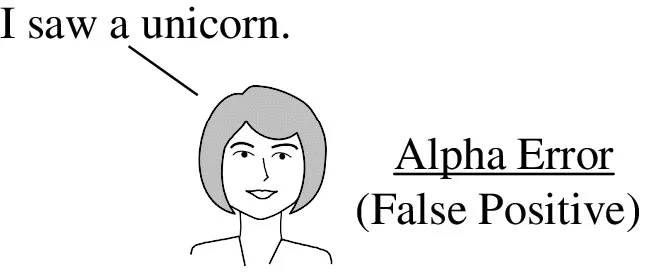
One type of error is the Alpha Error (also known as “Type I Error” or “False Positive”).
images
An Alpha Error is the error of seeing something which is not there, that is, concluding that there is a Statistically Significant difference, change, or effect, when in fact there is not. For example,
  • Erroneously concluding that there is a difference in the Means of two Populations, when there is not, or
  • Erroneously concluding that there has been a change in the Standard Deviation of a Process, when there has not, or
  • Erroneously concluding that a medical treatment has an effect, when it does not.
  • ...

Table of contents

  1. Cover
  2. Title page
  3. Copyright
  4. Dedication
  5. Other Concepts Covered in the Articles
  6. Why This Book is Needed
  7. What Makes this Book Unique?
  8. How to Use This Book
  9. ALPHA,
  10. Binomial Distribution
  11. Charts/Graphs/Plots – Which to Use When
  12. Degrees of Freedom
  13. Errors – Types, Uses, and Interrelationships
  14. F
  15. Hypergeometric Distribution
  16. Inferential Statistics
  17. Margin of Error
  18. Nonparametric
  19. p, p-Value
  20. r, Multiple R, r2, R2, R Square, R2 Adjusted
  21. Sample, Sampling
  22. t – The Test Statistic and Its Distributions
  23. Variables
  24. Which Statistical Tool to Use to Solve Some Common Problems
  25. Z
  26. How to Find Concepts in This Book
  27. EULA