- Features contributions from an international array of established and emerging scholars from across the humanities
- Explores the historical development of naturalism and its ascension to the dominant orthodoxy in the Western academy
- Juxtaposes theoretical criticisms with impassioned defenses, encapsulating contemporary debates on naturalism
- Includes discussions of metaphysics, realism, feminism, science, knowledge, truth, mathematics, free will, and ethics viewed through a naturalist lens
- English
- ePUB (mobile friendly)
- Available on iOS & Android
eBook - ePub
The Blackwell Companion to Naturalism
About this book
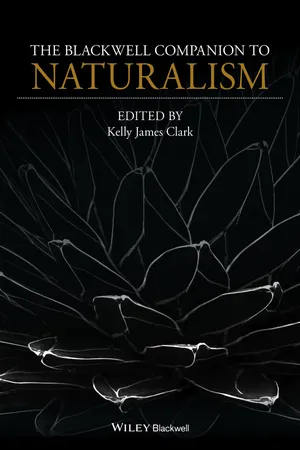
The Blackwell Companion to Naturalism provides a systematic introduction to philosophical naturalism and its relation to other schools of thought.
Information
1
Naturalism and its Discontents
KELLY JAMES CLARK
Every philosopher has taken his stand on a sort of dumb conviction that the truth must lie in one direction rather than another.William James
Introduction
In 1922, the philosopher Roy Wood Sellars proclaimed, “We are all naturalists now” (1922, vii). If by “we” Sellars meant fellow philosophers or academics, his triumphant declaration, though untrue then, is closer to being true now. At the turn of the 21st century, naturalism is the reigning orthodox assumption of most faculty in most universities across the English-speaking world. In the discipline of philosophy, philosophers increasingly identify themselves as naturalists.
What exactly is naturalism? Naturalism, we will learn, admits of no single, simple definition and comes in a wide variety of shapes and sizes (depending, for example, on its commitment to the natural sciences). After distinguishing ontological or metaphysical naturalism from the considerably more modest methodological naturalism, I will discuss the historical development of ontological naturalism, as well as arguments for or against naturalism generally. Before concluding, I will take moral goodness and badness as a case study of the problems and prospects for ontological naturalism.
What Is Naturalism?
It is impossible to offer a single precise definition of “naturalism,” one that captures everything that goes by the name. Defined too narrowly, it leaves out wide swaths of human thought and experience; defined too broadly, it includes many things that naturalists hope to exclude. A better approach, then, is to consider various understandings of naturalism, as well as naturalism’s historical development and recent rise. As we will see, naturalism has been understood in a great many ways. Given the diversity of understandings, we will cast our nets widely and consider the many different views and ideas that fall under the banner of “naturalism,” while noting uniting features that (at least most) naturalists share.
Naturalists, as might be expected, give pride of place to the natural world, to nature, and are dubious or even dismissive of claims that go beyond the natural world: so-called “supernatural” claims. These include most importantly the belief that God exists, but also beliefs in other sorts of non-natural or spiritual entities, such as ghosts and, for most naturalists, the human soul or spirit (as an entity that is independent from the brain), as well as non-natural or spiritual powers such as qi and astrological forces. So naturalists are typically atheists who reject, among other things, mind–body dualism. As such, naturalism is an ontology: it makes claims about what exists (and, perhaps more importantly, what does not). This view is frequently called metaphysical naturalism.
This rough formulation doesn’t tell us too much about the commitments of ontological or metaphysical naturalists. Nevertheless, there is one way in which it is helpful. That is, we can think of naturalism as standing in opposition to allegedly “spooky” – spiritual or theistic – understandings of the world and reality. Naturalists, then, reject any appeals to divine or supernatural entities or powers in their explanation of the world. Examples include, as we’ve seen, the claim that God created the universe and everything it contains and that human persons are a composition of soul and body. Naturalism came to prominence as an alternative to theism as a way of explaining the world.
As with all philosophies and philosophers, there is disagreement among naturalists. What precisely is “the natural world”? Some claim that it consists ultimately of subatomic particles (Rosenberg 2011), the ultimate and indivisible material reality. If the world were constructed out of material atoms, then naturalism would be synonymous with materialism (the view that everything is matter). But science has gone beyond (or “beneath”) atoms in its understanding of nature. Perhaps nature is made up not of atoms, but instead of matter and energy, or matter/energy in its various manifestations and relations. Or perhaps matter is reducible to waves or packets of energy, or even some sort of mental stuff. The point is, we don’t really know just what constitutes the natural world (and thus we don’t really know what lies beyond the limits of the natural world).
To be sure, naturalism is not by definition materialistic. Logical positivism, which arose out of philosophical naturalism, rejected attempts to go beyond the domain of human experience. Positivism’s severe empiricism restricted knowledge (and knowledge-based reality) to sensory experience (usually called “sense data”) and logical constructions of sense experience. Physical objects were considered no more than bundles of sense data. A chair, for example, is not a solid, enduring physical object (out there, in the mind-independent world); a chair, instead, is a collection of actual and possible experiences or sensations. Since experience is mental, reality for the positivist is mental. In short, for the logical positivist, naturalism (when allied with strict empiricism) entails idealism (the idea that reality is fundamentally mental).1
It’s also hard to know what counts as supernatural. Most naturalists would say that God, spirits, angels, demons, and souls are supernatural entities. But, beyond these, there is little consensus. What about such apparently non-natural, immaterial things as numbers, moral facts, merely possible beings (such as unicorns or fictional characters), and other abstract entities (like the concepts “red” and “true”)? Where in the natural world do we find “Murder is wrong,” Pegasus, or “2 + 2 = 4” (or the number 2)?
On these matters, as well as many others, naturalists themselves disagree. Even some atheist philosophers resist the temptation to naturalism. They don’t believe in God or gods, all right, but they do believe in such non-natural, immaterial entities or facts as numbers and morality, so they don’t believe they can in good conscience call themselves naturalists. Some naturalists, on the other hand, believe that immaterial entities such as numbers and other abstract entities are part and parcel of the natural world (or will eventually be shown to be so).
For the discussion that follows, we will (with provisos along the way) understand naturalism in the metaphysical or ontological sense that everything that exists is included in the natural world; there are no supernatural entities. We will from now on call metaphysical or ontological naturalism, unless otherwise noted, “Naturalism.”
Naturalism and Science
Some contemporary Naturalists go further, holding that scientific inquiry is the way of knowing in general and that the finally established results of science (especially physics) determine our view of reality. According to these Naturalists, the sciences are the only guide to understanding reality. Wilfrid Sellars, in a playful paraphrase of Protagoras, writes: “Science is the measure of all things, of what is that it is, and of what is not, that it is not” (Sellars 1963, 173). Such Naturalists have a correspondingly low regard for nonscientific forms of inquiry, such as those that appeal to intuition or tradition, or to religious experience and texts. Because such Naturalists believe science is the sole guide to understanding reality, they think we should apply the methodology of science to all domains of inquiry. Recent debates in metaphysics divide over those who think metaphysics should be studied/advanced independent of any considerations of science and those more naturalistically inclined who think metaphysics should take its cues from science.2
Scientific Naturalism constitutes a role reversal for traditional approaches to philosophy, which have relied on a priori theorizing about the nature and extent of reality. Philosophy comes first in the order of inquiry, on this traditional view, and science comes second; accordingly, philosophy has authority over science. But philosophy is no longer considered the queen of the sciences, sitting in judgment over scientific claims; philosophy is often now believed to be the servant of the sciences, taking its dictates as the sober and ultimate truth about the nature of Reality. Science, on this view, has authority over philosophy. Philosophy may help us understand the foundations and methods of the sciences, which scientists employ in their various practices, but science sets the limits and nature of human inquiry. Philosophy, on this view, simply accedes to the dictates of science.
Privileging science has much to commend it: there is no other domain of human inquiry that has been so remarkably successful in understanding the world and achieving rational consensus. Tradition, authority, and Holy Writ, for example, have failed to produce the rational consensus that we find in science (or any rational consensus whatsoever). Even those who affirm this or that text as Scripture find themselves with substantial disagreement as to what their Scripture teaches. Science or scientific inquiry offers what religion promised but has failed to offer: a method of inquiry for attaining rational consensus.
More than consensus, though, science also seems to be uniquely capable of attaining the truth: the universal law of gravitation, for example, or our sun-centered planetary system, or the age of the universe. More controversially, but I think undeniably, it has shown that all species, including the human species, have evolved from a single ancestor.
Finally, commitment to scientific modes of inquiry brings to Naturalists a certain open-mindedness: one should follow science wherever it leads, even if it challenges or contradicts some of one’s fundamental and cherished assumptions about the nature of reality. A scientific Naturalism may claim that nature is all that exists but also hold that nature is whatever will be disclosed by the ideal natural sciences. Since contemporary science is not, at least as far as we can tell, the ideal science, at this point in human history we may know very little about nature. So the scientific Naturalist remains open to understanding nature as science continues to disclose it.
Despite these marks in favor of naturalism, there are reasons to think that science is not able to adjudicate truth all by itself. For example, science must assume the mathematical truths that are so essential to its success. Where in the natural world can one find numbers? And while science has shown the dependence of the mental on the physical, it has not yet shown, even in principle, that consciousness is reducible to the brain or to brain states. Finally, and even more pressing existentially, is that science, the world of facts, seems devoid of ever...
Table of contents
- Cover
- Title Page
- Table of Contents
- List of Contributors
- Preface
- 1 Naturalism and its Discontents
- 2 Naturalizing Ethics
- 3 Naturalism in the Continental Tradition
- 4 The Naturalism Question in Feminism
- 5 On Naturalistic Metaphysics
- 6 Naturalism and Realism in the Philosophy Science
- 7 Naturalism without Scientism
- 8 “The Horrid Doubt”
- 9 Naturalism and Antinaturalism in the Sociology of Science
- 10 Why Methodological Naturalism?
- 11 Naturalism and the Question of Realism
- 12 Non-Naturalistic Metaphysics
- 13 Naturalism and Physicalism
- 14 Natural Mind
- 15 Naturalism and Dualism
- 16 Epistemological Naturalisms
- 17 Dewey, Naturalism, and the Problem of Knowledge
- 18 Truth and Naturalism
- 19 Against Naturalism about Truth
- 20 Mathematics and Metaphysical Naturalism
- 21 Naturalism and Mathematics
- 22 Naturalism and Free Will
- 23 Free Will and Naturalism
- 24 Does the New Wave in Moral Psychology Sink Kant?
- 25 Naturalism in Metaethics
- 26 Evolution and Moral Naturalism
- 27 Scientific Naturalism and the Explanation of Moral Beliefs
- 28 What’s to be Said for Moral Non-Naturalism?
- 29 Naturalism and Moral Psychology
- 30 Militant Modern Atheism
- 31 Why Naturalism Cannot Account for Natural Human Rights
- 32 Cognitive and Evolutionary Approaches to Religion
- 33 The Naturalness of Religious Belief
- 34 Naturalism in Indian Philosophy
- 35 The Natural History of Shame and its Modification by Confucian Culture
- Index
- End User License Agreement
Trusted by 375,005 students
Access to over 1.5 million titles for a fair monthly price.
Study more efficiently using our study tools.
Frequently asked questions
Yes, you can cancel anytime from the Subscription tab in your account settings on the Perlego website. Your subscription will stay active until the end of your current billing period. Learn how to cancel your subscription
No, books cannot be downloaded as external files, such as PDFs, for use outside of Perlego. However, you can download books within the Perlego app for offline reading on mobile or tablet. Learn how to download books offline
Perlego offers two plans: Essential and Complete
- Essential is ideal for learners and professionals who enjoy exploring a wide range of subjects. Access the Essential Library with 800,000+ trusted titles and best-sellers across business, personal growth, and the humanities. Includes unlimited reading time and Standard Read Aloud voice.
- Complete: Perfect for advanced learners and researchers needing full, unrestricted access. Unlock 1.5M+ books across hundreds of subjects, including academic and specialized titles. The Complete Plan also includes advanced features like Premium Read Aloud and Research Assistant.
We are an online textbook subscription service, where you can get access to an entire online library for less than the price of a single book per month. With over 1.5 million books across 990+ topics, we’ve got you covered! Learn about our mission
Look out for the read-aloud symbol on your next book to see if you can listen to it. The read-aloud tool reads text aloud for you, highlighting the text as it is being read. You can pause it, speed it up and slow it down. Learn more about Read Aloud
Yes! You can use the Perlego app on both iOS and Android devices to read anytime, anywhere — even offline. Perfect for commutes or when you’re on the go.
Please note we cannot support devices running on iOS 13 and Android 7 or earlier. Learn more about using the app
Please note we cannot support devices running on iOS 13 and Android 7 or earlier. Learn more about using the app
Yes, you can access The Blackwell Companion to Naturalism by Kelly James Clark in PDF and/or ePUB format, as well as other popular books in Philosophy & Philosophical Metaphysics. We have over 1.5 million books available in our catalogue for you to explore.