Cut through information overload to make better decisions faster
Success relies on making the correct decisions at the appropriate time, which is only possible if the decision maker has the necessary insights in a suitable format. Mind+Machine is the guide to getting the right insights in the right format at the right time to the right person. Designed to show decision makers how to get the most out of every level of data analytics, this book explores the extraordinary potential to be found in a model where human ingenuity and skill are supported with cutting-edge tools, including automations.
The marriage of the perceptive power of the human brain with the benefits of automation is essential because mind or machine alone cannot handle the complexities of modern analytics. Only when the two come together with structure and purpose to solve a problem are goals achieved.
With various stakeholders in data analytics having their own take on what is important, it can be challenging for a business leader to create such a structure. This book provides a blueprint for decision makers, helping them ask the right questions, understand the answers, and ensure an approach to analytics that properly supports organizational growth.
Discover how to:
Harness the power of insightful minds and the speed of analytics technology
Understand the demands and claims of various analytics stakeholders
Focus on the right data and automate the right processes
· Navigate decisions with confidence in a fast-paced world
The Mind+Machine model streamlines analytics workflows and refines the never-ending flood of incoming data into useful insights. Thus, Mind+Machine equips you to take on the big decisions and win.
The number of incredible opportunities with great potential for mind+ machine is large and growing. Many companies have already begun successfully leveraging this potential, building whole digital business models around smart minds and effective machines. Despite the potential for remarkable return on investment (ROI), there are pitfalls—particularly if you fall into the trap of believing some of the common wisdoms in analytics, which are exposed as fallacies on closer examination.
Some vendors might not agree with the view that current approaches have serious limitations, but the world of analytics is showing some clear and undisputable symptoms that all is not well. To ensure you can approach mind+machine successfully, I want to arm you with insights into the traps and falsehoods you will very likely encounter.
First, let's make sure we all know what successful analytics means: the delivery of the right insight to the right decision makers at the right time and in the right format. Anything else means a lessened impact—which is an unsatisfactory experience for all involved.
The simplest analogy is to food service. Success in a restaurant means the food is tasty, presented appropriately, and delivered to the table on time. It's not enough to have a great chef if the food doesn't reach the table promptly. And the most efficient service won't save the business if the food is poor quality or served with the wrong utensils.
The impact on a business from analytics should be clear and strong. However, many organizations struggle, spending millions or even tens of millions on their analytics infrastructure but failing to receive the high-quality insights when they are needed in a usable form—and thus failing to get the right return on their investments. Why is that?
Analytics serves the fundamental desire to support decisions with facts and data. In the minds of many managers, it's a case of the more, the better. And there is certainly no issue with finding data! The rapid expansion in the availability of relatively inexpensive computing power and storage has been matched by the unprecedented proliferation of information sources. There is a temptation to see more data combined with more computing power as the sole solution to all analytics problems. But the human element cannot be underestimated.
I vividly remember my first year at McKinsey Zurich. It was 1990, and one of my first projects was a strategy study in the weaving machines market. I was really lucky, discovering around 40 useful data points and some good qualitative descriptions in the 160-page analyst report procured by our very competent library team. We also conducted 15 qualitative interviews and found another useful source.
By today's standards, the report provided a combined study-relevant data volume of 2 to 3 kilobytes. We used this information to create a small but robust model in Lotus 1-2-3 on a standard laptop. Those insights proved accurate: in 2000, I came across the market estimates again and found that we had been only about 5% off.
Granted, this may have been luck, but my point is that deriving valuable insight—finding the “so what?”—required thought, not just the mass of data and raw computing power that many see as the right way to do analytics. Fallacies like this and the ones I outline in this part of the book are holding analytics back from achieving its full potential.
Fallacy #1 Big Data Solves Everything
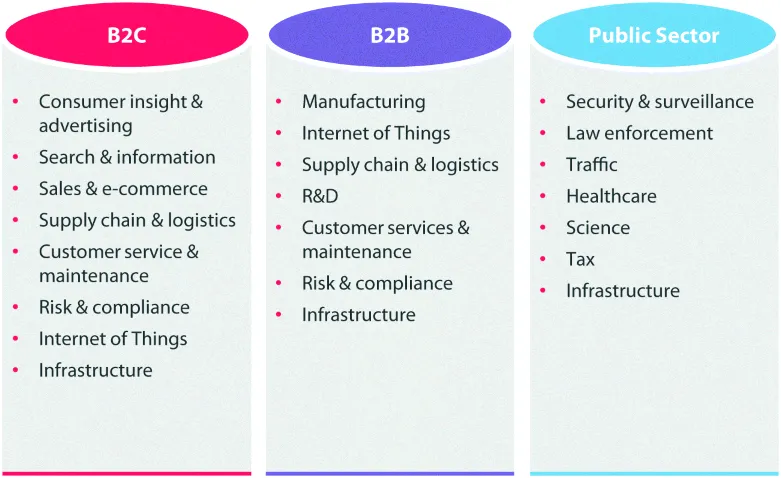
From Google to start-up analytics firms, many companies have successfully implemented business models around the opportunities offered by big data. The growing number of analytics use cases include media streaming, business-to-consumer (B2C) marketing, risk and compliance in financial services, surveillance and security in the private sector, social media monitoring, and preventive maintenance strategies (Figure I.1). However, throwing big data at every analytics use case isn't always the way to generate the best return on investment (ROI).
Figure I.1 Areas of Big Data Impact
Before we explore the big data fallacy in detail, we need to define analytics use case, a term you'll encounter a lot in this book. Here is a proposed definition:
“An analytics use case is the end-to-end analytics support solution applied once or repeatedly to a single business issue faced by an end user or homogeneous group of end users who need to make decisions, take actions, or deliver a product or service on time based on the insights delivered.”
What are the implications of this definition? First and foremost, use cases are really about the end users and their needs, not about data scientists, informaticians, or analytics vendors. Second, the definition does not specify the data as small or big, qualitative or quantitative, static or dynamic—the type, origin, and size of the data input sets are open. Whether humans or machines or a combination thereof deliver the solution is also not defined. However, it is specific on the need for timely insights and on the end-to-end character of the solution, which means the complete workflow from data creation to delivery of the insights to the decision maker.
Now, getting back to big data: the list of big data use cases has grown significantly over the past decade and will continue to grow. With the advent of social media and the Internet of Things, we are faced with a vast number of information sources, with more to come. Continuous data streams are becoming increasingly prevalent. As companies offering big data tools spring up like mushrooms, people are dreaming up an increasing number of analytics possibilities.
One of the issues with talking about big data, or indeed small data, is the lack of a singular understanding of what the term means. It's good hype in action: an attractive name with a fuzzy definition. I found no less than 12 different definitions of big data while researching this book! I'm certainly not going to list all of them, but I can help you understand them by categorizing them into two buckets: the geek's concept and the anthropologist's view.
Broadly speaking, tech geeks define big data in terms of volumes; velocity (speed); variety (types include text, voice, and video); structure (which can mean structured, such as tables and charts, or unstructured, such as user comments from social media channels); variability over time; and veracity (i.e., the level of quality assurance). There are two fundamental problems with this definition. First, nobody has laid down any commonly accepted limits for what counts as big or small, obviously because this is a highly moving target, and second, there is no clear “so what?” from this definition. Why do all of these factors matter to the end user when they are all so variable?
That brings us to the anthropologist's view, which focuses on the objective. Wikipedia provides an elegant definition that expresses the ambiguity, associated activities, and ultimate objective:
Big data is a term for data sets that are so large or complex that traditional data processing applications are inadequate. Challenges include analysis, capture, data curation, search, sharing, storage, transfer, visualization, querying, updating and information privacy. The term often refers simply to the use of predictive analytics or certain other advanced methods to extract value from data, and seldom to a particular size of data set. Accuracy in big data may lead to more confident decision making, and better decisions can result in greater operational efficiency, cost reduction and reduced risk.
High-ROI use cases for big data existed before the current hype. Examples are B2C marketing analytics and advertising, risk analytics, and fraud detection. They've been proven in the market and have consistently delivered value. There are also use cases for scientific research and for national security and surveillance, where ROI is hard to measure but there is a perceived gain in knowledge and security level (although this latter gain is often debated).
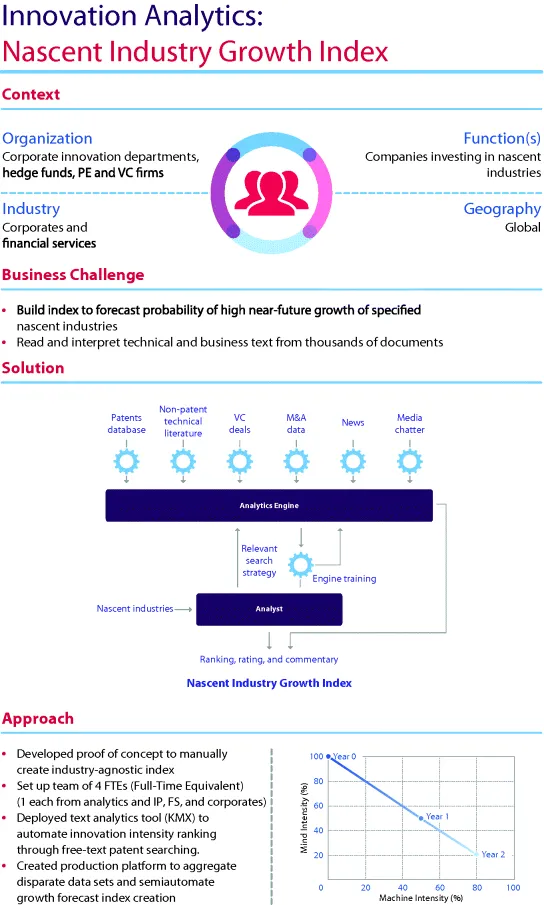
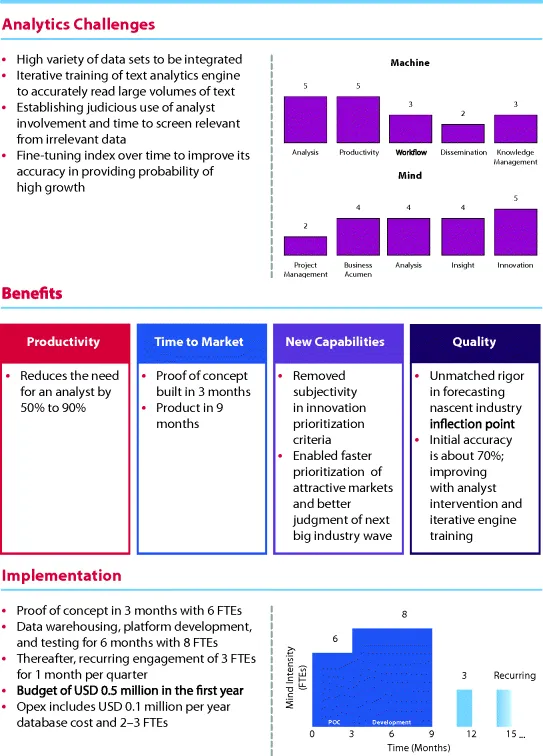
We've added a collection of use cases throughout this book to help give you insight into the real-world applications of what you're learning. They all follow the same format to help you quickly find the information of greatest interest to you.
Analytics Use Case Format
Context: A brief outline of where the use case comes from: industry, business function, and geography
Business Challenge: What the solution needed to achieve for the client(s)
Solution: An illustration of the solution or processes used to create that solution
Approach: Details on the steps involved in creating the solutions along with the mind+machine intensity diagram, illustrating the change in the balance between human effort and automation at key stages during the implementation of the solution
Analytics Challenges: The key issues to be solved along with an illustration of the relative complexity of the mind+machine aspects applied in solving the case
Benefits: The positive impact on productivity, time to market, and quality, and the new capabilities stemming from the solution
Implementation: The key achievements and the investment and/or effort required to make the solution a reality (development, implementation, and maintenance, as applicable), illustrated where possible
I wanted to include some of the more exciting projects currently under development to show the possibilities of analytics. In these cases, some of the productivity gain and investment metrics are estimates and are labeled (E).
The big data hype has its origin in three factors: the appearance of new data types or sources, such as social media; the increasing availability of connected devices, from mobile phones to machine sensors; and the evolution of ways to analyze large data sets in short periods of time. The sense of possibility led to a proliferation of use cases. We cannot say how many of these untested use cases will survive. Ultimately, the question ...
Table of contents
Cover
Title Page
Copyright
Dedication
Preface
Acknowledgments
List of Use Cases
Part I: The Top 12 Fallacies about Mind+Machine
Part II: 13 Trends Creating Massive Opportunities for Mind+Machine
Part III: How to Implement the Mind+Machine Approache
About the Author
Index
End User License Agreement
Trusted by 375,005 students
Access to over 1.5 million titles for a fair monthly price.
Study more efficiently using our study tools.
Frequently asked questions
Yes, you can cancel anytime from the Subscription tab in your account settings on the Perlego website. Your subscription will stay active until the end of your current billing period. Learn how to cancel your subscription
No, books cannot be downloaded as external files, such as PDFs, for use outside of Perlego. However, you can download books within the Perlego app for offline reading on mobile or tablet. Learn how to download books offline
Perlego offers two plans: Essential and Complete
Essential is ideal for learners and professionals who enjoy exploring a wide range of subjects. Access the Essential Library with 800,000+ trusted titles and best-sellers across business, personal growth, and the humanities. Includes unlimited reading time and Standard Read Aloud voice.
Complete: Perfect for advanced learners and researchers needing full, unrestricted access. Unlock 1.5M+ books across hundreds of subjects, including academic and specialized titles. The Complete Plan also includes advanced features like Premium Read Aloud and Research Assistant.
Both plans are available with monthly, semester, or annual billing cycles.
We are an online textbook subscription service, where you can get access to an entire online library for less than the price of a single book per month. With over 1.5 million books across 990+ topics, we’ve got you covered! Learn about our mission
Look out for the read-aloud symbol on your next book to see if you can listen to it. The read-aloud tool reads text aloud for you, highlighting the text as it is being read. You can pause it, speed it up and slow it down. Learn more about Read Aloud
Yes! You can use the Perlego app on both iOS and Android devices to read anytime, anywhere — even offline. Perfect for commutes or when you’re on the go. Please note we cannot support devices running on iOS 13 and Android 7 or earlier. Learn more about using the app
Yes, you can access Mind+Machine by Marc Vollenweider in PDF and/or ePUB format, as well as other popular books in Business & Decision Making. We have over 1.5 million books available in our catalogue for you to explore.